Thursday, October 28, 2010

The Knife of Never Letting Go


Patrick Ness
The Knife of Never Letting Go

Walker Books, 2009

THE FIRST THING you find out when yer dog learns to talk is that dogs don't got nothing much to say. About anything.
"Need a poo, Todd."
"Shut up, Manchee."
"Poo. Poo, Todd."
"I said shut it."

From the first lines of this novel (by the way, they’re very funny), we learn about the main feature of Prentisstown, the town where the protagonist of the book Todd Hewitt lives: everyone can read the thoughts of another. These thoughts are transmitted in the form of noise, incessant stream that does not stop ever, even during sleep. If someone can read someone’s minds, it does not mean that a lie disappeared from the world: Noise is called a noise that something important might be hidden behind other thoughts, make unimportant louder. So there are secrets.

Wandering through the swamp in search of berries, Todd with his dog Manchee suddenly stumble upon the silence. It simply can not be silent in Prentisstown, noise goes from all, even the insects. The silence soon turns out terrified girl, who not only doesn’t speak, but does not make Noise. Foster parents of Todd, Ben and Cillian, find out about the silence and immediately collect rucksack for Todd, give the map and send him out of town. Todd has to get to the next settlement: it turns out Prentisstown is not the only town on New World. Todd takes Manchee, the girl, too (she would have been killed by the local priest), and three of them flee to the nearest town. Behind them is a pursuit: boy Todd, who will become a man in a month, on the day of the 13th anniversary, is wanted by the mayor of Prentisstown.
«The Knife of Never Letting Go» is obviously a page-turner, with each chapter it ends so suddenly, on the most interesting place so that one must possess great strength of will to refuse to turn the page to the next chapter. There is almost no description in Ness’ book, but a lot of action. The whole book is one long chase, action-non-stop. Does this mean that the novel is brainless quest, hit-and-run? No way! Ness worked much with the language of the novel. Due to the fact that Todd can not read the words so knows language only by ear (and indeed on New World written language has been simplified, and forgotten for many), and Todd is a single narrator, the book is written in English of XIX century and English simplified, street, without a word from the depths of the dictionary.
«And are they gonna a-welcome us?»
«People are scared of what they don’t know, Todd pup,» she says, standing. «Once they know ye, the problem goes away.»

The book is all rhythmic, fast-paced; sentences often are like a machine-gun fire.
This novel is both Utopia and young adult novel at once. New World here is a kind of a planet where people came from Old World, hoping to build Garden of Eden and start all over again. But as always, some people are worse than others, and dream of paradise is crumbling. Throughout the book the author will still throw and throw new secrets, new mysteries, and clues of previous confusion of this world.
Theme of growing up in the novel is connected directly to the question: what makes a child an adult? Murder, on which everything and everyone pushes Todd? Not without reason the knife, mentioned in the book's title, plays a key role in the adventures of Todd and the choices of the future.

Patrick Ness, have written a book for children (as it presented by the publishers), actually wrote the book for all children and adults, too. This book is inventive to the last detail, affecting tears and breaking through sweat, funny, but about serious matters. And there's Story. If you think just tell the story is nothing, you're wrong.

Such a book should be picked up immediately in two copies: one on the shelf of a child, the other for himself. And it is only the first volume of the trilogy.

Wednesday, October 27, 2010

Seven Cities of Gold


David Moles
Seven Cities of Gold

PS Publishing, 2010

About our time. Muslims have reached the New World and started bloody battle with Christians. Shed much blood, even weapon of mass destruction was featured. This world is cruel, violent, poorly developed. There is no hint that the level of technology of that world is getting to that level of our world. In 714 AD, the history went the other way: seven Catholic bishops had fled from Spain across the ocean to North America to build seven golden cities and found the Christian empire. Japan, homeland of the protagonist of this novella, Chie Nakada, the doctor, does not participate in wars between Muslims and Christians. When the Japanese government hear about terrible weapons and about obsessive Christian leader, hiding somewhere in the depths of the continent, they sent a peacemaker (though with purpose to kill) Nakada to travel up the river Acuamagna in search of the leader Clara Dos Orsos.

While Nakada and her aides are floating down the river, on both sides of it opens a terrible picture: mountains of human corpses, fires, armed men. Nakada can not help anybody; she has a goal that should be reached at any price, to find Dos Orsos.

It really is a journey into the heart of darkness, the world after 9/11 as if there were never this date, but every day is always September 11; world crumbling, the world, where everyone slides on deaths, as on the water. The author essentially gives no guidance (place names say nothing to the reader), about the history of this world we know not from the author but the publisher, thus Moles makes it clear that his novel should not be read as some particular journey but as a metaphor of the journey to one’s own death and the death of all living, read like a hallucinogenic trip, during which death and life are irrelevant, they disappear as a concept from consciousness – Nakada is an opium addict, forced, even by power beating her "medicine" from people. The alternatively-historical component plays almost no role in the book, it clearly is secondary, the primary is the journey of the soul.

Moles has very poetic style, he tells this fast-moving story slowly, without admiring violence. Nakada is a charming drug addict.

«Seven Cities of Gold» is a brilliant book, an example of good fiction, but just fiction, not an alternative historical fiction.

Wednesday, October 20, 2010

Harmony


Project Itoh
Harmony
Translated by Alexander O. Smith

Haikasoru, 2010

The protagonist of this book, Tuan Kirie, a young girl working in the secret service, begins her story from her childhood. She and two her girlfriends conceive to kill themselves. The leader of this small group of young suicides is another girl, Miach Mihie. She starves herself almost to death, overeats, reads books and knows that once kids died on jungle gyms. In the world of the future everything little Miach does with herself is banned. After the terrible disaster (possibly nuclear) called Maelstrom governments of most countries of the world decide that it is time to put an end to the human deaths and prevent future catastrophes, so they create a global network of governments so-called admedistrations, the main objective and concern of which is human health. Person's life is almost given to society, life becomes main value. Because of the implanted devices overseeing a human life, a person almost never gets old and lives for hundreds of years. Naturally, the device WatchMe make out human diet, which excluded cigarettes, alcohol, fatty foods, spicy foods and anything that might cause any injury. All information is also obtained from the chip set, AR; books are banned as sources of harmful knowledge (respectively, all the books, where people not only kill, but just smoke, may show a bad example and even call to action).

Body does not belong to a man - and Miach hate it. So far she has escape: WatchMe is set only to adults, so you need to have time to kill yourself until adulthood. Persuading friends, Miach invites them all to drink pills and die, it is the only way to prove that the body and life belong to the owner, not the society. Miach dies, but her friends, narrator Tuan and Cian Reikado fear and stay alive.

Tuan still doesn’t like society. Now, as an adult, she works in a special service Nexus, which is engaged in problematic regions (in some regions not all people have WatchMe). Tuan chooses this job because WatchMe can be disabled, that is, quite simply, as another officer says “for the beer and the smokes”. Seemingly dead Miach horrifies - and throws a puzzle to Nexus - whole planet: first, at her command a few thousand people at the same time suicide, and then she puts a condition: to stay alive, every person on Earth must kill another one.

Dreams of utopia will always be spoiled by something - or someone: it is, among other things, that Japanese writer wanted to say in his book. Knowingly troublemaker, endangering the lives of all people in the world, was just a child: in the minds of children the most audacious plans are maturing, kids are almost not constrained by fetters of everyday life; their thinking is not contaminated with stupidity and petty fears. Itoh’s description of children at the beginning of the novel, their conversations, thoughts, are most successful part, with tender voices, despite the fact that the author knows that child fragility and honesty will be over soon. Until the middle the book reads like a fairly well-designed utopia, global, but with Japanese characters, but after the middle the author adds another plotline – detective one. The villain is known, but the main thing is not who?, but why?.

Sometimes the author for deeper describing the world of medical utopia (though it is medical only on the surface), is forced to mark time, so the protagonist sometimes repeats many times that she said in earlier chapters. Itoh’s terse language is consistent with the language of the narrator, Tuan (she in this world she despises cannot talk to anyone properly), what is more, she thinks in the html language, and the whole book is written with such markup:
"< recollection >
I want to dance on the graves of those kind, healthy people.
A waltz, I think.
< / recollection >"

Itoh didn’t quite make out the plot, so the ending rushes headlong, and the confrontation of ideologies to a greater degree occurs in dialogs, but not in turns of story. (Behavior of Miach in the end is rather non explainable.)
«Harmony», actually, is a book about what price you should pay to achieve harmony in the world and whether it is necessary at all if the price is too high.

Tuesday, October 19, 2010

“Remember You’re a One-Ball!”


Quentin S Crisp
“Remember You’re a One-Ball!”

Chomu Press, 2010

This novel, before Chomu Press publishid it, was rejected by many publishers. This is quite understandable: the book is quite strange, moreover, it is not well written.
A story unfolding before the reader is notes of a young man named Ramsey Blake. He graduates from university, does not know where to go for as long as he is invited for an interview with director of the school where he studied. The director, while interviewing Ramsey, suggest to future teacher that he is very suitable for the vacant position: Ramsey himself a graduate of this school. So tired student begins to work in school, teaching junior classes. There he meets a girl Jacqueline. Ramsey clearly suffers from mental illness: he is afraid of people, barely controlled by his mind, besides what he says about himself: «I may have had sex, I had certainly never fucked anyone». Life with Jacqueline takes really stressful for him. In parallel, he wrote the note, where he tells the story of his classmate who was teased one-ball. This oath, one-ball, went from children's song:
«Rule Britannia!
Three monkeys up a stick.
One fell down and broke his dick.»

Of his classmate Harley Owen, of abusing him, of child abuse and worldwide conspiracy, Ramsey remembers (and read about that in the dossier passed to him by the director) because in that class, where he has learned, there is another one-ball, Norman. Both boys really have one testicle: a second one children hurt in accidents, so it should be deleted.

Soon Ramsey finds a link between the two cases and sees the mysterious behavior of the director and reading a book titled "Learning to say" yes ". He understands a lot, but could understand one thing: a place devoted to him in this story.
If the narrator can not until the last minute understand what is his role in the story of two one-ball boys, reader understands that after only three dozen pages. This however did not spoil the whole picture: the novel is already written in a very uneven way. The book is heavily skewed, as a face of the person that does not like anything. This, of course, is a multi-faceted novel: there are the memories, the memories within memories, records, excerpts of self-learning book - but it seems that the fragments are often not in own place. Some fragments (for example, Harley Owens’s dossier) would have looked good in the form of short stories, but among the clutter of other fragments the best places lose their luster. Convincingly described the history of child abuse was almost nullified by unconvincing explanation of the origin of one-balls.

The author has the ability, of course, but if you ask me, whether I liked the novel, I will just shrug my shoulders.

Thursday, October 14, 2010

Evolve: Vampire Stories of the New Undead


Evolve: Vampire Stories of the New Undead
Ed. by Nancy Kilpatrick

Edge Publishing, 2010

Decided to make an anthology about vampires, Nancy Kilpatrick took on a very heavy burden. There are so many books about vampires that make something stand-out is almost impossible. And an author, who writes about bloodsucking creatures, puts himself in bounds: the space is narrowed, the majority of moves is known so the creator of the book or even a story about vampires still writes like in a game setting or novelization. Walls from right and left - either reader will not understand, or publisher will not publish.

Editor of «Evolve» hadn’t expanded customary bounds, too, and hence failed.
In the vast majority of the stories here there are all the same Goths teenagers who want to either become a vampire, or become victims of vampires; vampire hunters and hunters on vampires, bloodsuckers clans; rather spirits and ghosts, rather than vampires; vampires-musicians. Some stories are written better, some worse, but the style does not help the situation when the whole point anyway is reduced to the bite.
However, the book turned out not completely disastrous, if we assume that some stories were better than average. Kevin Cockle in his «Sleepless in Calgary» comes from the premise that to become a vampire can not through bite of a vampire, but only if you want yourself and drink the blood of other people. The author puts the protagonist in front of choice: a boring monotonous life of a person or free, not burdened with the work existence of a vampire. That's just is a bloodsucker worth a trust?

In Bev Vincent's «A Murder of Vampires» someone kills vampires. Nobody wants to help them, but one policeman. He takes this case. The story is not quite carried through (no explain of motives of the murderer), but the relationship between humans and vampires are written in not a trivial way.

Two of the most powerful stories were placed in the final part of the anthology. In «How Magnificent is the Universal Donor» Jerome Stueart there are virtually no vampires (at least those that originate through Stoker's Dracula). The story can be attributed to pure science fiction, and this is the definite plus. After the spread of a mysterious virus BDD, which kills 40% of carriers, to find a man with an almost perfect blood tests is nearly impossible. In the blood of people there is a virus or chemistry to treat patients. Doctors still find one person who has an ideal blood, hoping to use it to heal millions of patients. But the husband of carrier of the ideal blood (it’s a gay couple) does not trust doctors: they have forged the death certificate of his partner and does not let him see the body. This man has to pretend to be a doctor to get into the Medical Corps, where the doctors are going to remove all the blood from the kidnapped. Heroes of the story turned out some cardboard (taken as if straight out of 50's science fiction movies), but the plot did not require realistic characters.

Kevin Nunn in «The Sun Also Shines On the Wicked» tells the surprising story of how a vampire can sunbathe. To do this, he needs only a mirror and an assistant, watching over time. This story is not just a story with an inventive plot, but also a meditation on what is an eternity.

In general, the anthology is not as good as could be.

Sunday, October 10, 2010

Crazy Love


Leslie What
Crazy Love

Wordcraft of Oregon, 2008


I should start by saying that this book can equally be considered a collection of so-called science fiction or a collection of so-called mainstream, realistic fiction. Or a collection of both. What way a reader chooses to approach to this book, nothing could prevent him from obtaining the highest degree of pleasure. It is certainly one of the best books I've read this year.

17 stories in the book is the essence of a rich imagination and a rough but compelling language. Each story has a new idea, which more practical and calculating writer could expand to the extent of if not a novel, but long novella for sure. What does not spray her imagination over a wide area, stopping at seemingly narrow space of the human soul (and the body, too), but such self-limitation leads to a striking and far more successful results.

Already in the first story of the collection «Finger Talk», we read a story about two gorillas: one real, with a gift to speak through sign language, and another, a woman who walk almost all the time in a gorilla suit. Gorilla Koko helps to work out personal live of completely entangled woman. Fantastic element there is minimal, and it can be reduced to the imagination of the heroine, but it is enough to electrify the story. In the following, «Babies», at the beginning a woman named Roni Sue washes dishes; she feels uncomfortable, she's pregnant. And further: «The best she could do was remind herself that soon she would be blessed with babies, lots of tiny babies, and the bad parts would all be over.» Why will she have a lot of little kids? - The question is haunted. And soon we learn that the house is inhabited by a lot of cockroaches and people from the office comes in and sprinkles a house. And this story gives a dual interpretation: inside the woman are the larvae, which appeared after pollination with pesticides, or is it just imagination? Throughout the text hints are scattered that predispose most to the first version. But first and foremost it is a story about love: to children, whoever they were. The plot of «Why a Duck» has place on a dirigible. Two ghosts again and again crash, this is why their life is unbearably monotonous. And their love vanishes out of boredom and monotony. And a duck rescues fading feelings. In «Going Vampire» the narrator is a vampire. He works in Hollywood. Selecting the next victim, he seems to be willing to repeat what has made many times, but he sees something special in the new girl. Vampires can not only love, but they have a conscience.

Even less stand-out stories, such as «Frankenfetish», for example, where, after mother's death from cancer, the father and his two sons almost worship the surviving cancer cells, capable to draw not all sort of readers, remain highly penetrating, with a good layer of irony and sometimes dark humor.

And yes, all the stories in the book are really about a crazy love.

Saturday, October 9, 2010

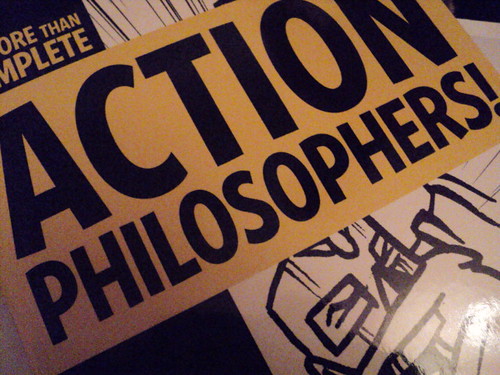
Action Philosophers!


Fred Van Lente and Ryan Dunlavey
The More-Than-Complete Action Philosophers!

Evil Twin Comics, 2009

A good idea occurred to the writer Fred Van Lente and illustrator Ryan Dunlavey: to portray the teachings and works of philosophers and thinkers of the past in the form of comics. Incarnation came to 320 pages in A4 format, so that this book can surpass some of the standard, consisting of letters, books on philosophy by the volume.
This book can hardly be regarded as a textbook, though it is not just an entertaining comic book. In the collection there are at least two layers, so that there are at least two approaches to read it.

Comics can be read as a guide to philosophy for a sort of lazy teenagers, for whom the word philosophy is almost not pronounceable, and Superman and Batman mean to their lives much more than Aristotle and Freud. In an accessible and beautifully illustrated form the book finally tells young people how the Stoics differed from the Cynics, how Spinoza earned his living, what were the major differences between the teachings of Jung and Freud. The authors of the book in chapters about each philosopher present a story about him in the form of biography, adding to it basis of the teachings of the thinker.

If you know philosophy or you are not interested in some of the philosophers, additional layer can be omitted, enjoying only the graphic stories. And here is something to see: Diogenes as a dog; St. Augustine drinking straight from the bottle in bed with two beauties; Schopenhauer in his underwear, watching TV; Karl Marx and the three little pigs. Philosophers there indeed produce an action, the philosophy here is not boring mutter.

The book is naturally very funny (perhaps only philosophers of the XX century have turned dull), you will not fall under the table with laughter, but the smile will not go from your face, that's for sure.

Philosophers would have liked it.

chapbooks from Nightjar Press, part 3


RB Russell
The Beautiful Room

Mark Valentine
A Revelation of Cormorants

Nightjar Press, 2010

This is the third pair of chapbooks, of which I write this year. Before that publisher Nightjar Press didn’t fall flat, as it turned out, and on the third time it didn’t as well.

RB Russell's story is beautiful and tight as the room where there were heroes of the story. Young couple chooses a suitable apartment, so that he is comfortable with the work, and she feels comfortable to have a rest. Room is immediately liked both of them: bright, spacious, with excellent views. In addition, other options did suit neither husband nor wife. Having admired the room, the husband decides that he will not buy it: this is a place to relax in the summer, but if you become cold, life here is no longer available. Wife really likes the room, and she persuades her husband to buy it. Matrimonial dispute is broken with weird noise from behind the wall.

The beauty of the story is not in a surprise ending, but how Russell, confining the narrow space and a minimum of characters, creates a memorable story about freedom, love, and that even the walls can not stop one who have wings.

Valentine’s, (he brought an element of the supernatural to a minimum), story turned out less charming, but a memorable one. The narrator is a writer who arrives in the province, deciding to start and finish a book on birds in Britain, mentioned in folklore, in the quiet place. The author seems to be follow a guide "What should be in a good story": a remote hamlet, the fragments of the book of protagonist, admonishing local resident, the relationship between reality and the book, mortal danger. It's all written in good style, but following the conditional pattern lubricates impression. Anyone who has read at least some of the British horror, will already have an idea about the next step of the author.

I highly recommend both stories.

Friday, October 8, 2010

The Sixth Black Book of Horror


The Sixth Black Book of Horror
Ed. by Charles Black

Mortbury Press, 2010

This anthology, which by its title, which includes the word «black», on the one hand, warns that it is a collection of horror stories, on the other - simply announces that the book was compiled by a man named Black, has the usual suspects, which can be found in any of something worthwhile book of the horror genre, and the names that I see for the first time.

The British have no problems with ideas, but often they tend to overly straightforward horror that has one purpose - to scare a reader. Maybe someone will like it, but not me:, I'm waiting from the story something more ingenious than just talking mannequins, and serial killers, inhabiting bodies of children.
I'm not even going to mention unsuccessful stories, they're really boring and written in a very rustic manner.

First-class stories (or, with the amendment - the first class in the horror genre stories) is four there. «Traffic Stream» by Simon Kurt Unsworth could easily adorn a collection of early Stephen King. The two men agree to meet in the evening to discuss the business case. One is already waiting in the office, and the second is about to drive up. However, he can not find the way to the office and generally seems to be lost. He calls up with a partner, asks him to wait while he unsuccessfully tries to find his way. Unsworth gradually pumps the atmosphere and the horror of the driver passes to the second man. Almost flawless story where no one can help to a man gone to hell. Gary Fry in his «Keeping It in the Family» also describes the madness, but madness of one person, not the madness of the world, like was in Unsworth’s. A married couple with a child decides to go relax for the weekend and take husband's brother. The brother gets along with children and suffers from schizophrenia. Fables and fantasies of madman (he also writes short stories) he tells the boy, are being implemented in reality. In Fry's story, perhaps, Lovecraft’s spirit flies, but nonetheless it is an impressive story.

Most elegantly written stories there are RB Russell’s «An Unconventional Exorcism» and Mark Samuels’ «Keeping Your Mouth Shut». Russell's story has a sort of spoiler in the title, and it spoils the story a little. The story is family history, with spirits, spiritualism, and, indeed, exorcism. In Samuels’, the protagonist is a writer-loser. Rather, even it is hard to name him loser writer: just over a few years of his career he didn’t wrote a short story. The story is more an exercise in style: seemingly lightweight, pseudo mad, but it is, from beginning to end, impossible to put down.

Anthology, I think, killed two birds: here a reader will find stories on their own fans of straight scary horror stories and connoisseurs of fine British horror with a touch of British humor. But it would be quite enough one dead bird.

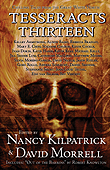
Tesseracts Thirteen


Tesseracts Thirteen
Ed. by Nancy Kilpatrick and David Morrell

EDGE Publishing, 2009

Annual Canadian anthology Tesseracts, until this collection supplying readers with quality science fiction, in the issue number 13 turned into an anthology of horror and dark fantasy. It might have been expected just by looking at the names of the editors: Nancy Kilpatrick, author of many vampire novels, and Morrell who is not just the author of "First Blood" and the literary father of Rambo, but also a writer, who wrote lots of thrillers with elements of horror.

What Canadian horror writers distinguished in comparison with their colleagues from the United States or Britain to the better side is a gentle approach to the description of the heroes of the story. This collection is inhabited not by the rough casts of characters, not the outline, but full, with the backgrounds and believable motives, characters.

However, solving this problem, many authors of the anthology couldn’t not solve the other, just no less important: to put the characters in such story, in which character’s three-dimensionality would have helped to the creation of three-dimensionality of the described world, where characters are placed. Most of the stories, having good inclinations, did not turn into something extraordinary. In the «Stone Cold» Kevin Cockle realistically described life of invalid, who also always feels a chill - he never gets warm. Unfortunately, behind a description of everyday life the story is lost: it seems get frozen together with the hero. The story of Rebecca Bradley «Kids These Days» has absolutely charming beginning: in the described world, children have lost all the life skills, something struck their brain: they can not themselves move or drink, or even respond to anything threatening their lives. Parents have an extremely hard to cope with their offspring. However, a story that could have been just finished brilliantly as well, the author has brought to the unbelievable horror ending. Such problem and with Susanna Church’s. It «The Tear Closet» unfolds the story of domestic violence from the view of a little girl, but introduced element of fantasy fades from the fact that the author almost sinking her story into melodrama, with one goal - to squeeze out a tear in the reader.

The two strongest stories are in the final part of the anthology. David Nickle in «The Radejastians» doesn’t give away many, so increasing fascination of his story. The story of three men who hard to call friends arrive in another country (another planet? Author hardly gives any hints on where the story takes place: it may be an alternative Earth, and perhaps a different planet.), go to obscure work, and one of them is invited to a certain church, to compare, whether it is better than the one where he visited before (What was that another church and where it was, still unknown). This story is not about God, but about religion, about how to find themselves and then lose. Another gem of the anthology is eerie tale by Mary E. Choo «The Language of Crows». It's a strange story of the family where the husband dies and the wife remains hostage to his whims. While reading this story, crow caw actually fills your ears.

A nice addition to a very good fiction part is review of Canadian horror and fantasy, written by Robert Knowlton.

Friday, September 17, 2010

Oh Pure and Radiant Heart


Lydia Millet
Oh Pure and Radiant Heart

Soft Skull, 2005

Ann, an odd librarian, one night has a dream: in the desert in New Mexico, a man falls to his knees, and on that background there is an explosion of the atomic bomb. Sleep does not bode anything abnormal: Ann and her husband Ben, working as a gardener, live in Santa Fe, near the spot where in 1945th were the first tests of nuclear weapons, and Ann is well aware of who is the man in a dream - father of atomic bomb, Robert Oppenheimer. However, the dream does not leave it up until on the street she meets the man she unerringly recognizes by the photos, available in all the history books. Oppenheimer and two other scientists who worked on the atomic bomb - Enrico Fermi and Leo Szilard – are replaced in our time right after the first test explosion in New Mexico. Each of them feels that he is transported in time not alone, but all three, so they quickly find each other. Ann tracks and finds them, too. She tells them that she had a dream about a man in the desert. Each of the scientists has some money, but money is out, and the inventors of the atomic weapons transported in our time need somewhere to live. Anne offers the three of them to stay at their (with her husband) home. Scientists agree.

They eagerly start to absorb information about themselves, about how nuclear weapons were used after 1945, and how in general the world has changed over the years that followed their sudden transfer in time. They make excursions into the desert where the tests were passed, then all together fly to Japan to look at Hiroshima and Nagasaki. There they get acquainted with the son of one of the richest people in the world, and opens to him the secret of the three scientists. Shortly after returning to the States around the trio a cult has been created.

This Lydia Millet’s novel is both hilarious satire on all in the world and in the same way a completely serious novel. Those who are inclined to reading this book as a satire will find here a large-scale ridicule of modern religion (Christian fanatics see Oppenheimer as Christ), intelligence, science fiction, politics. This is indeed a very funny book: Szilard surfs the Internet, uses teen slang, Oppie smokes marijuana, Fermi closer to the end of the novel differs little from autist - but not with his language. Millet has a very lyrical style; some chapters without exaggeration are finished poems in prose.

The book is written very even: not in the sense that it is not able to awaken the senses (it is able), but that throughout its length the novel does not sag, nor drops into to patter, does not slow down like a train before the station; plot is not stalled.

This can be called a collage-novel, too. Chapters, moving a story, interspersed with chapters, telling about real events: about scientists, the bomb, the U.S. foreign policy. So Millet combines facts and fiction in a wonderfully poetic book.

The author is also a delightful portraitist: each of the heroes of the book is described with love. Also in the background of thinking on God, history and loneliness heroes of the book are not lost, each of them is very memorable character.
«Oh Pure and Radiant Heart» acts with the effect of the atomic bomb: First, the book blows off and tears, like an explosion, and then left a long aftertaste, like radiation. After reading this book it is quite possible to become Hibakusha.

Thursday, September 16, 2010

The Word of God


Thomas M. Disch
The Word of God

Tachyon Publications, 2008

Reviewing the book written by God through normal review standards is something not quite right and comfortable. And fearful - all written God may deem blasphemous, on the one hand, and on the other - What to fear of if God who wrote a book is not worshiped and prayed by you? Disch, like any creator who creates his own world with his commandments, found such a comparison is quite appropriate for a literary game.
This novella can be read as a satirical statement about religion, but it's better to read like quite inventive memoir. Now, when Disch is no longer alive, the book looks like a logical final of writing career. Here is the places about the thoughts on suicide, and Disch-poet (in a book published a few poems), and the plans for the future, and Philip Dick, and the youth of the writer, and his old age, and on creativity, in the end ends. This is quite unevenly written book (sometimes the author forgets where he starts), but it has things for which we read books, including those ones that are not written by gods but by men: fear, hope, love, death, despair, sadness. In the text of the book Disch puts some short stories that make up a coherent story about Disch itself, his mother, Philip Dick, Thomas Mann, 39th year, and of course, this is all science fiction that Dish wrote all his life.
And if at the beginning of reading this book, we still doubt whether the author is God, then at the end we don’t anymore. Now it seems clear: God is.

Tuesday, September 14, 2010

Bound for Evil: Curious Tales of Books Gone Bad


Bound for Evil: Curious Tales of Books Gone Bad
Ed. By Tom English

Dead Letter Press, 2008

The editor of this book Tom English has done the unthinkable job: made an anthology with that name and remained alive. However, it is said that during the editing of this weighty volume he has become obsessed, so that filled, and filled the book with murderous stories, until it reached gigantic proportions. The obsession with this book did not do good.

The editor wanted to pick up as many stories, where books, one way or another, directly or metaphorically kill people. Hence - a very wide scope of authors (although it's worth noting, there are not translated stories in the book and it is yet more frustrating: in the literature of other countries of the world, not just America and Britain, surely there will be significant stories about the books that carry the death) of Lovecraft and Hawthorne to the writers whose stories in this book are their first publications on paper. Obviously, the language of writers who worked a century ago is different from the language of modern horror writers. But here comes the snag: some young authors somehow try to stylize their language to Lovecraft's contemporaries, as if trying to give his works certain, perhaps, validity, thoroughness even. "I'm not worse than Hawthorne!" - exclaimed the young author. In principle he is right: in a story he picks the obsolete words, construct sentences, like the author of the XIX century, that's just more of these techniques is not going. If even nothing came out of reading Hawthorne without teeth gnashing, then the modern authors is also heavier. No other trump cards in reserve there, and to imitate Lovecraft - well, what kind of trump card it is?

Another flaw of this book is that plots of the stories are too similar to each other. It seems to be the murder books are all different, but their actions are similar to each other to extremes. A man got a book, he reads it, and bad things happen to him. Those stories that are at the beginning of the anthology were lucky: it is about funny to read them at least, but when the same story but with different scenery begins to repeat itself from story to story, it is no laughing matter.
However, all written above does not mean that the book is not worth reading: here thickness of the book right goes to help. In addition to the weak, less original stories, there are those that take your breath away for real.

In the "Pact Anthology" by John Teehan Devil comes to an editor (which is also not so simple) and offers him a deal. Naturally, the editor refuses: he does not print pact with the devil stories. However, the devil this time invented a new move: he wants the editor write a story to his anthology. And the editor will be the devil himself. Inventive story, which in this thematic anthology looks very cool. The story of Simon Strantzas "Leather, Dark and Cold" has not entirely original plot, but it can boast of what doesn’t have the overwhelming majority of stories: any kind of prescribed characters. Some authors in anthology are not so interested in their same characters, that sometimes it seems: the books in the stories have more emotion than men. Strantzas before to give his characters to an apparent devoured (figuratively) by the book, lovingly describes narrator and his friend Chris Pace, who lures the hero into questionable dealings with the book of mysterious origin. "Limited Edition" by Andrew Wilson is a story of woman and young man who met at a small sale. The woman collects all copies of the book "Dreams of the City. Its author is grandfather of her, a magician, and each copy of the book can bring harm to others. She with the man, narrator, attempts to gather under one roof all copies of the book to protect people.

The book is pretty grim, but among the stories there are such as to cause laughter. A thief in the story of Rick Moore "The Incomplete Works of William Shakespeare" does not think, when a man named Beck asks him to steal the incomplete collection of works of Shakespeare. He does not care what to steal, and he also spat at British genius, if only work was done. But when the book falls into the hands of the villain Beck and he implements his daring plan, grief-thief is ready to weep. While he is bitter, the reader has fun. Fans of leisurely unfolding stories will be happy with "Happiness" by Ian Shoebridge: in his story all who read a certain book, no longer adequately perceive the world around them. In "The Adder" by the author of numerous collections of short stories and poet Fred Chappell no one will be killed, but the wicked book is here too. And it chooses its victim - or rather, it accidentally becomes - Milton. Necronomicon, or Al Azif, is able to change anything in the book, standing next to it on the shelf. The narrator is aware of this, but he thinks that the Necronomicon is able to change only a specific instance, standing next to, but not in general all publications of the author. At the end of the story a mistake will be corrected by the hero's uncle, although character begins to doubt in this. Rhys Hughes is presented here by two postmodern stories. The final «Lem's Last Book» has some similarities with the Chappell’s, and, I think, the story itself is the fruit of this, of course, fictional book of Lem. In the other story, "Finding the Book of Sand", Book of Sand is literally an inexhaustible source of energy; it can sink up to infinity. True, the hero of a story doubts in the infinity of it and destroys it. (It should be said that Hughes, perhaps, is the most original author of this book) In Gary McMahon’s "Guidance" the book, bought by the protagonist in a shop in Germany, opens the eyes of a hero to his wife. One of the most penetrating stories of the book.

Angeline Hawkes’ story turns out quite disastrous, it is finished as a wish to many authors of the book: "Adapt to the times." In "The Guest Book" by Gary Fry there is absolutely no science fiction, but that is a good detective story. "The Dark and the Young" by Ian Rogers cheerfully begins, but after the middle, unfortunately, sinks into an incredible cliché. Barbara Roden tells in "Association Copy" well written story about childhood, revenge and forgiveness. Her story is perhaps the saddest in the book. Mark Leslie in the story "Browsers" originally opened theme of inattentive or hurried reading: a very strong story behind the curtain of the book.

Having enjoyed the book, I advise you to remove it away: if such a volume, and with that title, falls on someone’s head somewhere off the top shelf, it is quite capable of killing. No kidding.

Monday, September 13, 2010

Music and Cyberliberties


Patrick Burkart
Music and Cyberliberties

Wesleyan University Press, 2010

This book is a 140-page study on how liberties of U.S. citizens in the web have been changing and how music has become the flagship of the movement for information freedom.

This activist’s guide is released by the university press and written by a young professor of the University of Texas, hence the frequent references to works of philosophers. Leaving aside not the easiest for the unprepared reader language and philosophers with social scientists, the book may well be informative and sometimes even fascinating reading for anyone who loves the first half of the book's title, but doubted that he is interested in the second half.

The author in the five chapters describes who is fighting against whom the struggle for free distribution of music, unlimited access to knowledge, the right to have for you to not be watched. Burkart examines in detail what societies, associations, organizations stand for liberties in the digital space, but concludes that there is not single movement still at all, all groups are scattered and irregular. Burkart tracks changes, which are performed by the Big Four (the major record companies of America, producing about 90% of all records), to protect their music from free distribution, but almost all the methods are either limiting the freedom of man, or so absurd as to cause laughter (thus, in the late 90's students were not even allowed to sing popular songs at the campfire). Bureaucracy has become one of the main characters of this book: it is so penetrated all corners of people's lives that prevent developing society as it would become a natural way.
Burkart absolutely is a true eye for what the music was always the first of the arts which brings changes. There are not among readers and moviegoers so many fighters for freedom in the digital space, as there are among music fans and musicians as well.

In "Music and Cyberliberties" there are some flaws. The author mentions that music itself in his work was not touched, noting that it might be completely different genres. Burkart repeatedly mentions that today's movement for cyberliberties originates from DIY-movement, but at the same time, throughout the book, he writes about the struggle with the musical giants of the business. Still, the policy of indie labels is very different from the policy of the Big Four, and in the book they are almost the same. And it is worth noting, the book still managed to somewhat outdated. It is clear that the process of publishing the book is not imminent, but since 2008 the number of changes have already occurred, which, if not radically alter the look and approach, but specify many particulars. Internet is still a very dynamic space.

However, these flaws almost do not spoil the book. Still, freedom is the freedom, whenever and wherever it is. And the author managed to capture the spirit of freedom.

Between the Assassinations


Aravind Adiga
Between the Assassinations

Atlantic Books, 2010

Booker winner Adiga in his second novel (though it seems, “Between the Assassinations” was written before "The White Tiger") makes the main character fictional town Kittur, and builds the plot as a series of almost unrelated stories - seven days of life of the town.

Despite the fact that between the chapters there are not even through characters that appear in one part and then another, and every day in Kittur’s life is a complete story with its beginning and end, "Between the Assassinations" still looks solid product, at least because the city in each chapter is a full-fledged member of stories to tell. Here in the finale ends don’t meet in a melodramatic ending, as, for example, director Iñárritu, and this is understandable: if there had been all the heroes of all chapters of the novel in one place at one time, they simply would not know what to do with each other and unlikely to find a common language.
India of Adiga has not Bollywood colors. The language of his prose is simple and even beggar from the outside like most of his heroes, but with a powerful energy inside: «He was an overweight man entering the final phase of middle age, he breathed through his mouth, and a thicket of hair poked out of his nose. The centerpiece of his body was a massive pot belly, a hard knot of flesh pregnant with a dozen cardiac arrests. To walk, he had to arch his lower back, tilt his head, and screw his brow and nose together in a foul-looking squint. "Ogre," the boys chanted as he passed. "Ogre! Ogre! Ogre!"»

The characters of the novel - the seller of books, a university teacher, bus conductor, a gardener, an editor, a loader, - whatever they might be engaged in, equally aware that to live in India heavily, that caste continues to exist and determine the development of every man, that corruption is large, but they also realize that nothing can be done. And at the same time, all their thoughts are about their country. The professor from one of the parts comes into the theater, sees cracks in the walls and chairs with holes: "The simultaneous advance of decay and decadence: the story of this theatre was the story of the entire country".
And Adiga himself with his characters is sad about his country seeing how poverty and injustice suppress India.

This is a good novel, but it lacks, as the characters are filled in it, self-confidence, a bomb the student in one of the chapters planted in a classroom for his teacher. Adiga is a good observer, but he had problems with the drive. He would, indeed, add the assassinations in the book.

Let's see what will be his third novel.