Saturday, March 5, 2011

Sharker, The Forgotten


Sam Spina
Sharker, The Forgotten

Self-published, 2010

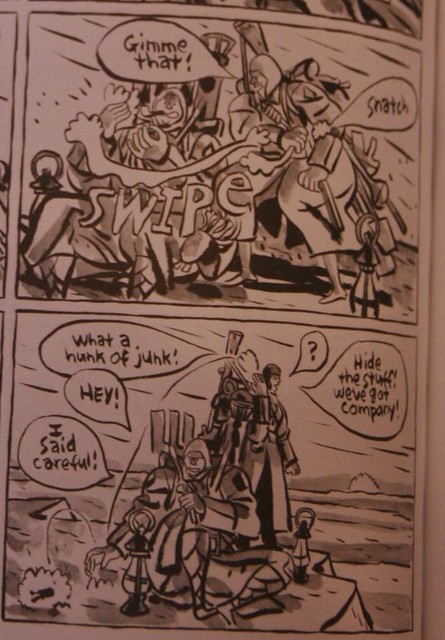
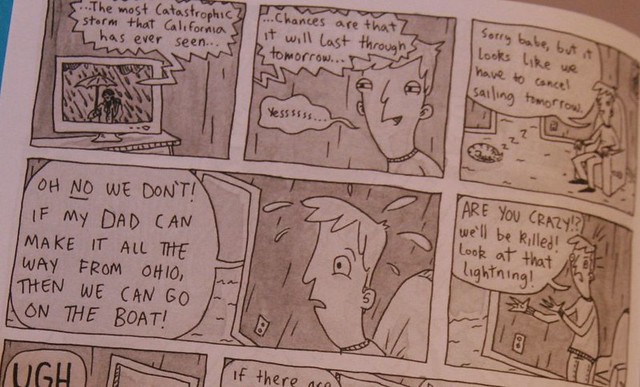
This small comics book is a science fiction story about a man who turned into a shark. The beginning of the book is in the spirit of stories about monsters and wrong turns with pulp element: a man named Sean Kerr does not want to go fishing, but at the insistence of his girlfriend after all fitted out boat, and now three of them (the third one is girlfriend's father) has been in a boat sailing in search of a good bite. But the premonitions do not lie to Sean, the storm begins, and the boat is sinking. Girlfriend and her father get out on the beach, but Sean is swallowed by a shark, which strikes of lightning. After having fought for his life in already inside the shark stomach, Sean calms down. When he wakes up, then he discovers that he is alive and can breathe underwater. His companion soon becomes a shrimp, nicknamed Shrimper. Sean also because of the consonance gets his new name - Sharker.
Sharker still does not know who he is, and the time elapsed since the transformation has resulted not in a couple of hours but as much as four years.

This story at first seems not so original, then delirious, but due to a combination of old school elements of horror and black comedy this comics reads like a homage to good old-fashioned science fiction with non-obvious ending. «Sharker, The Forgotten» is primarily a story of a man ceases to be himself and not knowing what to do now.
Black and white art of Sam Spina organically looks with a story, it turns out, as if watching a series of old black and white tv series. The only thing that seems boring is the addition to Sharker a talking shrimp. The depth of relations between friends in adversity is not observed, the humor of shrimp is flat, so that the shrimp can not be avoided.

Sam Spina has his own voice. It would be interesting to see what he can do in a larger form.

Death-Day (Part One)


Sam Hiti
Death-Day (Part One)

Laluz Comics, 2010

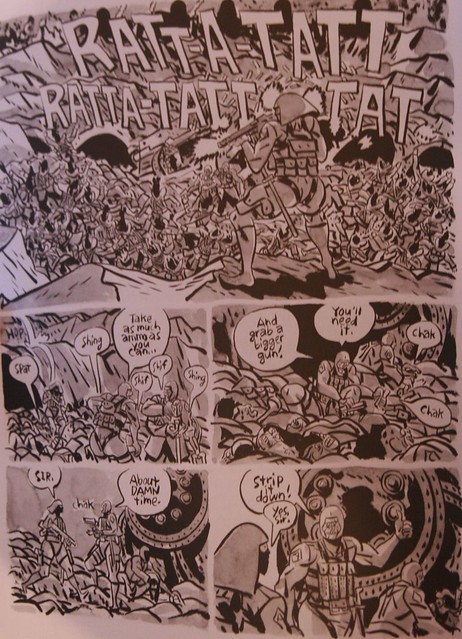
Since the first pages of this comic it is clear: we face something big. We see grandeur of sweep of the author at least in an increased size of the book and in panels on half a page. The choice of larger format allows the author to draw a giant canvas and the reader to closely examine the content of a page.

«Death-Day» is so pure sci-fi, where it is unclear whether action takes place in our world of future, or on another planet, or in a parallel universe, or all at once, because one does not negate the other. Already in the prologue (and the book besides the prologue made of four chapters - "episodes"), we see a huge battlefield where the army of people and army of orbs (six-fingered monsters, they seems stupid, but taking a number) prepare to attack. Each episode is a separate story line, but closer to the end of the book crossing between subplots becomes clear.

In the first episode, despite its seemingly large scale, the action is mainly concentrated in the headquarters of the Earth officers, who command the earth's army, following instructions of the Mother-0, the computer intelligence. Attempts of officers in different ways to stop the advance orbs lead to nothing, the army of the Earth suffers a defeat.

In the second episode, the central in the book, the main protagonist is a cyborg, one-armed man, scarred, with a mental disorder. He becomes the new captain for the squad of six men, whose previous captain died under mysterious circumstances. The new captain is not very ceremony with the soldiers, telling them to forget their names, and instead assigning soldiers to call signs, ranging from the X-1 to X-6. Under the leadership of the mad cyborg squad hunts for the Black Orb. In the third episode their adventures continue, and in the fourth again we are transported for a few years ago, where the battle between humans and orbs is at full blast.

Art style of Sam Hiti in some episodes becomes the main weapon of the author, in others - the main drawback. In large-scale battle scenes, when in the large panels we're looking at crowds of people and fight with the monsters, when scenes appall with their greatness, and fighting people and monsters are so mixed together that sometimes it is difficult to understand who is who in this battle, made in black and white, viscous, the style of art of Hiti is his main strength. Our eyes bury themselves in the battle, and it’s possible that you can look at a panel for a few minutes. This style makes a world three-dimensional. Such a world does not need color, it in itself is dim, this world of death, war, world of men. If there face are shown in large scale, they are either riddled with pain, or thirst for death.
But in other episodes, where the panel contains small number of characters with no special actions, such voluminous style sometimes interferes with focus on the moment. Art blurs the single episode, so do not even always clear what is depicted on the panel. This, for example, prevents in the second and third episode to get acquainted with members of the military detachment: a soldier sometimes is too similar to another one.

«Death-Day» is a multi-layered work, where the emphasis is in world building, not in some kind of hero in particular. Hiti apparently hid several cats in a sack for the subsequent books in the series, but just the first book tells us much about the scale of author’s creation.

Pug


Derek McCulloch (writer), Greg Espinoza (artist)
Pug

Image Comics, 2010

Writer Derek McCulloch and artist Greg Espinoza do not hide in their afterword that the creation of this graphic novel was influenced by their passion for old black and white noir films. The story of former boxer, who quit the sport and forced to make a living by helping the bad guys, actually originated in the 30's of last century, but what even until the plot is striking because is the art of the book.

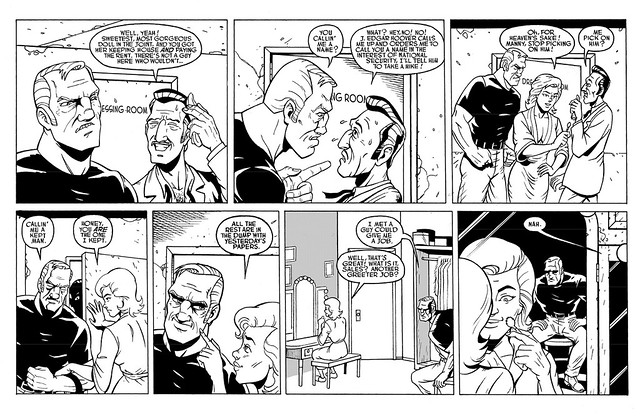
«Pug», as a film noir, is drawn in an old-fashioned black and white style. By removing all unnecessary, the authors brought their work closer to reality. In the novel there are no beautiful scenes, no broken noses in public, no girls undress in front of a hero, it all remains outside the page.

Jake lost an important fight a few years ago. At the same time his wife with his son left him, and a former boxer now lives with a stripper named Kitten, surviving on a one time job, then another. Drinking in a bar, Jake meets with one guy who is offering Jake a permanent job almost for free. Already at the first working day Jake realizes that the work is not dusty, but not of his type: with a blad man in glasses they go from house to house, knock out debts from gamblers. The pug does not tell Kitty about it: he is ashamed that instead of the normal work he received a dubious job of a muscle at a loan shark. Desperate, but not lost his conscience, Jake comes into conflict with his weasel-employer.

«Pug» is a generally very chamber story, you can count the players here on fingers, and the main action takes place inside Jake: Does he break under the pressure of circumstances, or not? What looks flimsy here it's flashbacks, from which we learn how Jake lost the fight that put the cross on the pug and why he still suffers from the leaving of his wife and son. Past is shown too messy, it has more action, and it does not allow us to see what's going on in heart and mind of Jake.

The pug, if not to take the episodes from the past, until the very end does not even use force, main battle is in his head. And the entire novel, in fact, says one simple truth: if you can, avoid a fight to the last. But if the time has come, then fight to the last. Do not lose in second time, as has already happened once.

Thursday, February 17, 2011

The End of the Line


The End of the Line
Edited by Jonathan Oliver

Solaris, 2010

What could be better than to pick up an anthology of British horror and read it a little every night? And if the authors of this anthology are horror dream team? The presence of star names, however, does not guarantee one hundred percent satisfaction from reading the book. Some authors confirmed that they are masters regardless of what they write. Another part moves only on the surface, not down there in the subway, in the dark tunnels of fear, in the trains full of despair and powerlessness.

All the stories in this anthology in one way or another connected with the subway. Topic is extremely interesting: subway, despite the level of technological development, the perfection of the security of the metro passengers, continues to keep dark secrets. It's worthy noting that there are no poorly written stories in the anthology (remember: all the authors are professionals, all famous writers), but some of them do not have enough depth. Fear is always hiding inside, not outside, and those writers who are not digging in, not sink into the ground, provided good stories, which, however, can hardly be called outstanding.

The first strong story in the collection - «The Lure» by Nicholas Royle. This is also most complicated story in a book, full of silences, omissions, secrets - secrets that we hide inside ourselves. The action of the story takes place in Paris, and Royle writes ease with the French. His story smells of French perfume, but it's not the smell that you want to inhale. «The Roses That Bloom Underground» by Al Ewing is much more straightforward, but appealing with ease and ill-concealed black humor. Candidate for mayor of London offers three weeks for completely renovation of the subway, if the people elect him. There is absolutely no dirt in the renovated subway, doors close silently, seats are not broken, subway inspires people a sense of happiness: you bet - it even smells like roses. But for the convenience you always have to pay.

Ironically, in the second half of the book there are much more outstanding short stories than in the first one. The best of them «In the Colosseum» Stephen Volk. Volk, like no one else succeeded in the short story to show how people go crazy and what this person feels. To get a good order, Marcus agrees to take part in the party, which his future boss organizes. Marcus and others from the party go down to the underground and locked themselves in the room, where the monitors are installed by security cameras. And what is displayed on these monitors, it is not something that every one of us would like to see. «In the Colosseum» is a story- mirror in which the author invites us to look and see what lies within us and those who are close to us. Michael Marshall Smith’s «Missed Connection» reveals the characteristic feature of the human: we are looking to the last of a logical explanation, even if everything does not fit in the usual course of things. Hero of the story comes out in a subway station, hoping to quickly get to the store to buy a family Christmas gifts. But not a soul around him, escalators don't work, so that the protagonist seems that the station is just shut down for repairs. «Siding 13» by James Lovegrove is rather a nice joke, but still creepy. «Crazy Train» by Natasha Rhodes exploits bored theme «death and rock 'n' roll», but it does so not without grace. The narrator of the story is committed suicide bassist of rock group, which have been woken up near the bar by a woman, suggesting the dead go to a concert. Musician is stunned, but agrees to travel on a crazy train. He does not know who this girl is and what this trip will lead to. Joel Lane in «All Dead Years» tells the story of two women - therapist Val and her patient Helen. Helen suffers from mental disorder: as soon as she descends into the subway, she becomes ill, she gasps, and she sees corpse remains in the walls. Desire to help the patient leads Val to strange consequences. Lane's prose is imbued with compassion and suffering. In this story, he showed how people can stay alone with the emptiness.

«The End of the Line» is very high-quality anthology of short stories in which a third of the outstanding, and the rest just good.

What They Hear in the Dark


Gary McMahon
What They Hear in the Dark

Spectral Press, 2011

I already wrote about the books released by Nightjar Press (damn, I reviewed all their books!), launched a series of dual release of so-called chapbooks - one book / one story. All six currently published books contained the outstanding story, picking up a very high standard for writers working in the area of dark literature. Now we have yet another British publisher, who is also engaged in production of chapbooks. The first their book came out very strong.

Gary McMahon is far from the debutant, he is the author of numerous novels, as well as several collections of short stories. «What They Hear in the Dark» is a wonderful example of how not using the straight-line methods, you can whip up the atmosphere, reducing the fantastic element in essence to a minimum.

After the violent death of their son, husband and wife moved into a new house, hoping to start anew. House, as well as their family life, is not at its best: want to repair. A place where spouses can escape from the oppressive emptiness becomes Quiet Room. In this room there is completely darkness, and most importantly - it has absolutely no sound. In this room, the sounds do not penetrate outside and extinguished all the sounds inside. The room becomes something like a drug for Rob and Becky.

This story is not a one-time reading, although I still will not reveal further the plot. McMahon feels what often overlooked by many authors of horror fiction: the worst lives always inside the person, not outside. The author describes the reliability of the person who lost the most precious thing in my life and does not know how to live.

A promising debut of a new publishing house. We will follow what Spectral Press will present us next time.

Tuesday, February 15, 2011

Netherland


Joseph O’Neill
Netherland

Fourth Estate, 2008

The protagonist of this novel, a Dutchman by birth who lives in England and the USA, Hans van den Broeck begins his memoirs from 2002, when Hans first became acquainted with Chuck Ramkissoon. They met at Walker Park in New York, where they played the cricket. During one such match some crazy runs onto the field with a gun in his hand. With all the players run off the field, except Hans and captain of the opposing team's Chuck, who persuades crazy to throw his gun and leave the field. After the game, in a bar, Hans and Chuck meet properly. Hans is white and from Holland, Chuck is black and from Trinidad.
The life of Hans is bursting at the seams. A year before the meeting by Hans and Chuck Hans’ wife Rachel leaves for London with their son Jake. After 9\11, Rachel does not feel safe in the States. She does not want to live in a country participating in war. Collapse of trade centers influenced on Hans, too, he feels an inexplicable fatigue. The job of analyst at the bank does not give him any trouble, he does it automatically. The next time, Hans and Chuck meet by chance in a few months after that cricket game. Learning that Hans is banking analyst, Chuck is interested in the services of Hans. He plans make some kind of deal, and perhaps Hans calculations will not be redundant.

«Netherland» is a book about embarrassment, about how you can not find yourself in a world of globalization, when many boundaries are erased. After the events of 9/11 Hans feels that it is something not right, he dropped out of society and does not know what to do. He tried to blend into American society, but the attack seems to have erased all his attempts, Hans became an indirect victim of 9\11. Against the background of inner feeling of being exhausted his family falls, and he can not do anything. A straw, for which he can catch (although Hans does not realize it) to get out, becomes Chuck. He is not a Native American, but settled better into this country than many people who were born and raised in the United States. Chuck had not only taken root, he wants to change the country, in its plans one can even discern the union of many nations, living in the U.S.

Ramkissoon in this novel is one of several heroes of American literature, which can be called great dreamers. His plan seems crazy, but it doesn't matter: a dreamer Chuck unwittingly helped Hans to find himself, to find his ego. Chuck is just a gangster linked to the Russian mafia, unwittingly embroiling Hans in his dark deeds, but because of his ideals and grand plans, the dark side of Chuck's almost not visible. Chuck does not become an ideal for Hans, he offers no solutions to Hans of how to save his life, but Chuck cleans Hans from accumulated emptiness.

This novel is also a book about urban life, with fine detail, magnificent scenery, with the turmoil, but the charm of this will be understood only by residents of big cities. For the rest it will not be so obvious. And in general, not living in the United States or Britain, it is difficult to capture additional meanings of this remarkable book.

Tuesday, February 8, 2011

Little Bird of Heaven


Joyce Carol Oates
Little Bird of Heaven

Fourth Estate, 2010

In the first part of this novel (and the most interesting part of it) we are introduced to the protagonist, Krista Diehl, 11 years old girl. Time in the narrative changes, moving forward and backward. In 1983, in the small town Sparta, Zoe Kruller who once worked at a local diner, but never leaving hopes on show business was brutally murdered in her home. Zoe had a bluegrass band with which she gave some gigs. Police suspicion falls on two men: Zoe's husband, with whom she has not lived for some time, and her lover, Eddy Diehl - the father of Krista. None, however, was not arrested, but Eddy's affairs became known to his wife. Eddy is forbidden to approach the Diehl’s house, not allowed to meet with his children, Krista and Ben. However, Eddy is constantly drinking, lives in another town nearby, and occasionally visits his daughter. And Krista is glad about that. She feels that her father would not lie when he says that he is innocent of murder. Krista loves his father more than mother, and in any disputes she protects him.

The strength of this novel is not in the plot, which in general is nothing special, but in the tone of the narrative, which Oates so successfully invented and used. A little girl who madly loves her father and, despite the obvious things, for all his sins, forgives his father, preferring him to her mother. Oates told the story of how two families are breaking down at once, from the inside, successfully selecting the lens: see through the innocent eyes of a child for what happens in adult life: murder, betrayal, suffering, injustice, shame.

The first part of the novel is simply brilliant. Transposing the action and the memories of Krista in the years ahead, then a week ago, the author collects before the reader not even pieces of the puzzle, but pieces of the life of Krista, her family, living a small town. Oates has created not only a convincing Krista’s portrait, but also portrait of her father.

The problem of the novel is in its second part. Oates tried to look at the story from another angle, in order to not only complete the picture, but also create another one complex character of Aaron, the son of Zoe. But nothing good comes out of such attempts. In the third person narrative there is not so much appeal, than in the first-person narrative. Aaron is less interesting to the reader character; the author couldn't create a unique identity, as happened with Krista in the first part. Aaron is more formulaic. In addition, we learned all story from Krista, and re-read what we have read, but in the worst performance, is not something desirable.

In the final, Oates raised another important theme of the book - the theme of memory. Staying in her hometown - it means to Krista to bury herself, to bury under the remains of a past that is not its best to remind myself of daily. And little bird of heaven flies away from her past.

Monday, January 31, 2011

100 Months


John Hicklenton
100 Months

Cutting Edge, 2010

John Hiсklenton completed this book the day before his death. He suffered from multiple sclerosis and ended his life in hospital. His last book is devoted to nothing else like death.

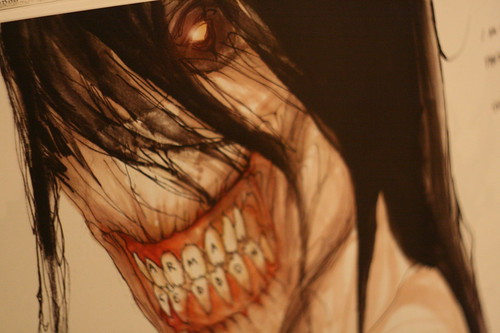
«100 Months» is more an art album, rather than comics. Death is a stop and not a move, so here the action is reduced to the minimum limit. The book is structured so that one page has one panel. Most often, on a page there is just Mara, the protagonist of the book, she's death, Armageddon, and all the rest of the space, the so-called backs, left white. This allows to focus more on the main character, besides the white space is emptiness, that surrounds the death, and that emptiness, perhaps, is death itself.

In the book there is very limited number of persons: Mara herself, the Priest, and the Pig. Mara, going to the last battle with the Pig, on his way met the inhabitants of this world, created by Hicklenton, but they are only outlines, shadows, copulating animals, which you do not care about – and Mara does not feel sorry for them. Mara is alone in this world; she does not know anybody, and who wants to know death, who can know death?

The world of «100 Months» is a pagan world. Mara has a purpose that she must meet, the murder of the god in the guise of a giant pig, to save the world, you need to sacrifice an animal.

This seemingly unhurried book is not created for meditation. There is a dound that you will be able to meditate when you see a mountain of skulls, trails and bridges made from the bones, and piles of corpses of creatures. But you can admire art of Hicklenton indefinitely. His death has not a woman's face but the face of death, often invisible behind the hair. Its red color is mesmerizing. In the scenes of battles Hicklenton sprays tiny droplets of blood on the page so that you inevitably checks is it not your own blood on book pages, so much it's real.

And Hicklenton in «100 Months» almost quotes of Brodsky: Death happens.

Years of the elephant


Willy Linthout
Years of the elephant

Fanfare\Ponent Mon, 2009

Linthout wrote this book as self therapy when at the age of 21 years old, his son committed suicide. It can be considered autobiographical: in the book alter-ego of the author, Charles Germonprez, too, loses his son, springing from the roof, tries to cope with the loss, tries to soften the pain of loss, has insomnia, visits a psychoanalyst, wants to commit suicide, but the author to reality full of pain, loss, despair adds a solid amount of surrealism, and so «Years of the elephant» is only half non-fiction, the second half of the graphic novel is a strange prose.

Book would have been impossible to write, if the author did not have a fair amount of self-irony. Germonprez here is a funny man in glasses, all the while wearing a sweater and with a tuft on his head. He must have been modest and awkward before the death of his only son, was a good family man, but the tragedy distressed him. He became nervous, he couldn't the focus on something else, it throws him into tears, then into anger, but whatever he wished, his thoughts are inextricably linked with his son.

When you notice while reading this book, that you laughed once, twice, and then smiled, at first you stop laughing: whether it is good to laugh, when a person has sorrow? But soon you can't do anything about that: it's very funny. And the author did it on purpose: laughing at yourself, it is possible to overcome the sadness and suffering.

Surreal story amplifies with good art. The fact that the entire book is drawn in pencil, but Linthout left pencil sketches without erasing. Critic Paul Gravett in the preface to the book writes that in such a way Linthout wanted to show that these drawings with their incompleteness has human hand and heart. I see in such sketch style another method: unpolished pencil lines stratify each subject in the book and every person. So in addition to surreal moments when, for example, Germonprez tries to lay on the place circled in chalk outline of the body of the son or Germonprez communicates with his son, using Morse code, such layering adds a surrealistic tint. The alter ego of the author not only losing his mind because of the tragedy, but he also splits.

«Years of the elephant» is a brave book, in which the author was not afraid to put on the language of comics his personal tragic experience. And just for this we should applaud Linthout for hours.

1-800-MICE #5


Matthew Thurber
1-800-MICE #5

Ambergris Books, 2010

What happened in the previous four parts of the 1-800-MICE comics or how all the books plots intersect, we can only guess. I have not read the previous parts, so I will consider this comic as a standalone product.

This thin book, drawn in minimalist style, is a strange one. The overall story is divided into four subplots, each of which complements the picture of the world, created by Thurber, but they do not intersect. In the first, the protagonist is a policeman, suddenly feeling that inside him lives the second "I", a mouse, in the second cat in the guise of a man uses a variety of modern gadgets. In the third storyline, we see how the mouse escapes from the chase, and in the fourth before us presents a meeting with the mayor of a town.

Thurber in this book continues the story lines of previous books, but the gusto in this fifth book - the individual scenes. Here's the policeman, who are already depicted as human-mouse (though it's not obvious at first viewing), goes to the café and he feels like a mouse inside him wakes up and he runs out into the street. Here is humanoid cat in the hat watching little fairy ass through magnifying glass.

Here's a mouse sees torture and pukes. Here's a horse asks the mayor at a meeting.
The author has a sense of the episode. In the chase scene, when a fleeing by hydro-power car mouse run from some thugs, Thurber divides page not on the usual rectangle panels, but cuts the page at acute angles, reducing the size of the panel, thereby transmitting the dynamics of the scene, and inside the panel accommodates only fragments: a hand, gas pedal, the exhaust machine - achieved through that style a fragmentary sense of danger that threatens the mouse. And then on the next page the author is already doing a close-up, posting only one panel on a page. Such a sharp contrast stops you, as if pushing the airbag from the previous scene.

Another incredibly imaginative scene is meeting of people and the mayor when the musical note that escaped from a tree-woman absorbs a mayor. At the three-panel page, we see how gradually the note closes frightened mayor, and then it remains only a black ball.

The world of "1-800-MICE” is an uncontrolled fantasy where you never know who you really are, where you're defenseless, where with the presence of nominal power and authority, power plays no role. It is the world of a mouse, which has only one rule: Run.

Hopefully, this and previous 1-800-MICE books will soon be collected under one cover. It's worth it.

Friday, January 21, 2011

Ninth Letter Spring\Summer 2010


Ninth Letter
Spring\Summer 2010
Volume 7, Number 1

Usually the world of literature and world of glossy paper have nothing in common. In Russia, there are thick litmagazines "New World", "Neva", "Banner" (here you can insert two dozen titles) and they are sold in places where not everyone who wants to read them can buy them. And there are magazines Tatler, Harper's Bazaar, Men's Health, and thousands more other titles, they are sold in all the newsstands even in the most remote towns, but they have no relationship with literature. Literary magazines directly relate to the literature, as they print literature on their pages, but they look so conservative and unattractive to the reader and the seller so that if you put "New World" to showcase of the newsstand, a buyer would have thought that a seller just wanted to cement the cracks in the glass case by this blue rectangle.

And so the magazine of the University of Illinois “Ninth Letter” attempted to combine a literary content and design of a glossy monthly magazine. It looks like as a blend of literary magazine with Esquire. 300 pages on excellent white paper, with a block of yellow paper, with a glossy block, with photos, with illustrations between the stories, with art. This hybrid turned out quite attractive, the designers have tried their best.

There is actually also something for a reader. The weakest component in this issue of Ninth Letter to me was poetry. Part of it is elongated in the column of prose pieces, where actually there is no poetry, while another part is something like the worst representatives of poor-written vers libres. From poetry, I would single out two poems by Leslie Adrienne Miller and Carolyne Wright’s poem «Credo in Blue».
Of the five fiction pieces in this issue stand out fragment of «The End of the Fire Cult» by Angela Woodward and Douglas Glover's story «The Sun Lord and the Royal Child». Woodward weaves in her fragments non-fiction, poetry and magical realism. This is a fictional love story against the background of a fictional war, as if written by a poet. Glover's story, too, combines reality and fiction, but the author is much more recessed into reality. «The Sun Lord and the Royal Child» is the story of a fatal mistake by famous archaeologist Nedlinger, his wife, who suffered from the glory of her husband, and another archaeologist who secretly met with Nedlinger’s wife. The author, choosing the heroes of the story archaeologists, finds a good metaphor for a way to show that our past is also the land in which we hide their secrets, but secrets will still become apparent as the exhibits will be found during the excavations.

Essay by T.A. Noonan «The Trouble with Correspondence» is one of the gems in non-fiction section. The author with self-irony argues what witchcraft in the modern world is and whether belief in oneself can change oneself.

In non-fiction part there is also an intriguing project called «National Book Award in 1960, Revisited». Michael Griffith and three other writers of the jury aimed to revision the results of the Nation Book Award 50 years after their results. The jury chose the entire short-list of the award that year by adding five more novels, which represent a decent job, but were not included in the shortlist. After reading all the selected books, the jury should have been vote from 2010. Why such a project was ever realized? Griffith in his introduction explains that the decision of any jury award affects several factors that have no relation to a work of fiction. But what happens if these factors would not exist, the jury would not personally know any of the nominees, the jury will have no interest in pushing a particular book, whether the results would be objective? Choosing one particular novel, we are doing this because at the moment it is very strong work, or we believe in the future, wishing that this or that work will not be forgotten decades later, and without an award, it risks being buried under layers of time?

And if the winner of the National Book Award 1960 was the debut novel by Philip Roth «Goodbye, Columbus», this jury chose the winner of the project Evan Connell’s novel «Mrs. Bridge ». To summarize, each of the writers who were part of the jury, wrote a brief essay on the novel in the short-list, which is most closely to him or her. And each of these essays is written with such love and respect for the chosen author that you wants to immediately read the book about which the essay is written (I especially liked the essay by Michael Griffith on the debut of Updike «The Poorhouse Fair»).

The magazine looks very nice, with interesting fiction and non-fiction sections, but I was disappointed by poetry.

Thursday, January 20, 2011

Nemesis


Philip Roth
Nemesis

Jonathan Cape, 2010

«Nemesis» is the thirty-first book of an American classic Philip Roth. Nemesis from the book title is the name of the goddess, and the actual wages dropped down to the hero of the book Bucky Cantor.

Twenty-three years old young physical education teacher in a school in Newark, Bucky in the summer of 1944 is the playground director, where children come to play. Bucky's parents died, and he was brought up by his grandparents. Cantor is young man full of energy, a great athlete, a good example for children, with whom he plays on the court. However, due to weak vision Bucky was not drafted into the army, in contrast to his two friends, flown away to fight in France. During that summer terrible polio epidemic happens, primarily affecting children. Every day, a number of kids who got polio grows more and more, and Bucky, strong physically, but spiritually hesitant young man, faces with the first dilemma, which he must decide for himself: Is it necessary during the epidemic to close playground, which may become a place where children can catch the virus, or vice versa, the playground should be open, because sport enhances children's bodies? Despite the death from the disease of the best pupil of Bucky Alan Michaels, Bucky leaves the playground open. The second test for Bucky Cantor becomes offer of his beloved Marcia, working at a summer camp not far from Newark. The young girl is worry about Bucky, fearing that he too can catch the disease and die. She offers him to quit work at playground and go to work at the camp, where she works: there are much safer in Indian Hill.

However Bucky can not so simply leave his grandmother and children, can not throw off all responsibility. Cantor blames himself for his lack of participation in World War II, it was his personal defeat and to leave his native city is exactly the same moral defeat to him. At the war ones fought with visible and tangible enemy, here, in Newark, at the terrible heat, in an almost deserted city the enemy is not visible, but it also kills, so give up and leave, no, Bucky can not allow himself one more fail. But the days pass, the number of polio cases keeps growing and growing, and Bucky calls Marcia: he is leaving Newark and will move to the camp in Indian Hill.

Roth chooses the narrator of the novel not Bucky Cantor, the main protagonist, but one of the boys, who in the summer, too, contracted polio but recovered, Arnie Mesnikoff. After several decades Mesnikoff and Cantor meet by chance on the street and from Bucky Mesnikoff finds out all the details of that story, what happened to his physical education teacher and forever changed his life. Roth thus moves the reader from his character, and in the mouth of Mesnikoff author actually puts those questions which he himself would have asked the aging Cantor. The distance between the hero and the reader does, of course, this novel rather model of the situation, than a situation itself. But Roth is the master, so from that as simple as two plus two story he drags on the surface these questions about God, free will, chance, weakness and strength that you wonder: how Roth the terrific writer is.

Bucky could not forgive himself of his act in that summer (and in the second part of this novel the reader learns to what this Bucky's escape to summer camp to Marcia led). Nemesis caught up with Bucky. Was that nemesis to Bucky God or Bucky himself was his own nemesis? Roth doesn't answer for us to this question. We ourselves will have the answer after reading this book.

Tuesday, January 18, 2011

The Homecoming Party


Carmine Abate
The Homecoming Party
Translated from the Italian by Anthony Shugaar

Europa Editions, 2010

A book, which is a portrait of childhood, can be interesting for reading not only by its author, but readers too, if it not simply imposes one memory to another, simply strings little pieces of memories on a skewer of fiction: the meat may be good, but the dish will not work (cooks should forgive me for the invasion on their territory). A story can have no plot (but better have it), but some secrets should be present.

There is a mystery in this novel by an Italian Abate, as there is weak but enjoyable plot. A story rolls up and rolls out like a carpet, which then have been put into a corner, then roll on the floor, and the center of the story is in one place. For Marco, a boy from an Italian family, living with his mother, grandmother, sister La Piccola and dog Spertina, time is measured not by calendar years, but by those intervals when closer to Christmas his father returns home from France where he worked as a miner to feed his family. The father of Marco had not an easy life: he left home early, lost his wife, stayed with a baby (Marco's sister Elisa, who is studying at a university), remarried, and now every spring after spending the winter home with children and the wife is forced to detach himself from his family and goes back to almost a year of work. The father once explained Marco why he leaves every year: imagine that someone puts a gun to your head and says: «Leave, or I'll pull the trigger!», and you should leave , there are no other choice.

Secret is here for Marco and for a reader at once becomes Marco's sister Elisa. The boy accidentally sees his sister in the woods kissing with some man who once saved Marco’s dog. Elisa's secret meetings with the stranger will stimulate mind of the narrator because his father and mother still can not guess who their daughter secretly meets with.

«The Homecoming Party» is a portrait of Italian small-town life. Here you all day play football, walk the dog in the woods and eat your mother's food, watch out for your sister, and the worst that can happen - you will get a fever, and even then it will play into your hands.

This book is hardly something special, it is too conflict-free, but you can not to dislike it. You can pull the trigger, I'm staying.

Monday, January 17, 2011

It's been a while since last time I posted review here. It doesn't mean this blog is on hiatus or something like that. I just was busy with my part-time job, but my reading has never stopped. During holidays break I had read a lot of books and comics so today or maybe tomorrow I will start to post reviews.

So: what has I read?
Philip Roth - Nemesis (it made my top of best books last year)
Carmin Abate - The Homecoming Party (very good though nothing special)
Timothy Taylor - THE BLUE LIGHT PROJECT (maybe I'll right a short review closer to release date; strange novel, I rather didn't like it; second part was far more enjoyable than the first one)
John Hicklenton - 100 Months (rather art album than comic book; very good)
Matthew Thurber - 1-800-Mice #5 (self-published comics; quite weird)
Willy Linhout - Years of the elephant (autobiographic graphic novel; funny and sad)

Now I'm reading Ninth Letter magazine, Finch by Jeff Vandermeer and a couple of things for my job.
Stay tuned.

Monday, January 3, 2011

The Executor


Jesse Kellerman
The Executor

Sphere, 2010

Joseph Geist is a student at Harvard, which for several years can not finish his dissertation. The beginning of the novel folds for him extremely unfavorable: his girlfriend Yasmin, Persian by descent, throws him out. His entire luggage is a small bag and a half of the skull of Nietzsche, which Joseph once bought from a dealer in Berlin, thinking that he sells half of the head of Einstein. Joseph has nowhere to live, except the apartment of his friend Drew. Drew also alludes to Joseph that he should not stay for long. But to pay for another apartment, Joseph needs money, and therefore needs a job. Despairing, Joseph browses job ads in the student newspaper, which runs across a strange one. From the announcement is not clear who exactly is required and what have to do, and Joseph decides to try. A woman who answers his phone call has a slight German accent and after some of the issues offers to Joseph to come to the interview.

Some reviewers called this book a thriller, but it's hardly a thriller in the conventional sense: there are not almost the usual thriller elements (chases, fights, conspiracies, investigation) here, and all the suspense is focused not on the throughout the novel, but only at the very end. However, the novel sneaks down to the bone better than any thriller. When the hero (he's anti-hero) sweeps out all traces and only thinks they catch him or not, you even begin to beat on empathy. And this effect is difficult to achieve.

It's brilliantly written novel. This book really could be written by PhD: the text has many delicious details, black humor, humor with philosophical bent; suffering of the spirit is devoted much more space than the suffering of the body. The first person narrative twice suddenly changes into the second-person narrative - in those very moments when Joseph sees himself as if from the outside, and all his actions are transformed into a continuous stream of consciousness. Joseph is truly a Griboyedov’s hero; we can apply the term "Woe from Wit" with 100 percent accuracy. He puts an experiment on himself becoming the victim of this experiment. He gets into the final that he had dreamed of, and thinks has he changed his choice, if the fate gave him a second chance, but the tone of the prose for some reason says the opposite: he was pleased with how everything turned out.

Stories of such cases had already been enough, but it allocates different language, an unusual choice of hero and brilliantly built plot.