Friday, April 22, 2011

Nazi Literature in the Americas


Roberto Bolano
Nazi Literature in the Americas

Picador, 2010

This novel finally confirmed that Bolano is a great fabulist. Imagine a directory of encyclopedia articles, written by a sensitive and well-educated scholar who has never read the encyclopedia, but read a lot of science fiction (and not only by South American writers) and watched European films. The book has through characters, but each article-chapter is a separate article and is devoted to a fictional writer. Among them are poets, novelists, but most often it is the writers - those who write: from plays to the letters. There are those who write all his life until death, there are those that released in a lifetime only two books of poetry.

Nazi literature from the title of the novel is something that unites all very different writers in this book. Though there are not Nazi literature by and large in the book, but in the fate of every writer there is a vital episode associated with the Third Reich. For Bolano the use of "Nazi Literature" in any case is no way outrageous, but the formalities necessary to give the seemingly banal encyclopedic compilation in novel form some mystique.

To understand the humor of Bolano - and appreciate it - you have to be bookworms and bibliophiles. Humor begins with the title of the novel. And anyone who tries to take the book seriously will be disappointed.

The merit of Bolano is not only his boundless imagination and a subtle humor, but also a sense of proportion. He knows when to get bored, and chooses the correct volume for the book. No matter how different writers’ stories are, sooner or later the author begins to repeat himself- and ends the book. Bolano himself appears in the final chapter, thus placing himself in a number of imaginitive writers. I made you up, and I, too, am made up by someone else, Bolano implies.

Well, probably so.

Beginners


Raymond Carver
Beginners

Vintage, 2010

«Beginners» is a collection of short stories by Raymond Carver, which was released in its original form, as it is conceived by the author. Earlier this book was known as «What We Talk About When We Talk About Love» and was a collection of the same stories, but in the editing of Gordon Lish, who is credited as a discoverer of Carver as a writer. In the book there are some notes which briefly give the basic differences in the stories between the versions of Carver and Lish. Such comparisons with a limited amount of space in the book do not give a complete picture: to compare the original version and edition of Lish is only possible if you have before yourself the full versions of stories. So to say what version is "better" is difficult; moreover, both have remained in the literary memory. And that's a matter of academics, to compare and comment. The reader, of course, will simply enjoy reading.

And there is a lot of enjoyable stuff here. Carver is a phenomenal storyteller, often not even at the level of plot, not on a level as something happens or has happened, probably on a level as something never happened. Carver primarily is a storyteller on the level of feelings and emotions (again - not shown feelings and emotions), and the story serves as a sort of escalator.

Beginners, this is all the characters of Carver’s stories. They are not new to life, these people are already with life experience, but they are all beginners to the level of feelings. And in those stories that the author tells, his characters as if for the first time are experiencing real feelings. And often from such an emotional shock - resulting, in general, for the first time - they are lost, not knowing how to go on.

First-class writer, first-class collection.

Wednesday, April 20, 2011

The Blue Light Project


Timothy Taylor
The Blue Light Project

Soft Skull Press, 2011

Eve Latour is a star. She is Olympic champion in biathlon and is known around the world. Latour became famous primarily because during the competition a cracker-sniper shot her in the leg, but Latour gave no sign, hidden injury and completed the race and won gold medal. She was bathed in glory, gave interviews, went around the world, was going to marry, but because of his father's death postponed the wedding.
Latour now works on TV and runs in the mornings. The reason for these workouts is the missing brother of Eve. When she returned from a trip to Europe, Latour discovered that her brother Ali was gone. Ali painted graffiti, filled his pictures in the most remote places of the city, so that Latour runs through the dark streets in hopes of finding his brother or at least someone who can give her any information on the whereabouts of Ali.

When Eve, along with Nick, who has not yet become her husband, watching television, they learn that someone took hostage an entire building with the children who starred in the TV show «KiddieFame», something like the "Minute of Fame" for the children.

Taylor introduces another important protagonist of the book as soon after the scene of hostage-taking. It is Rabbit, he is twenty-six. He partly is graffiti painter, partly parkur, partly implementer of a strange project. Rabbit, adding the device to selected of the roof of buildings, works on an installation.

This is a strange novel. He is superbly written, especially its second half. Taylor has charming style, he is very accurately conveys the tension, confusion, and hopes.
Time of the story is the future, 2014, the city has remained anonymous, but the author does not write science fiction, there is no change compared with our time there. Despite the seemingly serious subject that requires a correct approach, the author hadn’t written depressing novel, there are no anger, hatred, hopelessness, conversely, Taylor selects the protagonist of the novel light itself, and the author earned himself a hundred points with that, he is the author of hope.

The novel turned out metaphorical, not rudely embedded in reality. City’s name does not appear there, any historical names never appear in the text, the state machine is never called such. There are references to the terrorist attacks in Moscow and Beslan, but this is such beacons, which do not play a big role. Taylor seems to be not tied to the details, but it applies only to the details around terrorist attacks: everything else is very plausible, all the characters, their inner world, are three-dimensional; they are not puppets on the author’s string.

What, however, doesn’t quite work in this book, is incongruous inclusion of some storylines. The entire plot line of champion Latour doesn’t work at all. It is bound and serves only as sort of a lever, to somehow tell and fully disclose Rabbit and his project. The very story with the search of her brother, a worldwide fame at times are even annoying. Even the style of the author when he writes about Latour, is as if getting worse towards simplification.

And only that, perhaps, does not let to name the book excellent.

Tuesday, April 19, 2011

White Heat


M J McGrath
White Heat

Mantle, 2011

The plot of this novel takes place on the Craig Island, near Canada, near Greenland. Edie Kiglatuk, an experienced hunter and guide, accompanies on hunting two men who wished to be in the extreme conditions of the polar north. But the hunt goes awry: one man is shot dead. His team-mate because of poor visibility hasn’t seen who shot Wagner. When the wounded man is brought to the hospital of Autisaq, the city where Edie lives Wagner is dead. Andy Taylor in the situation reveals himself not with the best side: nervous, panicked. In order not to raise the hype and not to call police with big land the mayor of the town decides to stay on a version of the accident: Wagner shot himself by a ricochet bullet.

Edie between two jobs is applied to alcohol and watches silent comedies. She and a local policeman Derek Palliser, who dreams of a major crime which he would have been able to uncover to win the heart of his wife, suspect that something is wrong associated with the death of Wagner, but both decide not to go against the Council of Elders.

If you take a look at the style of this novel, you never say it's debut in fiction. McGrath has a smooth style, not the Arctic cold, quite the opposite - full of energy and internal heat. Because of the stylistic elegance, this book certainly falls under the definition of "literary thriller". The main dignity if it, however, not even the style, bur well chosen surroundings. It’s incredibly interesting to see how people live near the polar circle. Because of constant cold, not only the daily life of a person changes, but his train of thought. Because of the remoteness from the mainland, in this case from the civilization as such, social structure of the Inuit is different from way of life of Americans and Canadians. With one hand, people living in the north, are not savages, but in general, normal people enjoying the benefits of civilization, not barbarians, not the pagans in their expression of extreme. On the other hand, the Inuit live only in their terms, do not like strangers, still retain the ancient traditions. All this allows the author to create an atmosphere for the reader unfamiliar, placing in the center of the plot a criminal story, not forgetting to create the complex background.

Mysery component, respectively, is largely determined by the environment: guide and hunter Edie, a lonely, but strong-willed woman who must not only unravel the crime, but also in parallel deals with natural conditions. The novel keeps in suspense until the last page, though detective plotline is the weakest and the most unconvincing. In the story there are vile Russian oil businessmen, fragments of meteorites, intelligent life from Mars, the fight for gas and almost a world conspiracy theory. All this looks like an awkward conglomeration of ideas, little related to reality. If you start to disassemble these waves simply from the standpoint of logic, the majority of composite lines will no make sense. The part of the mystery puzzle that relate to daily life of Inuit and quite a mundane motives, look much more authentic, perfectly fitting into the overall picture.

Though the author has not quite got to weave a perfect mystery in the picture of the created world, «White Heat» still is a very beautiful novel. And McGrath has already written a sequel.

Tuesday, April 12, 2011

The Skating Rink


Roberto Bolano
The Skating Rink
Translated by Chris Andrews

Picador, 2010

Roberto Bolano wrap around this short novel according to its title. The story is on behalf of three male heroes who change each other in short chapters. Thus, the reader moves in circles, like on a skating rink.

In the center of the story the girl Nuria Marti, figure skating champion, which unexpectedly due to reorganization of the national team has been expelled from the team and lost the grant. Nuria, famous after his victories, is deprived of the most important thing in her life. Local official Enric Rosquelles, overweight, unattractive, not very popular among women, is charmed by Nuria. The only possibility of being closer to beautiful Nuria, even though in purely platonic way, is to help her again to do skating, to continue training. Had not committed any crimes before Rosquelles makes a risky move that could cost him everything: an official on the public money behind the Mayor’s back built in the old stadium the new rink specifically for Nuria. On evenings they come to the rink together, and while Nuria trains, Rosquelles just sits and stares at her.

Two other heroes of the book, a Mexican drifter and poet, who turned out in the tourist town of Z, Gaspar Heredia and businessman and friend of Gaspar for the old days in South America Remo Moran are also drawn into the story around the rink.
Everything ends with, of course, murder, and the novel has even formal features of mystery: an investigation, unclear motives, several suspects, the double ending. But do not think that Bolano was writing this novel, keeping in mind only the detective.
Bolano is generally a big dreamer. Invent the idea of a skating rink to win a girl – onlu this already says a lot. By and large «The Skating Rink» is a novel about love, and a skating rink is a metaphor for love. It hides, becomes a secret, but when the senses go out, it is often too late, only blood on the ice remains.

Bolano is not only a visionary but also a big humorist. There are no jokes as such in the book, but then, that, as a writer collects different cliches and features from the romances, detective stories, black humor prose and then just lays out these cliches, gives a clue to the reader that all this is certainly an ingenious invention, despite the fact that book is very sad.

This Bolano’s book, but like his other books, of course what is commonly called the poet's novel. This is indicated in style of the novel, sliding, but full of Spanish (even though most Latin American) heat, and the novel's characters are poets. Moran and Heredia, they are that kind of character that all the time in dreams, nostalgic for the old days - and the old places - man, broken, but without strain, in search of the senses, but not letting his own feelings goes free.

Whether it's a bad novel, it would be finish this review with Bolanesque joke, quote from a radio – «We are all united by a stadium». But this is a good novel, but the same joke comes to mind. I think Bolano would appreciate the humor: we are all united by a rink.

The Suicide Collectors


David Oppegaard
The Suicide Collectors

St. Martin’s Press, 2008

After the Despair killed almost the entire population of the United States, in a small town in Florida only Norman and Pops survive. At the beginning of the novel Norman’s wife kills herself, and when the Siucide Collectors come for her body, Norman does what no one before him did: he kills with shotgun one of the collectors.
Having lost the last close person, Norman ponders the fact that situation like this can not continue more. During the five-year epidemic people stopped to see a purpose to his life and made - one by one - suicide. Mysterious Collectors has always appeared for their dead bodies and somewhere took away the dead. Remembering that one crazy man get to their town news about the scientist in Seattle, who works on a cure against the virus, Norman offers Pops to fly to Seattle on an old airplane. The old man had nothing to lose, just as Norman, and they decide to take on a dangerous flight. Fly to Seattle does not work, the plane breaks down, so that the rest of the way Norman, Pops and a girl with the name Zero goes on the ground.

In this novel there is a very good beginning and a very good end, all that is in the middle turned out not so well. Beginning, with scenes of rural life, with shocking scene of murder of the Collector, an evening drink of Norman and Pops, aptly reveals the state of the loneliness of those who are still alive and do not attempt a siucide. Norman, protecting the body of his dead wife, looks not like a superhero, but like an ordinary man who has recently been taken away all he got. Oppegaard chosen the narrator with a success. The novel is written from a third view, and the author does not allow us to look deeply into head of Norman. Something that becomes clear from his recallections, some from the phrases and actions, but in the rest of Norman - an enigma, and for himself as well.

The middle part sags: too much of cliche action, making the novel begins to seem like a novelization of the comic book. All along the way to Seattle villains are one-dimensional, their actions (and actions by Norman and co) are predictable, there is no tension, the chapters all the more boring and more boring, because you know that Norman would get up to Seattle.

The mystery of origin of Collectors, too, seems not very original, in general, even tortured, but in the end Oppegaard turn everything upside down. Before that «The Suicide Collectors» reads like dystopia mixed with horror, then in the end the novel resets all genre labels and beacons, becoming an incredibly powerful journey into the heart of darkness, when a man with essentially hollow inside is in an infinitely long tunnel full of darkness and a same emptiness. In the darkness, you forget who you are and where you are. In emptiness you see something you have never seen before.

After the death there is always a birth, and David Oppegaard managed to write about this not ideal, but a fascinating novel.

Wednesday, April 6, 2011

new Nightjar Press chapbooks


Christopher Burns
Lexicon

Tom Fletcher
Field

Nightjar Press, 2011

«Lexicon» and «Field» are two new books from Nightjar Press, which last year published very strong stories - on the edge of horror and dark fiction. The stories of this year are no worse than what we read.

If Christopher Burns debuts in Nightjar, then Tom Fletcher in the past year have already written the chilling «The Safe Children». His new story «Field» is written in a very different way. «The Safe Children» was science fiction with elements of horror, «Field» is pure horror. Fletcher in his story creates a world where there is no rational and irrational. It's the same thing. When a person is left alone with a black hole (figuratively speaking), you does not need to guess who will win in the end. Fletcher does not explain what and why, he throws a hero (as well as a reader) into the mouth of the vast nothingness. If you want to live - run. It does not matter that the field has no end.

Christopher Burns in his «Lexicon» deals with the more delicate matters. The hero of his story is a refined killer enticing victims to his home. Burns is playing with archetypes, and there is some connection between the sins of the past and present. Evil is continuous, it is transmitted, but not by inheritance, but through the elements of culture.

Recent stories by Nightjar Press again did not disappoint. And Tom Fletcher must now enter the premier league of British horror.

Mistaken


Neil Jordan
Mistaken

John Murray, 2011

This, as critics say, Gothic, although it is absolutely realistic, novel begins with the funeral. One of the two who is constantly confused is dead. The one that remains alive writes a long letter (which became this book) to the daughter of the deceased.

Two boys are confused since childhood. Kevin Thunder, the protagonist, lives next door to the house where once lived the author of "Dracula" Bram Stoker. The boy often seems that he is constantly watching vampire, sometimes even talking to him in the dark. Kevin begins to understand that he is mistaken for someone else first, when he was caught in a comic book store: another boy stole something and the seller accepts Kevin a thief and tells him get out. Then again, Kevin is mistaken for another boy, when one of the high school boys offers him a cigarette: the last time you smoked, says senior. So, Kevin begins to suspect that there is another boy from another school, so like him that they are almost impossible to discern. Once in the queue for ice cream a girl calls out Kevin and wonders why he did not call, even though he had promised. Kevin does not tell her that he is not who was supposed to call. Kevin pretends for weeks, walking with a girl on a date, he even likes to be so different.

Kevin first meets with his counterpart, when high school students take away pocket money, and Kevin defends mistaken boy Gerald, who later became a writer. They are both in awkward situation: they are often mistaken. Kevin advises Gerald to call the girl, which he once has not called.

Despite all the realism, the novel actually reads like something mystical. Jordan has a distinct style, which successfully blends into the narrative while giving away cold, but and the same time waking-up emotions. The author then started a triple play: there are three writers here – Jordan himself, Gerald and Kevin. And Jordan skillfully uses this twist, affecting issues of writing, sometimes merging with the protagonist, sometimes pulling away from him.

The narrative is divided into two layers: in one Kevin remembers his past, in another he meets the daughter of the deceased twin and tells her about her father, helps her to deal with personal life, replacing her father thereby. Twins’ fate was such that each of them thinks his life as a failure, living in vain and for nothing. But each of the two dreams that it appear they are on-site each other, then things would have been much better. Everyone would get what he wanted. They both want to live someone else's life, forgetting that one should live his own life.

The culmination of the novel can be considered the murder of Loretta, Gerald's mistress. Jordan, as expected, could not do without murder here. But the murder in the novel is completely in place, interspersed here not to just add suspense, which is already enough here.

«Mistaken» last but not least is a novel about jealousy. Brothers frankly envious of each other's lives, but because of the fiber of a character, none of them does not openly show his envy.

Jordan took up the challenge - to write an unbanal novel about twins. He won. Perhaps the main fault of this book can be attributed only to the final, when the reader learns the mystery of twins. Version that the brothers have been adopted and that in fact they are the sons of cyrcus woman seems even vulgar on the general background of the novel. The author prepares the reader to the mysterious riddle, increasing tension with each page. And then we learn about some twin brothers of dissolute mother. It's like a Gothic facade of the building in which someone threw a rotten egg.

It would have been a brilliant novel if not that end.

An Attempt at Exhausting a Place in Paris


Georges Perec
An Attempt at Exhausting a Place in Paris
Translated by Marc Lowenthal

Wakefield Press, 2010

In this novella (although it is rather a separate genre under the name "stapled sheets of scratch pad") a French classic Perec, author of the translated books "Things","Life A User’s Manual”, etc., attempts to describe the indescribable. Perec actually is not a writer, he is describer, fixator. During three days in October 1974, the writer sat in cafe and wrote down everything he saw, everything that came within his field of vision.

Perec finds rhythm in emptiness, finds consistency in the daily nature of things, challenging time. Time, by Perec, is not measured for years and minutes, but for buses, boys with a dog, a man in a tie, pies eaten on the go. Perec is aware that it is impossible to fix everything that happens: in a second there are so much microevents that even the human eye can not see everything. Nevertheless, the writer exhausts place. It's funny that the title of the novella consists the word «place», though the book seems to be about time, not a place. But without the space time does not happen, and vice versa.

In the best moments this book is reminiscent of free verse, in the worst - optional clippings from old newspapers.

«A mailman with satchel
Two meter maid-to-orders
Two dogs, brothers, Snowy type
A man in a beret, looks like a priest
A woman in a shawl
A granny with baby carriage
A man in a Russian fur hat (it’s the same one, he’s come back)
A priest in a beret (another one)»

Perec does not write, he describes, but his description of time and space leads to the sad thought: in our life there is actually much more emptiness than we think.

Wednesday, March 16, 2011

Meanwhile, Between Two Eternities of Darkness


Gummbah
Meanwhile, Between Two Eternities of Darkness
Translated by David Colmer

De Harmonie, 2010

I should start with the fact that it is insanely funny book. You may not be a fan of comics, but if you are a connoisseur of good jokes, this Gummbah’s book will become a pleasure for long couple of hundred pages. On every page here there are two panels more often, and not funny ones among them can be counted on the fingers of one hand.
However, after this it is worth noting another fact - humor here is very politically incorrect, sometimes openly rude, and more - all the jokes are very strict.

Everything is under attack: unsuccessful writers and pedophiles, homosexuals, and dildos, religion and sex. It can only be confusing at first, until you start to delve into the image of the world created by the author. Despite the fact that all the panels are completed on its own, however, each of them belongs to the same world. People in it are ugly and not attractive. There are no children (nominally there are children, but they are all drawn in the form of adults). They just do nothing but fuck, laugh at other people's shortcomings, insult each other, go to the doctor, rape animals. Gummbah, however, created the world that does not look real: seemingly so, almost everywhere it is drawn: families, conversations between friends, picnics, trips by transport, in general, everything that is natural, what people are and do all the time but you feel that it is rather dark fantasy, not in vain here often appear gnomes (from the comics Smurfs), Mickey Mouse, Donald Duck. By introducing these characters into the narrative, Gummbah, firstly, shows the grotesqueness of the world: even where there is no Mickey Mouse there, we see that the world upon Gummbah exists under other laws. Secondly, Smurfs and Mickey Mouse show that the author sees a connection between his own work and the European and American comics.

Gummbah’s art is grotesque – grotesque-realistic: the artist often draws in color, but sometimes there are black and white panels, and sometimes the author has resorted to a collage, which is funny too, but they drop out of the aligned series of characters. Focusing on people and relationships between them, the artist neglected backs, often drawing the characters on a background of bare walls or solid color fills. It is difficult to attribute to the flaws, still Gummbah does not aim at full representation of the world, he is just joking.

In two words: an impressive book.

Saturday, March 5, 2011

Solipsistic Pop #3


Solipsistic Pop #3
Edited by Tom Humberstone

«Solipsistic Pop» is an anthology of British comics, published twice a year. The theme of this issue is wonder. There are a lot of wonders indeed. Part of the comics is made for younger readers, some for grown-ups, but even those comics who seem to be quite childish in style and art, will please fans of comics of all ages.

The first thing that catches your eye when you start flipping «Solipsistic Pop» is this is a colorful book. There is no black and white works, and among all the colors red predominates. Already a saturation of only red staggers and prepares for a heap of wonders.

«A Joke» by Tom Smith is accompanied by a poetic text. Poems here are as a voice-over to the surreal story: a young man goes to drink at the bar, and there he is met by the animals. The reader knows in advance that the entire story is a joke, but here's a young man about it yet to learn. Darryl Cunningham is represented in the book with three single-page stories, in each of which he exploits the same technique: the main character, which is easier to describe in two words «unknown animal», finds application to intangible objects in the picture, making them tangible. This animal uses the cloud and the so-called bubbles with words and thoughts. Cunningham comics are very simply painted, very funny, but jokes apart they still have genuine feelings of sadness, joy, and loneliness.

«The Torturer's Garden» by Rob Davis is a much more sophisticated. Davis experiments with the framework panels, alternating black humor with cruelty, and in the end uses postmodern trick. Philippa Rice in her «Interdimensional Treehouse Party» uses the most unusual artistic means. Two bored hero, like everything else in this comic, are not just painted, but carved out of paper, thus Rice makes something middle between a traditional animated film and a comic book. On the one hand, it narrows the artistic possibilities (too much static), on the other - the opposite of expanding. At least this reads very funny.

Octavia Raitt in «Molly vs. The Wondertaker» united in her short work two styles: the usual manner with a realistic three-dimensional on the description of the monster, the Wondertaker. In fiction narrative about a bored little girl, the author also put in pseudodocumental story about a monster. Fiction-like part often looks more organic, but the whole story together is a pleasure. Andrew Waugh in his «Teething Problems» uses the minimum number of words, but the picture conveys subtle humor stories. At the heart of comics is the relationship between suffering from excessive love for the master robot and a man. The story is full of gags, it has a very funny ending, but the author conveys to the reader one simple truth: we have a responsibility to those we have tamed, even if it's a robot.

«The Elephant of Surprise» by Faz Choudhury is like an illustrated story by Edgar Allan Poe with the elements of weird. Art of Choudhury is full of dark colors, details. «Sardines» by Becky Barnicout is drawn in indie-style, a style recalling Robert Crumb and co. This is a story of indifference, where in each panel, we look at abomination. Very strong work.

«Magic and the Man» by Kristyna Baczynski is a two-page comic drawn in a mirror manner: on one page we see the magician is at home, on the other - at work. That’s funny story, with impeccable design. «The Haunted Barb House» by Mark Oliver is a great example of how to paint a surreal story. The author not only invented a strange world filled with strange characters, he also added a few stylistic highlights: for example, answers of one of the two comic book heroes do not appear in the cloud, as it is customary, but directly on the face, making the man faceless. «The Egg» by Luke Pearson is another strange story about a boy and a girl. Power of Pearson in the first place is in his art: The picture is very realistic and at the same time it is something dreamy.

I was not very impressed with the plot of «Fruits Delamer» by Warwick Johnson Cadwell, but his artistic style charms. The author seems to admit negligence in the casting and working with color, but it works on the picture: art seems faded, lines are coarsening, and the picture begins to match the story, which is already several hundred years old.

«Solipsistic Pop» is 80 pages of continuous enjoyment. There is enough room for wonders for a year-old child and for one hundred years old.

Stripburger 54

Stripburger 54

If the previous issue of "Stripburger" was a disappointment for me - too many pictures and too little comics - that this, number 54, dedicated to Brazilian authors, is a delight.

In the issue there is an interview with one of the Brazilian artist Marcelo D`Salete. In this interview, D’Salete complains that nobody takes seriously comics in Brazil. Artists do not publish books because there are no comics publishers, readers do not read, because there are no comics and nowhere to learn about them, publishers do not want to hear about comics, making an exception for illustrated books for children. If you like to draw comics and be published - do comics for children. Such a situation recalled the situation in Russia, one to one similar to the Brazilian. If you do comics, just look for the opportunity to be published in the West, at home you could onlu get mockery. D’Salete in an interview remarked that comics in Brazil, made for adult audiences, have social background. His own strip in this issue is one of the strongest stories here. At the heart of D’Salete’s strip is a story about a girl who has lost her mobile phone. On the small number of pages of his work the artist tells us about the social life of Brazil more than we could learn from the Wikipedia articles or from news reports. Unsightly houses, barred windows, open spaces, the dark train, cowboy hats, petty criminals - the author doesn’t focus on this account, the reader himself notes the elements of urban life. D’Salete has lyric black and white art. Alternating panels on people and elements of landscape, the author demonstrates the inextricable link between the inner world of man and the place where he lives. Open ending does not contain harsh sentencing of Brazilian society, leaving hope for the best.

Allan Sieber, also from Brazil, is far less serious. Characters in his strip «Sorry, Olivia» are the couple drawn in the form of cats. The husband has a drinking problem and severe, the wife is tired of suffering. In brutal two-page comic «Car-Boy's Family» by Max Andersson from Sweden children's cruelty finds sometimes bizarre forms and it is aptly portrayed by Andersson.

In Rafael Sica’s works there are a lot of marginals. People in his comics are ugly, miserable, and full of despair. Sica often loops narrative in his short strips, thus speakingyou can not escape from your nature. In the comics of Laura Teixeira the time stops. Artist dispenses with plot, but her art is the story. Teixeira catches not a moment, but what happens between moments.

Art of Mateus Acioli in his comic strip «Prick» seems to have originated in North America, but the story is purely Brazilian, with elements of magical realism. Work of Acioli is about a moment, too, that moment almost doesn’t live and then die at once and it is impossible to capture.

It turns out that Brazil is full of excellent comic authors and «Stripburger» has done a great job to convey to the reader the best of Latin American artists.

Sharker, The Forgotten


Sam Spina
Sharker, The Forgotten

Self-published, 2010

This small comics book is a science fiction story about a man who turned into a shark. The beginning of the book is in the spirit of stories about monsters and wrong turns with pulp element: a man named Sean Kerr does not want to go fishing, but at the insistence of his girlfriend after all fitted out boat, and now three of them (the third one is girlfriend's father) has been in a boat sailing in search of a good bite. But the premonitions do not lie to Sean, the storm begins, and the boat is sinking. Girlfriend and her father get out on the beach, but Sean is swallowed by a shark, which strikes of lightning. After having fought for his life in already inside the shark stomach, Sean calms down. When he wakes up, then he discovers that he is alive and can breathe underwater. His companion soon becomes a shrimp, nicknamed Shrimper. Sean also because of the consonance gets his new name - Sharker.
Sharker still does not know who he is, and the time elapsed since the transformation has resulted not in a couple of hours but as much as four years.

This story at first seems not so original, then delirious, but due to a combination of old school elements of horror and black comedy this comics reads like a homage to good old-fashioned science fiction with non-obvious ending. «Sharker, The Forgotten» is primarily a story of a man ceases to be himself and not knowing what to do now.
Black and white art of Sam Spina organically looks with a story, it turns out, as if watching a series of old black and white tv series. The only thing that seems boring is the addition to Sharker a talking shrimp. The depth of relations between friends in adversity is not observed, the humor of shrimp is flat, so that the shrimp can not be avoided.

Sam Spina has his own voice. It would be interesting to see what he can do in a larger form.

Death-Day (Part One)


Sam Hiti
Death-Day (Part One)

Laluz Comics, 2010

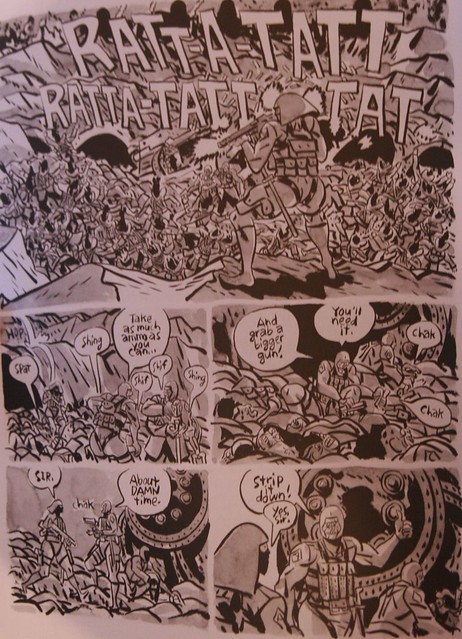
Since the first pages of this comic it is clear: we face something big. We see grandeur of sweep of the author at least in an increased size of the book and in panels on half a page. The choice of larger format allows the author to draw a giant canvas and the reader to closely examine the content of a page.

«Death-Day» is so pure sci-fi, where it is unclear whether action takes place in our world of future, or on another planet, or in a parallel universe, or all at once, because one does not negate the other. Already in the prologue (and the book besides the prologue made of four chapters - "episodes"), we see a huge battlefield where the army of people and army of orbs (six-fingered monsters, they seems stupid, but taking a number) prepare to attack. Each episode is a separate story line, but closer to the end of the book crossing between subplots becomes clear.

In the first episode, despite its seemingly large scale, the action is mainly concentrated in the headquarters of the Earth officers, who command the earth's army, following instructions of the Mother-0, the computer intelligence. Attempts of officers in different ways to stop the advance orbs lead to nothing, the army of the Earth suffers a defeat.

In the second episode, the central in the book, the main protagonist is a cyborg, one-armed man, scarred, with a mental disorder. He becomes the new captain for the squad of six men, whose previous captain died under mysterious circumstances. The new captain is not very ceremony with the soldiers, telling them to forget their names, and instead assigning soldiers to call signs, ranging from the X-1 to X-6. Under the leadership of the mad cyborg squad hunts for the Black Orb. In the third episode their adventures continue, and in the fourth again we are transported for a few years ago, where the battle between humans and orbs is at full blast.

Art style of Sam Hiti in some episodes becomes the main weapon of the author, in others - the main drawback. In large-scale battle scenes, when in the large panels we're looking at crowds of people and fight with the monsters, when scenes appall with their greatness, and fighting people and monsters are so mixed together that sometimes it is difficult to understand who is who in this battle, made in black and white, viscous, the style of art of Hiti is his main strength. Our eyes bury themselves in the battle, and it’s possible that you can look at a panel for a few minutes. This style makes a world three-dimensional. Such a world does not need color, it in itself is dim, this world of death, war, world of men. If there face are shown in large scale, they are either riddled with pain, or thirst for death.
But in other episodes, where the panel contains small number of characters with no special actions, such voluminous style sometimes interferes with focus on the moment. Art blurs the single episode, so do not even always clear what is depicted on the panel. This, for example, prevents in the second and third episode to get acquainted with members of the military detachment: a soldier sometimes is too similar to another one.

«Death-Day» is a multi-layered work, where the emphasis is in world building, not in some kind of hero in particular. Hiti apparently hid several cats in a sack for the subsequent books in the series, but just the first book tells us much about the scale of author’s creation.

Pug


Derek McCulloch (writer), Greg Espinoza (artist)
Pug

Image Comics, 2010

Writer Derek McCulloch and artist Greg Espinoza do not hide in their afterword that the creation of this graphic novel was influenced by their passion for old black and white noir films. The story of former boxer, who quit the sport and forced to make a living by helping the bad guys, actually originated in the 30's of last century, but what even until the plot is striking because is the art of the book.

«Pug», as a film noir, is drawn in an old-fashioned black and white style. By removing all unnecessary, the authors brought their work closer to reality. In the novel there are no beautiful scenes, no broken noses in public, no girls undress in front of a hero, it all remains outside the page.

Jake lost an important fight a few years ago. At the same time his wife with his son left him, and a former boxer now lives with a stripper named Kitten, surviving on a one time job, then another. Drinking in a bar, Jake meets with one guy who is offering Jake a permanent job almost for free. Already at the first working day Jake realizes that the work is not dusty, but not of his type: with a blad man in glasses they go from house to house, knock out debts from gamblers. The pug does not tell Kitty about it: he is ashamed that instead of the normal work he received a dubious job of a muscle at a loan shark. Desperate, but not lost his conscience, Jake comes into conflict with his weasel-employer.

«Pug» is a generally very chamber story, you can count the players here on fingers, and the main action takes place inside Jake: Does he break under the pressure of circumstances, or not? What looks flimsy here it's flashbacks, from which we learn how Jake lost the fight that put the cross on the pug and why he still suffers from the leaving of his wife and son. Past is shown too messy, it has more action, and it does not allow us to see what's going on in heart and mind of Jake.

The pug, if not to take the episodes from the past, until the very end does not even use force, main battle is in his head. And the entire novel, in fact, says one simple truth: if you can, avoid a fight to the last. But if the time has come, then fight to the last. Do not lose in second time, as has already happened once.