Sunday, August 22, 2010

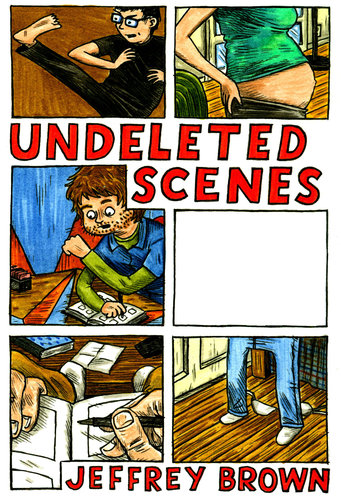
Undeleted Scenes


Jeffrey Brown
Undeleted Scenes

Top Shelf, 2010

«Deleted scenes» is called the not included in the film his segments, but are available as a bonus on the DVD. Jeffrey Brown, which American critics call indie comics legend and the genius of autobiographical comic books, named his 350-page book of his best works "Undeleted Scenes", very clearly identified the format. It consists entirely of fragments, pieces, which gradually set in a mosaic, although the fragments seem to be of quite different sources. The general is the life of the author. Besides the title refers to the fact that the fragments are not to be disposed of: some of them are the quintessence on two pages of what might have taken at least 50 from the other.

All the scenes are drawn by Brown himself and quite simple: black and white drawings, only the black lines on white. Technology changes a little throughout the book, but not much.
Brown wrote about that takes place in the life of twenty-with-something year old: the memories of childhood, meeting and parting with the girls, comic books, baby birth, work in the shop.

The book is quite funny: Brown the author puts Brown the hero in absurd situations, making fun of himself. Brown succeeds most in long fragments. In «Don` t Look Them In The Eye » lyrical hero becomes a victim of beggars, tricksters, boor shoppers, street madmen due to his naivety. He is fooled, he wonders, thinks, but in the end not much regrets that he is fooled by all those men who wanted to. «Every Girl Is The End Of The World For Me» is a memoir about girls of the protagonist. At Christmas, Brown manages to tighten almost all of his girlfriends at once, and not finding out who suits him more. Brown the author chose an ingenious method to show the inner world of Brown the protagonist: each of his girlfriends is a mirror to the protagonist himself.

What needs to the book, that is the button "Del": some stories could be removed, they look quite clumsy (it’s the title of one of the previous Brown’s books).
It is not always exciting reading, but here as with life: how it had not been sometimes bored, but nothing could help.

Werewolves of Montpellier


Jason
Werewolves of Montpellier

Fantagraphics, 2010

Artist and author of no less than a dozen graphic novels Norwegian Jason in his work almost always uses the same scheme: a lonely and somewhat suffering hero lives, dying of boredom, a woman who seems not with the hero, but always has feelings to him, hidden under the animal skin (all Jason’s heroes are personified animals), their meeting, longing. The author seems not enough satisfied with just drama (rather melodrama), because of that he always makes his short novels thrillers, adding criminal component. At this time, the werewolves are called to stir the surface of the novel.

Boring hero that does not dissolve in a haze of uneventful life (though later he explains that it pushed his case from his youth), at night changes into werewolf and travel on the roofs of houses, climbs in the window, plundering tenants. Werewolf mask serves him like a cover and a scare track just in case, if the apartment owners suddenly would catch him for the crime. After one of the burglaries his picture, where he jumps from roof to roof falls in the newspaper. Fake werewolf did not think that the city has a clan of real werewolves that do not welcome the appearance of an impostor. They ask the weary robber to leave the city.

«Werewolves of Montpellier» is a sad and even somewhat funny novel about the fact that loneliness is not hiding under the mask. Is this novel better or worse than other works of Jason? Probably not. Despite repeated methods in his books, novels are utterly worth reading. If you have a werewolf friend, buy him this book. If you don’t, buy two.

Wednesday, August 18, 2010

my interview with Lena Meydan


Lena Meydan is a bestselling author in her native Russia and won the Silver Kaduzei, the highest literary award at the Star Bridge International Festival of Fantasy, for her first novel. Her second novel, Twilight Forever Rising (translated by Andrew Bromfield), won Best Urban Fantasy for 2000-2005 by the 13th International Congress of Fantasy Writers in St. Petersburg.

- Lena, your novel, which is scheduled for September 2010, is about vampires. Do vampires in Russia differ from Western ones?
- Twilight Forever Rising will be released by Tor on September 28, 2010. This is a very multi-faceted novel and, I would say, multinational as well. Vampires have been living for centuries and, like people, change their place of residence, moving to different cities and countries. Little by little their community becomes very international. For example, the head of one family is a Greek woman who lived in the days of ancient Greece, the head of another family is a Marcomanni (Marcomanni lived on the territory of modern Germany), the head of the third one is a Gaul (Gauls were the ancestors of modern French). There are Italians, Irish, British, Arabs, and Bavarians, Czechs, Japanese, Swedes in the book... I travel a lot. I try to observe people in different countries, their behavior, temperament, read books about their history and culture. All of this is reflected in the novel as far as I could understand different people, different nations and their history. And, of course, I did not forget the Slavs. One of the vampire families in the book have Slavic roots and live an ancient Slavic way of life. I based them on the symbolism of an ancient Russian folktale "Ivan Tsarevich and the Grey Wolf". Even the head of the family is called Ivan.

- Can you define what kind of fantasy it is?
- I think it is vampire urban fantasy; maybe romantic urban fantasy. I think critics might be better at answering this question. Especially as I have heard repeatedly that with all the romance and lyricism inside the book, it has the features of a mystical thriller. It is an epic saga.


- Vampire fiction has flooded the fiction market. Are you afraid that your novel might get lost among the abundance of "bloodsucking" literature?
- There is a proverb "nothing ventured, nothing gained." No, I'm not afraid. I wrote about what I'm interested in and tried to make the book enjoyable enough so that it can be read many times. I, myself continue to be interested in the world of my novel and, of course, it’s my hope that readers will feel the same way.


- The fourth novel in series will be coming out soon in Russia. Will the whole series be published and translated into English?
- The fourth book is coming out in Russia on August 30, 2010. I hope the whole series will be translated. Of course, this depends on the audience’s reaction. So far, critics’ reviews have been positive. Remarkable authors Nancy Kilpatrick, Sherrilyn Kenyon and P.N. Elrod provided blurbs, which will be on the cover of the book. And now the translator is working on the translation of the second book in the series.

Twilight Forever Rising will be released on September 28, 2010 by Tor.

Wednesday, August 4, 2010

Shambling Towards Hiroshima


James Morrow
Shambling Towards Hiroshima

Tachyon Publications, 2009

A successful b-movies star Syms Thorley is at the peak of his career: he stars in films with such titles as "Corpuscula", "Lycanthropus", "Curse of Kha-Ton-Ra" and their many sequels, writes his own script, which is already predoomed to success, and generally has fun life. Hollywood is Hollywood, but that is the early summer of 1945, Japan still resists in the Pacific Ocean, but the military plans are maturing how with minimal losses to end the war. For plan realization they need someone who knows how to convincingly play in the costume of the reptile. This is Thorley. After listening to a plan of U. S. Navy, Thorley could not believe his ears: there is a secret project that America wants to use to intimidate the Japanese without using nuclear bomb. A team of U.S. scientists raised in the laboratory dragon-like terrible lizards, like Godzilla, to release them on the Japanese cities. However, the reptiles were not dangerous than kittens, besides they don’t live long. The plan had to be adjusted: in a secret hangar an exact copy of one of Japan's cities had been built, the delegation of embassy had been invited, and the role of the lizard would have to play Thorley, especially for him the suit of mighty lizard had been stitched. According to the plan Thorley with stage effects would destroy the city to scare the ambassadors so that they would run to the Emperor to beg him to stop immediately the war to save innocent people from the giant reptiles.

If in retelling it looks just funny when you read this book this is very funny. It's not just an ability of Morrow to construct convincing despite its seemingly absurdity and impossibility plot, but that’s Thorley himself. That b-movies star jokes as good as Chandler’s Marlowe, besides he has a dig at Hollywood celebrities of that time (cinephiles will get a special pleasure), Thorley is witty and resourceful.

This brilliantly written short novel has, it seems, only one flaw: for all his playfulness and irrationality, Thorley is too contrite. But without actor's contrition this book which is the longest suicide note in the world as well wouldn’t appear.

Bearings


Gary K Wolfe
Bearings

Beccon Publications, 2010

For nearly 20 years (he began writing his column in 1991), Gary Wolfe is a permanent reviewer of "Locus". In his columns he usually writes about three or four or five books (such reviewing policy is set by the magazine), often finds in even the most dissimilar books something in common, any link. "Bearings" is his second collection of this kind. In the more than 400 pages volume contains his reviews written for “Locus” from 1997 to 2001. In the introduction Wolfe notes that he excluded from the book “year in review” columns, reviews of annual best anthologies, as well as small-circulation academic books, which is now difficult to obtain.

Whoever he wrote about, Wolfe always seeks the roots of modern science fiction writers in science fiction writers of the past, of "Golden Age", "New Wave” etc. He's very good at reviewing classic SF: the critic can not only praise covered with dust and sometimes outdated prose by Sturgeon, Bester, CM Kornbluth, William Tenn, but also give them a place in history, knowing that what was written 70 years ago can not be evaluated as well as what was written ten years ago.

He is equally good at reviews on both the author's collections and novels either. When reviewing the novels he is less than Clute absorbed with plot descriptions, digging deep into the problem, wondering how would a novel look after 5 years, and is there anything to expect from a writer in the future.

Wolfe prefers science fiction to fantasy; he is interested in hard SF as well. Among his favorite writers (judging by the number of reviews, attributable to the writer) are Le Guin, Elizabeth Hand, Sheri Tepper, Baxter, Greg Bear.
If Clute in his reviews builds Baroque performances, Wolfe rather is called a realist: he is persuasive, keen-eyed, trying to be unbiased.

"Bearings" is hardly a guide to all the attractions of fantasy and SF during five years, it is impossible to write a monthly column about all, besides that we need to consider the taste of the critic, but weak books among reviewed in this book almost did not appear - that's for sure: Wolfe simply does not spend their time on them.

Perhaps, there is not enough eccentricity in his text (sometimes reviews are too smooth to be interested), but it already can be attributed to his manner of writing.
That's 20 years of writing about the same theme in the same venue - and Gary K Wolfe didn’t write himself out. It needs a great talent for that.

Occultation


Laird Barron
Occultation

Night Shade Books, 2010


Laird Barron (“Occultation” is only his second book) have already been christened a successor of Lovecraft and the most promising writer in the horror genre. Barron had managed to get shortlisted for genre awards, won genre awards, and published his stories in year’s best anthologies. Is this good author's collection (three stories here original to the book)? Absolutely. Is this good horror collection? Not quite sure. Here's why.

Among nine stories and novellas in the book, the most powerful seem «The Forest», "The Lagerstätte", "Mysterium Tremendum", "The Broadsword" and "- 30 -. It is rather novelettes, and this is their advantage. When the Barron has enough room to display his talent, he is much more skillful and accurate. In these five stories the author can create such a dark atmosphere that even if you read this book during the day, always seems that now it is night. These works have the same features: extremely morbid attitude of the heroes of stories with the world. If the other stories in the collection, "Occultation", "Catch Hell", "Strappado", "Six Six Six", nightmare creatures (and sometimes they are hard to be named creatures - just something ghastly) appear as if suddenly, that all horrible, inexplicable, inhuman comes from outside, creating in some sort of surprise, in the already mentioned 5 other stories the beyond has no need to come from nowhere - it was as if baked in the system of the world according to Barron. And this creates an atmosphere of hopelessness and doom much stronger. In «The Forest» cinematographer comes to the forests of New England, where discovers that his fellow scientists conduct bizarre experiments on insects. All the time, while Partridge is in camp with friends, Barron describes as a viscous drowsiness of cinematographer, from the first pages you realize that something inexplicable, daze is already embedded in the genes of the story. And to survive, you need to change the cover. In "The Lagerstätte" woman loses in an accident her husband and son. Her life becomes a phantom: she goes to a therapist, trying to extricate herself from the depths of the memory of the victims, but the memories again and again pounce on her. Son and her husband return to her, and the woman does not know who they are and who she is now. "Mysterium Tremendum" (aka Black Guide) is a book a few friends find in a shop. It describes the strange places of the district where guys live. A wild journey of two gay couples turns into a nightmare. The old man and a resident of the hotel "The Broadsword" once lost a friend in Vietnam. He was not just killed, he had a something worse - he was kidnapped. The old man does not know, but guesses that kidnappers were not human. Tormented by not being able to save a friend many years ago, the old man lives as in delirium. Up until the victim's friend comes to visit remaining in human form old man. Even those stories that seem to be less strong as the stories are well-plotted.

Barron is also a very skilled stylist, also with brisk dialogues. Sometimes speech of the characters seems fake, but nevertheless you realize that people in principle say that way.

Repetitive elements fly through most of the stories: masks, doctors, dead children, young couples, worms. Attractiveness of Barron’s prose in the fact is that he never shows the thoughts of his characters. Heroes are absolutely transparent. It is ideally suited to the type of prose the author creates.

Why as a horror collection "Occultation" does not fully work? Laird Barron is a very talented writer as a realist. His prose is palpable, accurate in detail, even realistic, if I may say that about horror. Even the beyond in his stories so firmly encased in the reality that they do not contradict each other and make a whole. Is a horror story capable now to scary someone? I do not know. Not me. Besides that, the collection has another flaw, very serious. Novelettes and stories in it are generally very similar to each other. They are plotted on the same principle. Because of that the book is hard to read from cover to cover.

After «Occultation» it will be hard period for Laird Barron. If he does not create something new, doesn’t go to another level, it will be very good, but the repetition of the old. For the writer there is nothing worse than this.

Friday, July 16, 2010

Red Planets


Red Planets: Marxism and Science Fiction,
Ed. by Mark Bould and China Mieville


Wesleyan University Press, 2009

In this book with the intriguing subtitle "Marxism and Science Fiction" equal proportions between the constituent parts of it still are not observed. And whether it is good - for the book and the reader - can not be answered unequivocally.
Eleven articles plus, the musical language speaking of, the intro and outro from the editors of the book explore the theme of relationship between Marx's theory and the actually science fiction with varying success. If Marx's works appeared in the middle of the XIX century, the critical thinking of science fiction through Marxism got its start a century later, in the 60's of last century. The founder of leftist approach became the most influential SF critic Darko Suvin, which, in general, is mentioned in every article of the book under review.

The theme "Marxism and science fiction" is treated by each of the authors in his own way, so one way or another both subthemes of the book varied. Thus, science fiction in the book is an example of not only the classics, but also more modern authors of SF, with examples from film and even painting. This, of course, is the step towards the reader: one who knows little of the cinema will grasp the meaning of articles which subject is literature, the one who knows little in the science fiction books, may be happy to read articles about the movies.

Another fact that causes a double sense is that critics, scholars, academics, presented in the book, for his articles selected examples known to everybody. If this is cinema, that is Lang, Kubrick, Wilder, Wenders. If this is literature, that is Disch, Stross, Le Guin, Stanley Robinson, Verne. On the one hand, it helps better understanding of articles: it is always easier to understand that once looked \ read himself, not relying only on the retelling of critic. On the other, it seems to say about the narrowness of the range considered works by critics, about their non-wide reading \ non-wide watching.

The article’s authors, despite the Marxist approach, seem to feel that reliance on only left-wing critics is not enough, so almost every article calls for help Zizek, Lyotard, Badiou, Adorno, Althusser, Lacan and others.

Among the number of articles of the book suddenly greatest interest is provoked by those that focus on the relation of Marxism and film, not literature. Thus, Carl Freedman in his article compares the film noir with the SF films from the viewpoint of Marxism, and names an exemplary film showing a perfect blend of noir and science fiction not Blade Runner nor Alphaville, but Dark City by Alex Proyas. A detailed analysis of criticism in the Weimar Republic is presented by Iris Luppa in «"Madonna in Moon Rocket with Breeches": Weimar SF Film Criticism during the Stabilisation Period». She discusses the attitude of German critics of the early films by Fritz Lang and shows that politicized film criticism of those period still did not know what to demand from cinema, looking to the future, hence not a warm reception of Lang`s films. John Rieder found the Marxist roots of Wim Wenders in his "Until the End of the World", noting pronounced themes of colonialism and technology in this film.

The book, of course, for its better understanding demands from the reader acquaintance with the works of many philosophers, not necessarily left-wing. Without that not a simple language of book’s articles can become an insurmountable obstacle to make the book read on. The book was published by university press, so this should be expected.

Once again returning to the cover of the book and its subtitle, it has to be admitted that Marxism in the book was still more than science fiction.

Canary Fever


John Clute
Canary Fever

Beccon Publications, 2009

No need to explain who John Clute is. He is known for his Encyclopedia (new edition of the Encyclopedia of Science Fiction which will be published online), critical works and reviews. Actually, reviews made this solid, more than 400-page volume. «Canary Fever» is the fourth book of this kind By Clute. In this edition, he collected his reviews as from 2003 to 2008, written primarily for online magazines, as well as older ones.

The book is divided into 5 parts: three of them were brought to the reviews of individual writers important for the author - Thomas Dish (who the book is dedicated to), John Crowley and Michael Moorcock, and one, only 8 reviews, is compiled from old reviews, which were not included in previous books; a main body comprised reviews of recent years.

In almost every review Clute invariably mentions two of those key words around which criticism of Clute is built. These are fantastika and Story. Once invented a term “fantastika”, he remains faithful to it, always picking works for review so that they could illustrate the viability of the term. Sometimes it seems that the author too flirts with fantastika, giving the term too much room in the review, as though he has nothing to say about the actual book.

Story is generally supporting structure of his reviews. Clute skillfully retells the stories; sometimes his scale in the description of the book is amazing. Retellings of some of the books look more solid and weighty than the books themselves. In his reviews he gives the comparison with films, classical literature and even opera. I can not say that he encourages them to help because he had nothing to say. He always has something to say about the Story, and he knows how to say that. Sometimes written by Clute requires has not yet written Clutish vocabulary to understand. His style is baroque, but behind it there could be always seen how story is unfolding- Story of review.

Moreover, the critic in his reviews had managed to create a tower of Babel of the dozens of languages. However, the tower is not falling apart, and serves entirely to Clute. The critic uses words from different languages not to display his encyclopedic knowledge, but in that case, when the English equivalent is not required. Encyclopedic knowledge helps him in catching errors in academic books, though.

The critic can be blamed for his passion for space opera and British authors. Both reproaches are not solid: space opera (those examples selected by the author of the book hardly anyone calls weak books) allows Clute display hi talent fully, stretching Story to cosmic proportions. But American authors in the book, perhaps, are not less than the British (and British reviewed books are of the highest grade).
«Canary Fever», perhaps, isn’t a guide to the reader for the stated period (there is also quite mainstream authors and small press, important figures in science fiction), but I doubt that the author set himself this as a goal.

This Clute’s book, despite the fact that this is not fiction, is a Story.

Sunday, July 4, 2010

Temperance


Cathy Malkasian
Temperance

(Fantagraphics, 2010)

In the first, the shortest, part of this long comic story a man with a very angry face chops down trees by huge ax. He is watched by the two girls, one small with bulbous nose, the second higher, reminding, have put her on the pages of a fantasy novel, a princess of distant kingdom. Little, whose name is Minerva, names a man Pa, the high one says that he is not their father. Soon, Pa beckons to Peggy, the high. Instead of talking on the souls Pa shows the power and, it seems, just about rapes his own daughter. But a traveler in a straw hat, appeared from somewhere, prevents it. The girl hides in the woods, and Pa and wanderer begin to beat each other. Pa however cuts down the defender and makes her daughter to cut off the traveler's leg with an ax. She refuses, and then Pa himself does it, leaving the girl with a young man lying in a pool of blood. All the rest of the book the two of them will play the loving couple: a young man loses memory.

Malkasian`s book contains all the variety of genres. This is quite a traditional fantasy (queen, clans, the expectation of war), and not quite a traditional fairy tale, and sometimes physiological sketch, and surreal painting, and even the kind of superhero comics (Pa here is just as the chief villain). Painted in two colors, the story of most of the book unfolds around the castle, where some people, whom Minerva, one of the daughters of Pa, leads by the nose for decades, live. She also hides from her husband Lester, an amnesiac, how he got into the castle. He does not remember anything and silly runs around the castle at night for the birds, considering them enemy spies.

In the final part of this graphic novel Malkasian seems, like Minerva, which had lost power over the husband and the city, lose the thread of the story. In the end without much logic, the author mixes Pa, Lester, who comeback part of his memories, missing Peggy, trees, birds, wooden doll, so you have to ask yourself: why then were two previous parts needed?

In the end Cathy Malkasian doesn't have enough madness to make the novel truly psychedelic, as well as lacked the ability to construct the plot. It would be a significant book about lies, self-destruction, pervasive evil, but it became just a fairy tale about how dangerous is sometimes to interfere in one's affairs.

Black Water Rising


Attica Locke
Black Water Rising

(Serpent`s Tail, 2010)

Black lawyer Jay Porter who has not enough the money arranges for his wife a short trip by boat across the bay near Houston. Jay himself doesn't really like this night aquatic journey, but it is the most affordable and cheapest option of a small gift for his pregnant wife. Three of them: Jay, his wife and the captain, they slowly wheel through the waves, while a serene rest is not interrupted by the sound of gunfire on the shore. Porter, who grew up in not very affluent neighborhood, knows that it is better not to get involved, especially with having a pregnant wife. He tells the captain to not pay attention, but his wife insists that Jay interjects: someone's life is in danger. Soon they hear the cries of woman and see how a white woman jumped into the water. Porter swims toward her and pulls out of the water. Woman is scared and says nothing. They float on, then moor at the town and decide to take a woman to the police station. Jay drops off the woman at the door of the site and leaves without knowing whether she had gone inside. He thinks he will never see her again.

It would probably be too easy, to stop by on only one of the storyline, but Locke gives a reader not just detective, she worries more of social problems. The father of his wife, the Rev. Boykins, asks him a favor: black workers from the oil companies want to strike until they get the same rights as employees with white skin, so Jay is required to put in a word to the mayor - a girl with whom he had once was close. Jay hesitates, but eventually agrees. However, troubles will be there as well.

Looking at a short retelling of the beginning of the book, you can immediately assume that such a novel would never have written by Russian writer, but also because a number of features there wouldn't be too close for Russian reader. First of all, the protagonist is a lawyer. Secondly, the main character is the Negro. (This combination has already seems impossible, not for nothing that one of the characters in the novel, finding out what Porter is engaged, looks at him and asks: Black lawyer? "- And puts his into the house as if it were a double proof of lawyer's honesty.) Thirdly, racial theme dominates the novel. However, the two layers - crime and race - do not overlap, do not pull the blanket, but supplement each other, making the intrigue multi-faceted and tenser. Chapters alternate: Jay unravels the case of the woman he saved, and helps father-in-law, parallel recalling his first trial: the one where he was nearly sent to prison and the one where he himself stands by counsel.

Despite the fact that the action takes place in 1981, this is also a very modern novel. One can not say, is it plus or minus for this book. Oil, confrontation single man and large corporations, the power of lie - all this makes the novel very urgent. But Locke is not quite able to catch the spirit of that time. If not the figure in the beginning and an example of a real strike, we would have nothing to point us that the novel is set not in 2010. There are no such clues to the level of language and psychology at the characters.

Attica Locke managed to write a very smooth novel: the style is closer to the end does not become crumple and clumsy, there is logic in the behavior of the characters. Though in the end the plot begins to limp, the level of "black water", according to the title, rolls over, but it does not spoil the general impression.

James Ellroy on the cover of the book says it is “the best bad town novel in some time”. It's not quite true: the city in the book plays not the last role, but the main is still people. This book is about how a good man in a bad town remains good.

Sunday, June 20, 2010

2 chapbooks from Nightjar Press


Michael Marshall Smith
What Happens When You Wake Up In the Night

Tom Fletcher
The Safe Children

Nightjar Press, 2009

A small British publisher Nightjar Press publishes small chapbooks. They are published in a limited edition of 200-300 copies, so you have to grab it as soon as possible. The two first authors, who opened the series and the work of publishing in general, became Michael Marshall Smith (needs no introduction) and Tom Fletcher, whose first novel will be published this year.

Since the book contains only one short story, to say something intelligible about the stories can only be, one way or another, told to readers some important moments of the narrative. So I can`t do it without spoilers. For those who believe spoilers are necessary evil and will not read any further, we can only say that these are two very strong story, but the stories are not something that would goose-on-skin-horrible (although the book publishers still are drawn towards horror). Which one is better? Both are good, you can easily buy both books.

For those who are not afraid of spoilers, we continue. The main theme of both stories is children. In Smith's story the protagonist is a little girl, the protagonist of Fletcher`s one lost his son. Smith has written fantasy, Fletcher - science fiction.

Maddy, still quite a child, in Smith`s story wakes up in the middle of the night. She is afraid of the dark, so she sleeps with a light. They agreed with her mother: Maddy sleeps with the light on, but if she wakes in the night, the girl can go to the parents' bedroom only if it is absolutely necessary. At this time, waking up, the girl discovers that the night light is off and thinks that her mother had violated the deal and turned off the light. Maddy wants to go to the parents' room to say that the mother had violated the deal. But the girl is not succeeding in that: in the darkness she can not find the door. Solid wall and there is no trace of a doorknob. After some time girl`s mother wakes up, hearing her daughter rustling. Mom said that Maddy has violated the deal by going to the parents' bedroom. Maddy also blames her mother that on the contrary, she has violated the deal, turned off the light in the Maddy`s room.

The contract did not violate anyone: the father, the mother and the girl woke up all in one room on the floor, where there are no windows, doors, cold and dark. Maddy's parents tries to understand what is going on, going past the walls in search of doors or windows, but no exit.

Smith, a superb stylist, shows excellent speech and thought of a girl, when she just wakes up in the middle of the night. She is capricious, rely more on imagination than on rationality; just such a silly. At the end of the story not a children's sadness, the bitter realization that nothing will change either today or tomorrow shows up in her thoughts, in the tone of her voice. So Smith alludes to the fact that the girl has managed to grow up, so long the three of them are in this room (they do not feel hunger, but the room is still cold and dark).

«What Happens When You Wake Up In the Night» is not only a sad story of hope and despair, but the lesson with a fair amount of author sneers: better to sleep, closing with a blanket and putting his head under the pillow.

Fletcher is more serious and concerned about the social implications. James gets on the train to go to work. Along the way he remembers his perished son. Looking during a trip to a futuristic landscape, he also recalls a line from a once read fantastic story: "Where are my safe children? Where is my flying car?" Indeed, James feels that the future has already arrived, but he still gets a train, and children continue to die. At the new place he is met by the administrator, who explains James' duties. They are a bit unusual: all that is required is just to sit in the lobby of the factory and once a week to check arrivals, checking their names with the database. The rest of the factory is fully automated. James is surprised, but agrees to work. Administrator is to leave for home, leaving the hero alone with the empty hall and a computer.

Fidgeted for some time of boredom, James suddenly hear sounds similar to the steps, and then cry "Daddy!" from the wall. James totally terrified and immediately calls the administrator who has left. Administrator arrives and opens a mystery of the factory to James: in its walls children, certain robots are produced, so similar to humans, that James with a long time does not believe that they aren't alive though the administrator says so. Why did the factory produce these little boys? The truth almost knocks James off his feet: children are sex toys. They were specially produced for rapists and pedophiles to secure real, living children. The administrator assures that children are robots and feel nothing. They look like real, but still not real. But they are crying, James` trying to say something. “Go home, administrator replies. And come back tomorrow.” And James leaves.

He received his safe children, thanks to robots. Children of flesh and blood must now be safe. But is this that security he dreamed of? Why the boy robot is called him Daddy?

«The Safe Children» is a story that does not leave even a robot indifferent.

VARDOGER


STEPHEN VOLK
VARDOGER

Gray Friar Press, 2009

Young couple, Sean and Alison, comes to the Shewstone Hotel to spend the weekend in each other's arms. However, on arrival the first dislocations start: Booked room was paid for the previous weekend, as Sean and his wife were in the hotel last weekend. Solving the problem with room and with a credit card someone used without the knowledge of the owner, a husband and a wife finally overrun in the room. But the annoying things continue to hurt Sean: staff of the hotel and local guests treats to him as if they met him before and knew his habits. Sean gets angry and categorically stated that he had never been in this hotel. These little things could not spoil the rest, but the very next morning after his arrival Sean looks out of the window his wife goes by the handle with a certain man. The stranger turns around, and Sean sees that Alison goes with anyone else but with someone so similar to him that Sean understands that this is he.

Volk, not only a novelist, but also a screenwriter, makes good job with a plot, confusing it no worse than a cat playing about with a ball of yarn. Is the kidnapper of Sean`s wife his counterpart and who`ll gave a clue, we do not know until the last pages. The author managed to hold down the hero in the grip so feeling of madness climbs from the pages of novella. Sean, confused and mix-uped, can not trust anyone and he is one on one with himself. But is he alone? And who is he? He`d want to know, too.

The Norwegian word «vardoger» will not appear on the pages of the book. Sean probably does not even know such a word, but if he knew he would doubt: who of the two of them, he or his twin, are the vardoger?

Volk, succeeding in creating a nearly ideal atmospheric thriller, in the end cheats so much that in a card game for such deception he could get it in the neck. Artificial end like a patch on the new trousers slurs over the impression from the story. Nevertheless, the book asks an important question: are we who we are? And the writer answers: vardoger knows.

Thursday, June 10, 2010

Black Static #16


Black Static #16
TTA Press


Jonathan McCalmont, reviewing this issue of British magazine devoted to horror in all its aspects, tries in a few paragraphs to disguise the fact that one can say just two words: all the stories in this issue are crap. Clearly, McCalmont does not want to offend the creators of the magazine, that`s why he invents numerous theories that justify its reluctance to call a spade a spade.

Have read the issue, I can not agree with McCalmont: stories, consisting the number, are not shit (well, OK, one of them is really is), but really pretty good.
Before we start with the prose, there is worth saying a few kind words to non-fiction section. Peter Tennant and Tony Lee are as always inclusive, generous in word and accurate in the estimates.

The issue is opened with one of the most powerful stories, «The Overseer» by Tim Casson. In his story, coincidence faces fate, despair faces faith in the best and the ability to watch faces the ability to see. Darius, who could become rich and not work until the end of his days, did not listen to wise advice of his father, wanted to commit suicide, but eventually had enough to eat pills and drank whiskey and passed out. After waking up there is no question about any wealth: for a living, he and several of his friends work in a kind of plant under the supervision of a mysterious man in a mask of a jackal.

The described time and place may resemble the early twentieth century London, but if the capital of the United Kingdom in the story is mentioned, we can only guess about the time. The atmosphere in the story is very gothic, dark, ominous. The main character feels doomed long before something happens with him. Due to the unforgettable atmosphere Casson managed to create a strong story about that is not horrible when you are watched, but it`s more terrible when you watch himself.
The story by M. J. Preston is much weaker. His «Extreme Latitude» is a diary of one of the scientists at the station, located near the North Pole. He feels lonely - and tends to become more self-absorbed. He almost can not go from the station and, eventually, begins to hear a strange noise.

This story is too cold, like the scene of action, and scientists are too plastic to empathize at least someone in the story, it`s like a diary written not by man, but cookies auto-filler.

«One Last Wild Waltz» by Mike O`Driscoll could won, put the author the fantastic element aside at all. The narrator's brother dies and he goes to brother`s funeral, but rather because he wants to see the wife of the deceased, since a youthful years he didn`t lost love to her. But even after the death the deceased shows his bad character, not giving lovers to live peacefully. Characters are described with affection and precision, but because of the horror element of conjecture at the end of the story, the whole composition seems rather far-fetched. It spoils the story, but not enough to just admit his failure.

Alison Littlewood`s story turned out lyrical and persuasive one. In her «The Empty Spaces» protagonists, two widower, live in their old age years in one house. One of them, Laurie, at the doctor says that he saw Marilyn Monroe in his room. His neighbor and the doctor suggest that Laurie has Charles Bonnet Syndrome: when due to poor eyesight brain itself fills the rest of the picture his eyes do not see. Laurie does not agree: it seems to him he really sees things that are actually there.
Despite the fact that one hero of the story has poor eyesight and the other - hard of hearing, the author`s hearing and vision is good: Littlewood wrote quite an original story which has almost the perfect rhythm and a very smooth writing. The best story of the issue.

The issue turned out good, if we assume that more than half of the stories in it is successful.

Friday, June 4, 2010

We Never Talk About My Brother


We Never Talk About My Brother
By Peter S. Beagle

Tachyon Publications, 2009

If someone begins to tell you about the death of the short story, show him this book as a living proof that the story, genre or not genre, it does not matter, is alive and well.

In this collection, Peter Beagle, known more for his fantasy novels, presents nine new stories, each of them deserves the highest praise.

Starting collection with the most powerful story is a two-edged sword. On the one hand, knocking down after reading the first story, you certainly want to read the entire book, and the sooner the better. On the other, moving lower and lower in content, feel some bitterness - the other ones fail to reach the level of the opening story. Beagle broke the sword: his story «Uncle Chaim and Aunt Rifke and the Angel» which opens the collection are the best, but if the remaining eight ones inferior to it, then not too much. At the very least, a sense of frustration does not arise. This story tells about the childhood of the boy whose parents leave him with his uncle and aunt. Uncle Chaim is the artist, and the boy all his spare time spends in his studio, watching as his uncle paints. One day, when the uncle works on a portrait of the wife of his friend in his studio an angel shows up. This is a woman, and she requested that Chaim paints only her and nobody else. His uncle is stubborn at first, but then agrees, despite protests from his wife. Angel is a perfect poser: she does not get tired and all day can sit in the same position, she does not need to eat and drink. But the boy's aunt Rifke still feels that something is wrong with this angel: the angel knows almost nothing about the life on the earth, but she is silent about life on the heaven. The aunt with Rabbi reveals the secret of the mysterious angel.

The narrator, a little boy, is largely Beagle himself , what he acknowledges in the preface to the story, because it is based on the memories of the author about his childhood in New York. And this is the boy, and not Uncle Chaim, Aunt Rifke or the angel, who in the final pages makes the reader wince. This audacious in its precision and accuracy in drawing the characters, and simultaneously very touching and melancholy story of humility and self-sacrifice.

Children but those who had matured became heroes of the second story in this collection, which gave the title to the entire collection - «We Never Talk About My Brother». Older brother Jacob and his sister no longer mention in the conversation of younger brother Esau, after one case in their childhood: little brother warns his abuser, that he would run off the car. The next day it happens. The path of Esau in his life was easy. But his older brother also has its own secret. A strong story about, it may sound corny, good and evil, where the worst is that good and evil are always brothers, one blood.

«The Tale About Junko and Sayuri» occurs in Japanese set. Junko hits the otter, after recovery, a beautiful girl. The former otter Sayuki and Junko marry, live happily and would live so always, if not envy of Junko. Slim and graceful story.
In the «King Pelle the Sure» King unleashes a war with hiss neighbors just for fun. This leads to dire consequences for him and his country. Anti-war story in which the humanistic message does not hurt the eyes.

In «The Last and Only, or, Mr. Moscowitz Becomes French », perhaps, the strangest story in the collection, ordinary man, whose native language is English, loses his "Englishness" and becomes - becomes a Frenchman. That's only he does not see anything French in other Frenchmen.

The easiest tale in the book turns out «The Stickball Witch». Boy games on the street often have not the most pleasant consequences: the ball for the game in stickball accidentally flies into the courtyard of one woman, long rumored that she was a witch. The witch, however, shows himself to quite unexpected side. It is more realistic story, but the atmosphere created by the author still makes change your mind in the direction of fantasy. (If you have not yet felt a sense of humor of Peter Beagle, the title of the story should have been convincing you in his presence: it sounds funny, “The Stickball Witch”, doesnt` it?)

The final in the collection are «By Moonlight» and «Chandail». They are, perhaps, too monotonous and verbose. «Chandail», taking place in the world of Beagle`s novel «The Innkeeper` s Song», so deeply dives (the story takes place into the sea) in the theme of memory, describing the fear of our past, that we have to hold our breath.

Beagle has shown himself not only a good novelist, but also the absolute master of short fiction. «We Never Talk About My Brother» means one thing: we wait for his new short stories.
Lady Churchill`s Rosebud Wristlet #24


Lady Churchill`s Rosebud Wristlet #24

The 24th issue of this small press magazine doesn`t seem to taste hard science fiction fans: in this issue they will not see any spaceships or time travels or people of our time in world of 5-headed lizards. Epic\s&s fantasy fans`ll throw up their hands (or winkle their noses): the descendants of Conan and the royal families can not be found in the issue as well. The authors of the magazine write strange and ordinary (but not trivial-and-boring) prose at the same time (we call it so to avoid the word “mainstream”), but with the addition of the fantastic - more fantasy - elements. Even if you read the story about the other world - it's like our world.
I called the magazine small wittingly: stories, filling the magazine, are too small in size. There are, unfortunately, weak stories, mainly flawed by the fragmentary, incomplete, and there are those that are good, like jokes, but to call them stories is difficult.

Among the unequivocal successes is «Dusking» by Liz Williams. Light and elusive tale, like a moth, which fill this story. The girl, who lives with his aunt, dreams about dusking, but her aunt is strict to her and she does not allow the girl much. But here comes a young man from the family friend, who can be trusted to go with her niece at the evening, and the aunt can enable her to go dusking. But this is a little girl, she wants to know the unknown. Amazingly beautiful - and somewhat terrifying - story about what happens if a person is a long time to be kept in captivity.

In quite another way, but with the same emotional, Jasmine Hammer works. She showed itself in the story «Tornado Juice» not only like a wonderful teller, but also an original humorist. The girlfriend of the protagonist of the story Kaiko has the most beautiful hair in the world. With this the narrator begins his story. More than that - with their help, wrapped a lock of hair around his head, he can travel between the worlds. Worlds, however, are all somehow a bad lot: in one of the worlds people are squat and hairy, with their very long hair trailing on the ground. In the second world there are no people, whereas in the third winds constantly blow and tornadoes occur. The habit of the protagonist to lock himself in the toilet comes to travel to other worlds, but as well can lead to not the best consequences for him. Briskly written narrative, which to the original idea adds more thoughts about the complexity of human relationships.

Weaker than these two, but, nevertheless, also a good story «Superfather» by J. W. M. Morgan continues the issue. The story, as true as indicated by the title, is dedicated to the father of the family. Dad is really an odd one: participate with a set of sculptures in the exhibition "World Peace", offers his plan how to survive after a nuclear winter to the president, can not talk to family members for months, and then for some reason makes the refuge in his workshop. The son of superfather watches extinction of his father, but do seem to do nothing. A sad story about fathers and children, and that not everything can change, and whether you want to change that?

This LCRW issue is worth reading at least because of these three stories.