Showing posts with label tta press. Show all posts

Thursday, June 10, 2010

Black Static #16


Black Static #16
TTA Press


Jonathan McCalmont, reviewing this issue of British magazine devoted to horror in all its aspects, tries in a few paragraphs to disguise the fact that one can say just two words: all the stories in this issue are crap. Clearly, McCalmont does not want to offend the creators of the magazine, that`s why he invents numerous theories that justify its reluctance to call a spade a spade.

Have read the issue, I can not agree with McCalmont: stories, consisting the number, are not shit (well, OK, one of them is really is), but really pretty good.
Before we start with the prose, there is worth saying a few kind words to non-fiction section. Peter Tennant and Tony Lee are as always inclusive, generous in word and accurate in the estimates.

The issue is opened with one of the most powerful stories, «The Overseer» by Tim Casson. In his story, coincidence faces fate, despair faces faith in the best and the ability to watch faces the ability to see. Darius, who could become rich and not work until the end of his days, did not listen to wise advice of his father, wanted to commit suicide, but eventually had enough to eat pills and drank whiskey and passed out. After waking up there is no question about any wealth: for a living, he and several of his friends work in a kind of plant under the supervision of a mysterious man in a mask of a jackal.

The described time and place may resemble the early twentieth century London, but if the capital of the United Kingdom in the story is mentioned, we can only guess about the time. The atmosphere in the story is very gothic, dark, ominous. The main character feels doomed long before something happens with him. Due to the unforgettable atmosphere Casson managed to create a strong story about that is not horrible when you are watched, but it`s more terrible when you watch himself.
The story by M. J. Preston is much weaker. His «Extreme Latitude» is a diary of one of the scientists at the station, located near the North Pole. He feels lonely - and tends to become more self-absorbed. He almost can not go from the station and, eventually, begins to hear a strange noise.

This story is too cold, like the scene of action, and scientists are too plastic to empathize at least someone in the story, it`s like a diary written not by man, but cookies auto-filler.

«One Last Wild Waltz» by Mike O`Driscoll could won, put the author the fantastic element aside at all. The narrator's brother dies and he goes to brother`s funeral, but rather because he wants to see the wife of the deceased, since a youthful years he didn`t lost love to her. But even after the death the deceased shows his bad character, not giving lovers to live peacefully. Characters are described with affection and precision, but because of the horror element of conjecture at the end of the story, the whole composition seems rather far-fetched. It spoils the story, but not enough to just admit his failure.

Alison Littlewood`s story turned out lyrical and persuasive one. In her «The Empty Spaces» protagonists, two widower, live in their old age years in one house. One of them, Laurie, at the doctor says that he saw Marilyn Monroe in his room. His neighbor and the doctor suggest that Laurie has Charles Bonnet Syndrome: when due to poor eyesight brain itself fills the rest of the picture his eyes do not see. Laurie does not agree: it seems to him he really sees things that are actually there.
Despite the fact that one hero of the story has poor eyesight and the other - hard of hearing, the author`s hearing and vision is good: Littlewood wrote quite an original story which has almost the perfect rhythm and a very smooth writing. The best story of the issue.

The issue turned out good, if we assume that more than half of the stories in it is successful.

Saturday, April 24, 2010

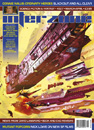
Interzone #227


Interzone #227 (March-April)
TTA Press


British magazine Interzone, which unlike its counterpart on the publisher Black Static, mainly focuses on horror and dark fantasy, specializes in science fiction, but does not hesitate to print fantasy.

Non-fiction part of the issue consists of book, DVD and film reviews, in my opinion, is weaker than non-fiction section of Black Static. Maybe it's the problem with that single issue, but it looks all pretty boring. Peter Tennant has some sort of depth and the extent, in Interzone, with all diversity, breathtaking polyphony does not arise.

With the stories all is much better. To failures - and at a stretch – there can be attributed only «Chimbwi» by Jim Hawkins, had once printed in New Worlds. Nice setting - Africans have learned to convert sunlight into electricity by 98%, but nobody told the secret, Europe and America are dying; black men are murdered around the world – was not turned into a cheerful story. An English professor hired by the people of Zimbabwe must participate in the construction of the second underground tunnel under Africa. He blames Africans in cruelty towards them, the Europeans, but Africans have an irrefutable answer: did you helped us in due time, when we were starving? The author immersing in African motifs did not benefited the action: instead, to make the hero look at the dying land, he forces him to play with the gods.

I have mixed feelings with the story by Nina Allan «Flying In The Face of God». Detail-written psychology of characters tries to win plot over to its side, leaving the story without intelligible plot and, consequently, any changes within the characters. Two women, Anita and Rachel, suffer from the fact that soon they will become separated: Rachel will fly to the stars, so her body she undergoes the necessarily procedure, so that parts of her body is transformed, as Anita will make a documentary about this story. It would be foolish to blame the lack of action to this women's drama (which in addition to that two friends have added to Anita`s mother and grandmother): it's not space opera, the title of the story still involves a flight. Besides the fact that the heroines yearn, think, talk to each other and read old letters, there is nothing more and nothing is assumed. But conflict in the end did not occur, so that all experiences and passions do not lead anywhere.

Chris Beckett takes in this issue sort of a joke: in his "Johnny`s New Job" the society judges employee of the Welfare, which overlooked a little girl - and she died. For that he will have to stake his life on, and possibly his child`s. The future of Britain's unenviable, but the writer smooths out the horror of the situation by satire and eccentric characters, and style compensates the expected ending.

Mercurio D. Rivera in his «Dance of the Kawkawroons» affects the theme of contact but avoids erased topics, translating it to another plane: greed and people's dependence on new technologies. Two astronauts on a planet meet with a specimen of another race, like a cockatoo, which just like the birds lay eggs. Because the eggs, which give a person superhuman capabilities, human beings kill the Kawkawroon and take the eggs. Drily written, but thoughtful story.

The opening story «The History of Poly-V» by John Ingold because of the title may not be immediately arouse interest, but actually turns out to be one of the gems. If any work addresses themes of memory, past and future, search for yourself - plus the important role played by drugs - that certainly Philip K. Dick comes to mind. So when with the reading «The History of Poly-V» - but if some writer could be compared to Dick, allowing his influence, it might be a good compliment to a writer. In the story a group of students by experiment ways find the new formula of the drug poly-V, and its effect is difficult to understand. It is difficult to the heroes to understand it too. They, to find out what is the effect, write in his diary all of his actions during the experiments with the drug. The reader will also need to write for understanding what is happening with the characters. The author did not immediately reveal all the secrets, and this story is very appealing.

Another gem in this issue is «The Glare and the Glow» by Steve Rasnic Tem. The author immediately offers an unusual combination: a story about the light bulbs narrated by the man who speak only with quotations and even thinks this way. Juicy and very skillfully written short story about what the darkness hides.

Perhaps, fiction part of Interzone looks more advantageous than the recently reviewed the Black Static issue one. Together they compliment each other.