Friday, October 26, 2012

Act of Fear


Michael Collins
Act of Fear

Open Road Media/Mysterious Press e-book, 2012
(originally published in 1967)

«It began with the mugging of the cop.
Person or persons unknown jumped the patrolman in broad daylight on Water Street near the river, dragged him into an alley, and cleaned him out. No witnesses. This is the lower west side, the Chelsea district, where alley windows are boarded up and people do not see what they’re not sure they should see.
We all knew the cop: Patrolman Stettin. He’s a young cop, Stettin, not long on the force and still eager. We all heard that he felt so bad about being taken that he offered to quit. That shows how young he is. Sooner or later everyone is taken in this world. This time the mugger took it all: billy club, pistol, cuffs, summons book, watch, billfold, tie clip, shoes, and loose change. The mugger was good. Stettin never even saw a shadow, according to the report I heard.»


What a beginning! Everything really began with the mugging of a cop, and in a few days private detective Dan Fortune is hired by a young client. Pete Vitanza, college boy practicing as a mechanic, can’t find his best friend, Jo-Jo Olsen, also a mechanic who is obsessed with motors and interested in Vikings. The boy did not come for work, and parents say that he had gone somewhere, but Pete feels something’s wrong and pays detective fifty dollars (big money for a boy), that he’d find Jo-Jo. Fortune thinks Olsen certainly has gone with some girl and will soon appear, but to appease the conscience, decides to fulfill the received fifty dollars and ask around here and there. Fortune guesses that either the Olsen mugged the patrolman or saw who did it, that's why he went into running. Detective looks for a fugitive for three days and have already decided to quit the case, did not find any clues, as in the alley Fortune is attacked by a burly man who threatens that Fortune should forget about Jo-Jo and mind hos own business. The big man is the father of a runaway boy, and it finally convinces detective, that something is wrong with the Jo-Jo case. Later the local mafia is mixed in the case, the blood will spill, and apart from the search for Olsen Fortune will have to save his own life.

«Act of Fear» is the first book in the series about one-armed private detective Dan Fortune, and this book will knock you down. Friends, whom Fortune has got not much, called the PI Pirate: nickname stuck after Fortune in his youth had lost an arm. He does not like to tell the real story, which is nothing to be proud of, often inventing new and new stories about losing his arm. Detective though does not feel flawed: in the text, he never calls himself disabled, and others do not attach much importance to the one-armed (in the novel, there is one scene where a dumb girl begins to laugh at one hand). Despite the absence of the left hand, the detective did not allow himself to be an insult.

Fortune is a loner, a soul who cares for all the downtrodden. He walks down the mean streets of New York’s Chelsea, and his way is hard. He himself is a child of slums and musty apartment buildings, he traveled around the world, but now he feels in Chelsea at home. He wants people to strive for the best and go out of this troubled place, but he had already passed this stage, finally settling.

The plot of «Act of Fear» is replete with surprises, twists and revelations to the extent that would be enough for two dozen contemporary novels. For nearly 50 years the book is not outdated at all: people are still driven by greed, fear, self-interest and stupidity, honest and conscientious among them are one in a thousand.

Certainly one of the best PI novels of all time.

Thursday, October 25, 2012

Benny Muscles In


Peter Rabe
Benny Muscles In

Prologue Books, 2012 (e-book)
(originally published in 1955)

Petty crook Benny with a funny last name Tapkow is tired of being a valet for his boss Pendleton. For seven years Benny was a driver for Pendleton, and now Benny wants to climb the criminal ladder. Only Pendleton does not want that, and when Benny shows independence, boss puts Benny into his place. Angered, Benny wants to get even with the boss, knowing his weakness, his daughter Pam, a wild thing, accustomed that her father in no way denies her wishes. Benny comes up with a plan of the kidnapping of Pam, enlisting the help of another crime boss, Big Al Alverato. But the kidnapping plan goes awry, and Benny plunges into the sea of problems.

The title «Benny Muscles In» was coined not by Rabe but his publisher. Initially the book was called «The Hook», and it is more appropriate to that history. On the surface this is a gangster novel, but in fact it is only the outer casing. «Benny Muscles In» is the story of a man who is struggling with his own emotions. To become a gangster, you need to disable feelings, and feelings are a drug, which is hard to get off. Emotions have ruined more than one gangster, Benny knows it. Hate, love, fear, and uncertainty – you need to get rid of it all. There must be only business. Struggle with feelings and emotions, that is at the heart of the book. Resort for dopers, bad kidnapping, escape from a former boss, inflating drug boss' daughter are all just Benny’s bad dream, his nightmare.

In this book there is so much sweat and dry tears, lick it, and you will feel the salt.

Monday, October 22, 2012

my son, my son


Douglas Galbraith
my son, my son: how one generation hurts the next

Harvill Secker, 2012

Before us a memoir of forty-something-year-old Scottish writer Douglas Galbraith, father of two children, who once returned home from a trip out of London, where the writer was doing research for his next novel, and found that his wife, a Japanese-born, stole two their sons and they had gone to his home in Japan, leaving no information.

Galbraith wrote his memoirs five years after the event - a little drama, as he calls it. Over these five years, the writer has never seen his sons. At the time of the abduction Satomi, the eldest son, was six years old, and the youngest, Makoto, was four. Brought up in a multicultural family, children initially could equally speak the father tongue, English, and the mother tongue, Japanese. Mother gradually began to dominate in the family, and the children became less and less using English. Strangely enough, but the author did not immediately reveals the chronology of abduction, the chronology of events prior to the abduction, when gradually became clear that Tomoko, the writer's wife, and he could not live together.

Galbraith monitors how the children gradually became the prerogative of women, not men, and how the child is still something of a property of his parents, not a full human being. However the law changes, no matter what the international covenants to protect children and their rights were not concluded, children will still remain dependent on adults, not fully independent. They can not choose for themselves, they can not vote, even though many of the children are more conscious than adults.

«My son, my son» is thepiercing memoirs of enormous power. In today's world, where everything seems to be focused on the safety and protection of a person and a child in particular, children will still remain dependent on adults, and sometimes even a toy in the hands of parents. Feelings and desires of the adult can go counter to the wishes of a child, can be harmful to a child, but no one asks a child. So one generation can destroy the life of another, even without considering the consequences.

Thursday, October 18, 2012

The Yips


Nicola Barker
The Yips

Fourth Estate, 2012

«The Yips» is a strange book, which is hardly novel, but not a play either. Most of the text consists of dialogues, which actually describes the entire novel’s action. Between dialogs there isn’t any action, and the so-called space between the dialogues there is not too much. Heroes meet and discuss what happened to them in the past. Heroes are the main driving force of the novel, they are the clay from which the novel is built. The plot here rather is that adorns basis, minor detail.

At the heart of the book is a professional golfer Stuart Ransom. From his former glory remains a little, personal Ransom’s life tarnished his career. He has a wife and daughter, but he rarely sees them. In Scotland, Ransom is together with his manager Esther, a pregnant woman of Jamaican origin, which not very fluently speaks English. At the beginning of the novel Ransom is sitting at the bar in a provincial hotel, drinks and tells bartenders stories about golf and more. His mouth never closes. Bar is empty, and so he tells his stories only to girl-bartender Jen and her assistant Gene, who works in a bar part-time. Jen has recognized Ransom, and Gene has not.

Each of the characters in this book is so strange that the book is read not as something realistic, but rather as an urban fantasy. It is indeed a strange world, a wild story, overheard at the bar. And the whole story starts in the bar. Bar is a place to talk, and «The Yips» consists almost entirely of dialogue.

These dialogues are more than real, if that happens, but these are not bar or the market chatter, these are full, catchy in their reliability dialogues between living people. Once the book on 90 percent of the dialogue, faking the human speech would be fatal, the novel would have simply collapsed. From the speech of the characters we know who they are, know what they did. Silence is golden, but if nobody said anything, we would not have seen this wonderful novel.

«The Yips» does not spare the reader: Nicola Barker explains very little and certainly nothing brings on a platter. The first hundred pages, and even more, we have to read with eyes almost closed: from the situation is not clear on 70 percent. Gradually, from the subsequent dialog, we take out the information about the characters. This novel is complex but not overcomplex, requiring patience and the work of the mind.

The place of the novel is Scotland of 2006, but you feel like you are on Mars. Few can achieve the same effect.

Tuesday, October 16, 2012

Ancient Light


John Banville
Ancient Light

Viking, 2012

Actor Alexander Cleave is at decline of his career. He lives with his wife, Lydia, with whom they still grieve for their lost daughter Cassandra, who died ten years ago in the Italian resort of all places.

To once again remember what love is, Cleave writes a story about the greatest love of his life. His memories start with the day when he saw a woman's underwear, who rode on bycicle. He was not sure was it the same woman that he knew closely for the next five months. Alex was 15 years old at the time, still a schoolboy, with a very limited knowledge of the opposite sex. His best friend was Billy Gray, with whom they often walked, went to school together, and Alex in the morning waited at Grays home while Billy would prepare himself to go to school. One morning, Alex was waiting for Billy and decided to walk through the corridors of the Gray’s house. Grays have had a big house: Billy's father, Mr. Gray, kept optics shop, and the family lived quite comfortably, compared to many others. Passing by one of the rooms, Alex accidentally had seen Mrs. Gray, naked, looking at herself in the mirror. The boy held in memory this remarkable moment, until one day Mrs. Gray had given him a lift home after tennis game, and during a stop asked to kiss her. After the kiss, Alex doesn’t sees the woman who is older than him by 18 years, she was 33, for a week, thinking it was a random incident. But a week later, Alex is again in the house of Grays, and then in the basement laundry room, Mrs. Gray puts him the mattress and makes love to him. Since then the regular meetings between the boy and the mother of his best friend begin.

From the beginning there was a suspicion that the actor Cleave was an unreliable narrator. There can not be a person of such a memory. From the way he seemed to deliberately missed the point, copying them to the gaps in memory, one could guess that something with the narrator was wrong.

And it was, although it was impossible to predict the final, it was possible only to assume that the twist would be, and that sort of twists there are in every Banville’s novel. It is, of course, right to say that you need to read this novel not for the unexpected finale. «Ancient Light» is a dust photo, which the writer has restored so that it had become even better than before. Banville weaves verbal lace, as a poet choosing the right words, often those that you can see only in poetry.

Banville always stands out because he fills his books with ravishing descriptions, accurate details, such as the nail on the head, but his prose has plot. It moves like a snake with tattoos: We consider drawings of unearthly beauty and watch the graceful snake-story. The author has possession of colors, the language, and the canvas, the story, so they’re mixing – and we see a picture.

The novel is daring at times, but not one that is asking for trouble. The book is not about the provocative love, but about the rebirth of love and revival of the memory of love. The central plot-line there is the five months of passion (love?) between Alex and Mrs. Gray, and the subplot about the film and the actress is clearly secondary. This plot-line connects the «Ancient Light» with two other novels by Banville, which I have not read. But the past and present intersect here just with the theme of revival of love.

This book offers an elegant and refined reading and is hugely enjoybale.

Monday, October 8, 2012

Million Dollar Baby


F.X. Toole
Million Dollar Baby

Open Road Media ebook, 2012
(originally published in 2000)

Toole was a trainer and cut man, and boxing was his passion and his profession. This book brings together flawlessly written stories about boxing, often interspersed with crime. If we reject all sports comparisons (Toole wins by knockout; Toole’s prose has more power than a right hook; this collection deserves the belt of the champion of all boxing organizations and associations; throw the towel - Toole is the best), you can gather up the hundreds of laudatory statements not related to boxing praising something about that masterful collection of stories. There is not a bad story there, and I have not read it perfect short story collections, where all the stories would be close to ideal, for maybe two years.

The characters in his stories, on whose behalf the story goes, as a rule, are aging men, devoted their lives to boxing. They've seen everything, they know even more about the game (and for professionals boxing is not a game, it’s business), and for them the boxing remains honest sport. Yeas, there are the corrupt players, cunning trainers, greedy promoters, but it is important to be honest, whatever happens around. Moral of many stories lays on the surface, but on the surface and the face of a fighter lays – hit and you get it.

Toole essentially writes production prose: he can for half a story analyze fighting techniques, or training heavyweight, or stop blood on dissection, but you read it and do not feel any fatigue. On the contrary – you feel delight, as if you are initiated into a secret that very few people see. When finished with the mechanics, Toole goes to biology - the fights, and around them mant plots are construdcted. And it should be said that the plots are perfected to the smallest detail.

What is more notable about this collection: most stories are written in first person. The story is told by semi-literate people, and therefore they’re written in the style of a street, as I hear so, I write so (it is possible to say the stories are written in so-called black people talk-style, but the narrator is usually white). Often when such a style device is selected, it's annoying. A writer’s trying to be closer to reality, but in fact he makes it difficult to read. Semiliterate speech does not bring together an author and a character, on the contrary, as if the writer is laughing at retarded character. Toole’s street language is seamlessly woven into the narrative that says only one simple thing: most of the boxers are really uneducated and illiterate people - but they have different skills and dignity.

«Million Dollar Baby» is a first-rate collection. Perhaps the best thing I've read about boxing. And yes, it guaranteed kicks a tear.

Wednesday, October 3, 2012

Meltdown


Ben Elton
Meltdown

Bantam Press, 2009

The economic crisis of 2008 has hit the six university friends hard. Jimmy, Robbo, Lizzie, Henry, David and Rupert graduated from university in 1993, then got wives and husbands, children and homes, the high statuses and high-paying jobs. Friends, swimming in cash, were in the chocolate until the crisis hit. Elton tells how they all came to the situation they had come.

In the center of the novel are financial trader Jimmy and his wife Monica. Jimmy wanted to be a director and make documentary films, but once tried to be a trader at a major office and realized that it is rock’n’roll! Jimmy himself made the reality, not the reality made him, and money poured in. He began at once to get more money than his friends; every day bought new clothes because there was no time to go shopping. Jimmy gradually began to spend all the money on booze and drugs, and would have been in rehab, if not married to Monica, who worked in the catering company and distribute sandwiches to offices in the same building where Jimmy worked. They married, celebrated their honeymoon in the United States, Jimmy gave up bad habits. They had three children, and the eldest, Toby, at the time of the crisis has already been in a private school. The family did not count the money, giving thousands of pounds for charity, buying a five-story building with an elevator and a few cars, hiring an Australian nanny who served the entire family. Jimmy has invested in a new project, buying an entire street, where a construction of expensive homes had begun. But then the crisis came.

Writer Elton is from the category of professionals, which do not write badly. They are not great prose writers or prominent novelists, but they know their craft. They rarely jump bar genius, but rarely fall low.

«Meltdown» is strong work, ephemeral novel, but surely written with refined drama, with lots of details, flavored with tasty little words and expressions. Obviously, the book has been written on the topic of the day in the wake of the headlines. The financial crisis is behind us (and if it ever was), and the situation described in the novel is a little bit dated. However, the book reads voraciously and cardboard heroes here look more authentic than in many novels. All university friends from the novel are character types, characters from jokes and anecdotes, stilted models, giving the author the opportunity to build his attack on the different strata of British society. Part of the jokes and understanding the problem will be lost, because you need to know some aspects of British life, to understand political structure, economic situation etc etc. But even if you do not know the half of it the book would still be funny and sometimes very funny. Elton writes brilliant dialogue and tries his hand at satire, and at the sitcom, and at economic analyst.

Evolution of university friends is prominently: ordinary young men and women come to a crossroads, try themselves, climbing gradually higher and higher, turning into pretty nasty characters. People are losing their human form until the collapse occurs.

The characters of the book are unpleasant, but Jimmy is a success. At least from the type he turns into an ordinary person, who sees life around, life that can be fun.

Elton adds action in the politicial/economic satire. Death of a friend, the inspector, illegal trading, the fire in the house - it all fit into the plot, making it more refined.

The novel is hardly the top of the British prose, but this is a strong work, worth reading.

Tuesday, October 2, 2012

Brown's Requiem


James Ellroy
Brown’s Requiem

Open Road Media\Mysterious Press eBook, 2011
(originally published in 1981)

Los Angeles licensed private investigator Fritz Brown works as a repoman since being kicked from LAPD. Having quitted the booze, Brown repos for a modest fee used cars, and in the evenings listens to classical music and talks to his alcoholic friend, Walter. When fat stinking caddy nicknamed Fat Dog for a considerable sum for a homeless asks Brown to dig something, the PI decides to postpone repobussiness and take a case. Younger sister of Fat Dog Jane Baker, cello player, lives with an elderly businessman Sol Kupferman. He is her sponsor and mentor, no sex, but the caddy thinks that the old man has secrets, and asks Brown to dig some dirt on Kupferman.

Brown knows his stuff and first checks Fat Dog Baker himself and discovers that he was a big pervert, born caddy and psycho. Brown, digging further, concludes that Kupferman and Baker had something to do with the old crime when one bar had been burned down. Brown understands that this is his breakthrough case that could bring him fame and money. Naturally, things are trickier than it seems, and the dead bodies will appear one after the other.

Ellroy admitted that his debut was written under the influence of Chandler, but only intersections with Chandler there is this is a PI novel, and in a few stylistic tricks that could be written by Chandler. Otherwise, it's Ellroy-0, a place for the early experiments with the themes that will continue to prevail in the writer’s books. There are also a long-time crime with conspiracy, and obsession with LAPD, and the mention of Black Dahlia, and psychopaths, and stunning descriptions of Los Angeles, and the lower circles of the criminal world.

You may think that «Brown's Requiem» is Ellroy-light, but it is not. Yes, there Ellroy is still warming up, looking for his style, but that's another Ellroy, Ellroy in the first person, Ellroy’s PI novel, his only novel PI. Brown is only nominally positive character of the book, and his motives are far from noble and ambitious. Only at the beginning of the novel, he is guided by good intentions, in the future he is a predator who violated the possible laws more than any novel’s villain. The fact that he is no better than the people he wants to punish, Brown certainly understands that, but his inflated ego does not allow to take this understanding. Brown is a tricky and quirky creature and still an LA cop inside, no wonder many of the characters of the book take Brown for the police, although he had long lost his badge.

Ellroy is meticulous and attentive to detail, which is why his novel works as a successful murder mystery, and as a social novel about America of the early 80's.

This novel was a requiem for Brown, for me it’s just the beginning of exploring Ellroy’s work.

Thursday, September 27, 2012

The Dispatcher


Ryan David Jahn
The Dispatcher

Macmillan UK, 2011

Ian Hunt is a police dispatcher in small town Bulls Mouth, Texas. Most days Ian plays solitaire on his computer, occasionally distracted by calls about lost keys or beating by a drunken husband. Four months ago, he buried his daughter Maggie: the procedure was formal, the girl's body was never found after she was abducted seven years ago out of the bedroom window. After his wife divorced him, Ian lives alone in a small apartment, drunk unconscious by the end of the day to fall asleep faster.

At the end of one shift Ian receives a call from a girl asking for help. Hunt recignizes the voice: it is his missing daughter’s, alive, but someone is chasing her. Now the 14-year-old Maggie did not have time to tell his father who abducted her, the attacker grabs her and takes away.

Who kidnapped Maggie and where she was all those years, we learn in the initial chapters of the novel: a local hospital janitor Henry Dean for seven years held the girl in the basement. And Maggie was not the first one he abducted and kept locked. Now after the phone call Maggie expects help from her father, and Hunt will do everything possible to bring his daughter back.

The main feature of the novel lies in the fact that the name of the abductor is known from the start. David Jahn relies not on ingenious solutions (guess who the villain), but on the psychology of all the participants of the drama. The story is told from points of view of three characters: a chapter from Hunt’s point of view, then Maggie’s, then Henry’s. Jahn puts his cards on the table, but he has a few aces up his sleeve.

If the second Jahn’s novel «Low Life» was claustrophobic thriller narrated by one protagonist, the structure of Jahn’s debut is similar to the third. The debut «Acts of Violence» also switches narrators, but then it turned out too fragmented picture, which is why «Low Life» was stronger work. «The Dispatcher» is more compressed book, and the different points of view make the story fuller. Each participant sees what is happening in his or her own way, and each of them is convincing. Stylistically Jahn is integral, no matter who of the narrators tells a story, you do not have the feeling that all three characters monotonically mumble with the same voice. Jahn captivates emotional pressure, he even sometimes causes us to sympathy for monster Henry.

Store is no sore, and in addition to psychology there will be more decent action, violence, driving on a deserted highway. «The Dispatcher» was published not only in the UK, but also in the U.S., and I’m pleased to see that Jahn finally started to be recognized at home, too. This author is uncompromising and emotional; he deserves an audience wider than he has now.

Friday, September 14, 2012

Killing Time


Donald Westlake
Killing Time

Penguin Books, 1966

Tim Smith is a private detective, working in the small town of Winston. Moreover, Smith is the only private detective in this twon. At the beginning of the novel, he is sitting in a bar, drinking coffee, minding his own bussiness, when a man enters a bar and tries to shoot Smith. The PI disarms the attacker and calls the cops, and as the police are going to lock an unknown man up, someone with a rifle from a distance is killing hapless attacker.

The deceased is a hitman from New York, and Smith concludes that someone wanted to remove him very much. This is not surprising: Smith works for the City Hall and knows about everything that is going on in the town, has incriminating files on everyone and stores these files in a safe in his office with the alarm. While working in Winston Smith has collected lot of dirt on corrupt politicians and greedy businessmen, rotten cops and bribing citizens, but Smith himself is in dirt.

A reform group comes to the town which is cleansing state towns of corruption in the government, and Smith quickly connects attempt on his life with the advent of a new political force in town. Attempts on Smith’s life will continue, and he is not sure who to trust, but he knows that he must find a villain, until he killed the only private eye of Winston.

«Killing Time» is Westlake's second novel, and it is assumed that this is a kind of homage to the novel «Red Harvest» by Hammett. Both of them are really written in the hard-boiled style, and both are told in the first-person from the point of view of a private investigator. There are the differences between them, of course, this is not a remake, not rewriting of the classics. In the Hammett's novel (written forty years earlier) unnamed Continental Op was a stranger in the town, where he had been sent to by the detective agency. In the Westlake’s novel Smith knows every dog Winston and every dog knows him. At the same time, Smith is not exactly a private investigator in the classic term. He’s not being hired by clients, he is on City Hall’s payrol, he is a fixer who solves its problems, while fat Hammett’s PI works for a detective agency, and we have repeatedly seen how he was hired and how he took up his clients' cases.

In this novel, as always, the plot will have a few twists and turns, but the investigation part of «Killing Time» is inferior than in «The Cutie», and two subsequent novels of the writer (not to mention the Hammett). Much more Westlake succeeded in creating the main character, who does not understand how far he fell, thinking of himself as an honest and perfect man who lives in an imperfect world.

The end is a killer, and the book itself breathes despair. Damn good.

Wednesday, September 12, 2012

Savages


Don Winslow
Savages

Arrow Books, 2011

Ben and Chon grow marijuana. Best marijuana in California. The total market is theirs, and the money flow like water (although Ben and Chon almost doesn’t think about them). They had clashes with other drug gangs, but the conflicts were resolved quickly. Chon is a former SEAL mercenary, had participated in military operations in Afghanistan, and therefore knows how to get rid of enemies. Chong is the muscle, Ben is the brain. He is responsible for the financial side of things. Ben still obsessed with oriental scholars, engaged in charity work in third world countries, and tries to be a real Buddhist. They are both in love with the local Playgirl carefree Ophelia, whose friends call her just O. And O, in turn, is in love with Ben and Chon, not preferring one to another.

Friends enjoy life, smoke their own product, admire the beauty around. Until Chon receives an email from the Baja Cartel with the video of cut off heads. Chon and Ben risk of losing their own heads if they do not work for the cartel. And the cartel, and the head of the cartel Elena Lauter, has its own problems, so the cartel has to expand - from Mexico to California, fror hard drugs to distributing marijuana. Chon and Ben used to work for themselves and are not willing to work for someone. Friends understand that together they can not cope with an army of mercenaries. Ben wants out and to leave for for Asia, but Chon is ready to fight. During the first meeting with the cartel’s representatives Ben and Chon tell the Mexicans to go away (see the first chapter), and Elena does not like it. But the savages have to fight with wild and cruel methods.

(Ben wants peace.
Chon knows
You can't make peace with savages.)


Corrupt DEA agent gives advice to friends: «You want my advice, boys? And girl? I'll miss you, I'll miss your money, but run.» Friends do not have time to leave, and the cartel kidnaps Ophelia, and Ben and Chon are in trouble up to their necks.

Winslow tells his story playfully, provocative, inserting in the text unusual abbreviations (for example, O calls her mother Paqu - Passive Aggressive Queen of the Universe), lists (hilarious) and politically incorrect jokes. If I write that Winslow wrote his novel in poem-prose, I will be laughed at and probably will hear "You exaggerate", but in this case it is not an exaggeration. Winslow writes poetry and prose by inserting fragments of free verse in his prose.

(O's face
Lights up when she sees them
Big smile. «Hi, guys!»
Hi.
Hi.)


Antsy style helps the story to move with an exorbitant rate. Winslow throws the reader sentences like a stick to the dog – get it. And the reader is running, because he can not not to. (In this case you don’t feel yourself like a dog, Winslow avoids cheap tricks.)

The story told in the book is very rooted in reality. The author with incredible authenticity describes how a large cartel works. Winslow knows what he writes about.

At the same time, the novel is over the top, everything there is exaggerated. Cool characters, cool story, cool violence, cool villains, and if Winslow stoped somewhere between fairy tale and reality, «Savages» would have been nothing more than a mediocre action thriller, with cardboard characters and over-embellished story. But Winslow is over the top in everything, and in this lays book's success.

Drug dealing for Ben and Chon is a hobby, but this hobby brings good money. They violate the law, but you sympatize them. The more fun it was to get to the end of the book, and see how it would end. Will the author punish the heroes who are essentially criminals too, but not as brutal as the Baja Cartel, or won’t? (Personally, I was happy with the ending.) No less interesting in the novel a love triangle is. Relationship between two friends and a girl is not about the type that we see often in crime films or books. All three lovers do not envy each other. Ben doesn’t want to have Ophelia alone, Chon doesn’t as well. O also selects the two of them. It's a free love, and in that its manifestation is rarely come across in American literature (although the word "love" here does not mean platonic love, a threesome is there, all right).

Winslow wrote GONRI (Gripping Original Novel, Read It).

No
Jokes.

Friday, September 7, 2012

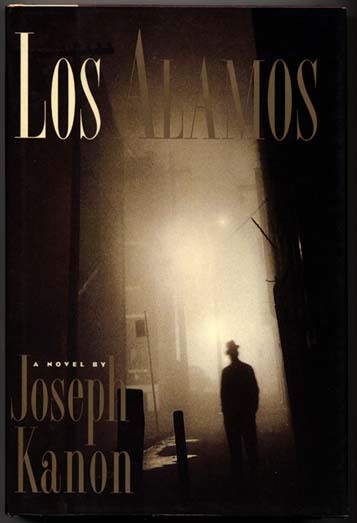
Los Alamos


Joseph Kanon
Los Alamos

Island Books, 1998

In the spring of 1945, Michael Connolly is sent on a secret military base where the best minds of the U.S. build an atomic bomb in order to use it against Japan. Connolly is not the military officer, he is a former reporter, "rewriter," as he calls himself, but the Army needed an outsider to conduct an independent investigation.

Near the military base was found an unidentified man, murdered. His head was smashed, but the strange thing is, he was found with his pants down. Police suggests that the victim was a homosexual and was killed for that reason. In the area three weeks earlier there’d been a murder like this, a man was also killed, with traces of copulation.

Army knows the identification of the second victim, he was a security officer at Los Alamos Karl Bruner. General Groves explains the situation to Connolly, pointing to the delicacy of the situation. On the one hand, the murderer of the security officer must be found, but at first it has to be found out whether his death was related to the project. The existence of the Manhattan Project, even in the White House, is known only to a few people. Groves gives an order to investigate quietly, so as not to distract scientists from work. Connolly is appointed to replace slain Bruner as security officer to investigate undercover. The partner of the deceased officer Mills introduces Connolly the ropes, telling what Bruner was himself, how he liked to know everything about everybody.

On the first cocktail party for the project participants and their families Connolly meets with Oppenheimer and Emma Pawlowski, the wife of one of the scientists. Connelly quickly falls in love with Emma, so does she.

Of some writers sometimes it’s said that they are writing the same book for whole life. This can be seen, in some cases, as a compliment, but it is possible and as severe criticism. Joseph Kanon writes the same book over and over, and I can not say it's a compliment. «Los Alamos» is his debut novel, and it is 95 per cent like «Istanbul Passage», and «Alibi». I suspect that the rest of Kanon’s books are the same. What changes? The names of the characters, the scene, a little different the premise. All the rest is one endless self-repetition. The main character is always the same, an American semi-professional associated with espionage cases. He always has a lover, someone's unfaithful wife. He is helped to investigate by an inspector or police detective. The era is also one and the same, about-World-War-II.

And yet it all would be okay, but the most incredible of all that is that all novels have the same ending, a drop of water, an identical copy of another drop, and the third is copy of the copy. Everywhere the same hospital, rewriting the results, the uselessness of the truth.

«Istanbul Passage» was a bright and fresh, «Alibi» was a dull copy, because I had read the same thing in “Passage”, «Los Alamos» - well, would you please stop? This is the only reaction. Does the author have no imagination? Why did he not change his direction? Why repeat himself over and over? He has an ear for dialogue, and the story (one and the same) is tense and exciting, and he can write.

If after reading of "Passage" and "Alibi" I picked up "Los Alamos," I would have thought that the publisher is trying to fool me, offering me the novel I already read but by another title.

And one, not so polite, question to Kanon: what, your record has stuck?

Thursday, September 6, 2012

The Devil I Know


Claire Kilroy
The Devil I Know

Faber & Faber, 2012

The novel is written in the form of questioning. Someone named Fergus in 2016 questions the novel’s protagonist Tristram St Lawrence, who was involved in a real estate boom in Ireland in 2006, and then in the collapse of it.

Tristram at the beginning of his confession tells how he nearly died on a plane to make an emergency landing in Dublin. There at the airport hotel Tristram meets accidentally an old friend Desmond Hickey, real estate developer. Hickey immediately takes Tristram to the bar to drink. But Tristram can not drink. Tristram is a former alcoholic, barely survived after a binge. When Tristram has not arrived at his mother's funeral, everyone thought that he’d died ("It was another Tristram St. Lawrence" - Tristram jokes every time). Tristram is rescued by a mysterious character who instructs Tristram by telephone. A stranger appears as Monsieur Deauville, and from that point, as this man made Tristram to join the "Alcoholics Anonymous" and pulled him out from death, Tristram follows instructions from Deauville.

Tristram and Hickey come to the bar, where Hickey buy them a pint, but after five minutes in there Deauville calls Tristram and says that a taxi is waiting for Tristram, it's time to go. Tristram returnes to the castle, which belonged to his mother, but now to Tristram himself (he, after all, is the thirteenth Earl of Howth on the title). His father is living in the castle and does not even want to talk to his son. In the castle Tristram also finds servant Larney who seems senile and talks in riddles. Hickey makes Tristram a business proposal, and at the direction of Deauville Tristram agrees to it.

This book boasts a delightful blend of the real and the unreal. Start with the fact that the action takes place in the future, in 2016. From the beginning, it is not clear whether the narrator is alive or not, it is unclear to whom he tells his story. At the same time, the real estate boom in Ireland really was, as was the collapse, and accuracy in the details regarding property is respected. «The Devil I Know» is, of course, the picaresque novel. If measure it for the quantity of black humor this novel is like "Master and Margarita" plus "Dead Souls" by Gogol. Characters are still those boobies, but, of course, a purely British boobies. All this is compounded by an unreliable narrator, and here I can clearly see some parallels with Stephen Fry. Tristram is Black Adder (from TV series of the same title), and former alcoholic, and a simpleton, which Ireland has never seen, and the person who has become a puppet of the devil. He is certainly an apocryphal, grotesque, hilarious character, but charming, clever even, just trying not to use his wit.

Page-turner is not always equal a good book, but in this case it is a good page-turner. You should get all the fun right away, and read the book quickly, the plot goes like a storm, though it seems there is not a lot of action here. Claire Kilroy writes clever, brilliantly and boldly. Her writing is multi-colored, but without excess.

The theme of real estate today may not be the most relevant, but the devil is always something out there somewhere.

It’s a great novel, call it fantasy, the mainstream, even a modern fairy tale. Very good.

Tuesday, September 4, 2012

Zoli


Colum McCann
Zoli

Random House, 2008

The story of Gypsy poet and singer Zoli Novotna is told by several narrators from several layers of time. In 2003, the journalist comes to the Roma settlement, where Zoli Novotna once was born. Gypsies share stories of the past of legendary Zoli with him.

In the early 30's, when Nazis became power, the laws began to change, and Gypsies were killed and evicted from the land. All Zoli’s family, except for Zoli and her grandfather Stanislaus, had been shot. Zoli with her grandfather hide in the woods with a horse, while not adjacent to the tribe of Gypsie harpists. Zoli at that time was six years old, and while she and her grandfather was hiding in the woods, Stanislaus’s taught her to read and write on "Capital", which he always carried with him, breaking the gypsy traditions, because girls were not allowed to reading and writing skills.
The girl is getting married early, at age 14, for a gypsy named Peter, who is much older than her. Grandfather soon dies, and the war ends. Success comes to Zoli, but later, after the war. Stephen Swan, who is the narrator in one of the parts of the novel, is English, but with Slovak roots.

Obsessed with the ideals of communism, after the war, he traveled to Czechoslovakia, where Stephen is patronized by local poet Martin Stransky. Swan translates into English, lives just like everyone else, often gets a cold. In 1950, Swan met with Zoli.

Stransky was the first to discover the poetry Zoli, and drew attention to her. He wants to publish her book of poems. Roma have no written language, and Stransky and Swan, as his assistant, transfer Zoli’s songs and poems, existing only in oral form, on paper.

McCann in this novel is like the heroine of the novel Zoli tells his story so fascinating that you even stopped to care what is happening. McCann writes really well, loudly, correctly placing the intonation, he’s especially good in the first half of the novel. Beginning is fascinating, when the story is told from the point of view of a six-year girl, it’s touching and funny. The author's style is truly British, he avoids Gypsy’s words, does not insert italics gypsy sayings, not trying to assimilate his style. No less successful is the second chapter, when the first-person narrator Stephen Swan becomes gradually fascinated by strange beauty of a Gipsy Zoli. Swan seems fascinated by form and not substance. He is mesmerized by otherworldness of the poet herself, her tongue, her voice, the ability to attract attention. But Swan never tells about the content of poems and songs of Zoli (McCann in the text itself rarely gives examples of Zoli’s poetry).

The second half is not that written worse, but more monotonous. Kicked in disgrace, Zoli as Gingerbread, is rolling across Europe, small events heppen with her, but they do not mean much, and similar to each other. The interest is waning, besides McCann inserts into the narrative Zoli’s letter to her daughter, and the question of whether Zoli will survive or not, by itself disappears. «Zoli» is is a one-man show (or rather ome-woman), because there are no other characters. And this author has difficulties. If the reader is interested in Zoli as an individual, it will be interesting to trail the story, if not - you hardly even will read to the end. You can not be interested because McCann inspires us to believe in the tragic nature of the heroine, the complexity of her fate, her troubles, but the novel lacks something that would show us an aura of mystery around Zoli. We spent too much time with the character, so we learn almost all about Zoli, a little too much. Besides if you’ll look at the gypsy sober, you can see not a gifted woman, which no one understands, but selfish thief, cheating woman, traitress.

«Zoli» is an uneven novel, above average, but read it only if you’re in the mood.

Hard Man


Allan Guthrie
Hard Man

Polygon, 2008

Baxter's family’s got troubles. 16-year-old daughter of Jacob Baxter May married 26-year-old sadist Wallace, cheated on him, became pregnant, and Wallace did not like all that. Jacob feares that Wallace now will use violence to his daughter. The father asks his two sons, Rog and Flash, "talk" with Wallace, so that he’d leave May alone. But a karate expert Wallace does not like to listen to other people's instructions, and the whole Baxter family this first time is left with minor injuries after a conversation with Wallace on the souls.

Jacob finds a solution. He wants to hire a local ex-con Pearce, who would "solve a problem" with Wallace and become a bodyguard for May. Pearce with his difficult character and financial problems ponders offer to earn a few thousand, but after weighing all the pros and cons, he refuses to eat the stranger’s shit. Baxter family has to persuade Pearce in more sophisticated ways. The action begins to accelerate, the plot flies like swirl.

Pearce has been a hero of another Allan Guthrie’s novel, «Two-Way Split». Pearce's past is full of violence: killed a drug dealer for his sister's death, served time, saw the robbers killed his mother, took revenge for the death of the mother, barely escaped punishment. Peirce never had friends, except his dog. As well as a permanent job, but «Pearce needed the money. Arsewipe. Maybe he should think about proper job. Only thing he'd done since he got out of prison was debt collecting. And that wasn't an option now Cooper was inside». But Pierce, who is just that «hard man» from the title, is not the only main character in the book. Guthrie slowly puts the pieces, revealing the characters of all Baxter’s family members. This is a hell of a family, so prepare for the parade of errors, unexpected twists and black humor.

With humor there is no problem, but with everything else ... The previous two Guthrie’s novels also were crowded with characters who are cruel, crazy and unpredictable. Favorite writer’s method was taking a large number of characters in one pile and see how they will deal with common problems. At the same time, Guthrie changed narrators in the process, but did not do it very often, staying with one character enough time to avoid flickering in the eyes from the narrator’s switching. Reading «Hard Man» the eyes will just dazzle. The author so often changes the angle of view, that in the end you just stop to closely monitor these cuts. You just get headache, and no fun.

The second half of the story is divided into two sub-plots and Pearce ends up on the sidelines. Somewhat unexpectedly to see how the main character of the book suddenly stops practically participate in the development of the plot. Guthrie in the first half of the book takes us inside the mind of Pearce, to just throw this character away without visible results.

In the novel, there are a few surprises, but their stock is running out quick, and the ending is already possible to predict in a few dozen pages before the end.

In the first two Guthrie’s books, we saw what he was capable of («Two-Way Split» was wonderful, «Kiss Her Goodbye» is a little worse). This is no good. The first half of the novel was promising, but then the novel turned sour. It is better to find his first two novels, this is not a must.