Tuesday, April 30, 2013

Serious Men


Manu Joseph
Serious Men

John Murray, 2011

At the center of this funny story are two men working at the Institute of Theory and Research in Mumbai, India. But the place of work of perhaps is the only thing that unites them.

Ayyan Mani is a representative of the lowest caste. Janitor's son, Mani began working at the Institute as a courier, rising to the position of secretary to one of the most important researchers of the Institute Arvind Acharya. Mani, after ten years of marriage, became tired of his silly wife and half-starved existence. His wife no longer seems attractive; the future does not seem bright. Not being the holder of outstanding intelligence, Mani nevertheless has the ability to intrigue. Every day, Mani places on the stand at the Institute fictitious quotes, allegedly belonging to an outstanding scientist or thinker, but in fact he makes these statements up. The only way to rise from the bottom Mani sees in his clever son. But just cleverness alone is not enough, you need something more. Deaf in one ear, Adi is presented by his father as a mathematical genius.

Eccentric people inhabit this somewhat eccentric story. «Serious Men» can be easily mistaken for satire, but it is rather humorous novel. Satirical allusions to the structure of Indian society, Indian science and Indian religion then are withdrawn dashed, and the humor here, perhaps, is even English.

All the troubles come from women - about this with a smirk on his face Manu Joseph is trying to tell us. Indeed, the plot is moved with this premise. This is the same engine of the ridiculous here. The two main characters are tormented by vanishing love in them. They're both tired of their wives, available lovely creatures with whom they had once felt good, and now somehow uncomfortable. Both the secretary and the scientist, excel, as they can, just to pull themselves out of the swamp, to refresh their covered with cobwebs existence. Mani sets up to the scam involving his son to shake his wife, to prove to her that even the lower castes can achieve something. Acharya is looking for bodily pleasures, and finds them in a lovely young colleague. But the scientist forgets that science and feelings are different matter, and they require a different approach. At the beginning of the novel there are a few funny scenes where Acharya looks in the mirror at his body, starts to use deodorant, though he already seems to have given up on his looks long ago.

The story would be lost in the background of similar ones, if the action occurred in Britain, for example, not in India. Exotic colors entourage battered story in a new way. The people there have a different mentality, different views on life, different values. The mere fact that India has the Institute for the search of extraterrestrial life, is laughable.

Joseph is verbose, but he does have a sense of the word. He can equally good describe the poor neighborhood and the meeting of the Disciplinary Commission. This is a leisure reading, but because, after all, it is not a thriller.

Serious Men does not discover new lands, but tells a story that could suck you in and make you laugh.

Thursday, April 25, 2013

Hogdoggin'


Anthony Neil Smith
Hogdoggin’

Bleak House Books, 2009
(e-book, 2011)

After Yellow Medicine Billy Lafitte remains at large, proved his innocence in the terrorist case. But an FBI agent Rome does not think so. Rome secretly from his colleagues continued to develop Billy’s case, hoping this time to catch Lafitte on the old crime. Billy himself now has been hanging out with a gang of bikers, acting as a muscle for the gang leader Steel God.

Rome hopes to reach out to Billy, using his flabby ex-wife. After learning about the actions of Rome, Lafitte immediately takes off, throwing the bikers, but not breaking ties with them completely. Billy is going home, and already on the way bad things start to happen.

If in the first Lafitte novel Yellow Medicine Billy was a kind of axis around which the events of the book revolved, there Billy is such an arrow that is tangentially touches everyone and everything, the thread on which planted other characters-beads. And it turned out not a fun trinket from the imitation jewelry department, but an explosive mace, uncontrollable and deadly. «Hogdoggin'» is written in the third person, and almost half of the book Lafitte spends unconscious. And if in the first book we learned Billy through the other characters, here we learn other characters through Billy.

Anthony Neil Smith already in his debut proved that he has the wildest imagination. In Hogdoggin' he proves it, imagine for example half a dozen officers of the law gone AWOL.

This novel, like rottweiler (see the title), is cutting into your throat and doesn’t let you go live. They say the third book about Lafitte is already written. Well, looking forward to.

Monday, April 8, 2013

Schroder


Amity Gaige
Schroder

Twelve, 2013

Before us is a letter of apology written by Eric Schroeder, to his ex-wife Laura at the time, while he awaits trial. Schroeder is accused of kidnapping his six-year old daughter, Meadow, which he calls Butterscotch. His lawyer asked him to write a long letter with all the details describing what Eric did with his daughter in the days after the kidnapping. Such letter, according to the lawyer, might help to mitigate the punishment, if Laura forgives her ex-husband.

Eric Schroeder is not a crafty criminal, but his whole life was built on lies. At an early age, Eric and his father immigrated from East to West Berlin. Eric had almost forgotten sis mother, and Eric is not sure, whether they left the mother, or she left them. At age 14, Eric moved with his father to Boston, where his father was offered an electrician’s job. Father and son wanted to be naturalized, but remained in the US illegally. Wanting to leave the past behind, at 14 in 1984, Eric invents himself a new identity. In an era when there were no databases and computers, it was easy to become a different person. Eric is applying to a summer camp as Eric Kennedy, a good student and an obedient son of the patriarchal family with money. So, three summers in a row, Eric goes to the camp as Kennedy, and the coincidence of his name with the name of the Kennedy brothers opened many doors to him, though he denied the family relationship with the president. When he’s 16, in the camp, Eric met with Laura, which promptly falls in love with. Eric and Laura quickly got married and honeymooned five days on the beaches of Virginia. After that Eric begins to sell houses, and he does it perfectly. Soon Meadow, a daughter, was born, and Eric is quite able to give his daughter everything a baby needs. But the marriage did not last.

Despite the fact that this book in the form of the message is addressed to Laura, Laura is almost outside of the narrative. Schroder is more than a personal letter, but an open letter, because Eric Schroeder’s thoughts and feelings asks out, it is essential to know everyone about them, not just one person.

The whole book is hardly a love letter: it certainly has the remains of feelings to the one who is the narrator once loved, but, as Eric says, times struggles with love, and time usually wins. But there is no open hatred to the one that robbed Eric of his child.

Schroder is a tragic story with a known right from the beginning ending, but that snatches you and pulles forward. Behind the thriller’s plot hides a non-thriller story, made entirely of different stuff than a thriller. This is such antitriller when there seems to be all related elements, but they do not fit in the usual way. The protagonist is not a bloodthirsty monster, stealing children and cut them into pieces, but a strange man, a psychologist and a good father, lost in himself and in the world. He can cause such empathy and sympathy for the course of reading, that you would never call him a criminal.

Meadow, the girl, is also not a faceless creature that has been stolen as useless broken iron, but a full-blooded little child, thinking and quite charming. Meadow is the companion of her father, not the victim of kidnapping. Angel, another heroine of the book with an unusual view of the world, is the signal from the past, the personification of American roadside motels.

Knowing that everything will end soon, the narrator tries to finally speak out, to find the causes of what happened in the past. The hero of the book examines pauses, and the book is made up of these pauses, innuendo. The narrator seems to be very sincere, but his behavior can be judged that his sincerity has gaps, gaps in his story. We listen to his stories, we want to ask more questions, but this is not a dialogue, this is a monologue, a letter to one side.

Letters of this kind and this force should have been put into the bottle, then to throw them into the sea - for our future generations. Then our followers will appreciate the power of the writer's gift of humanity.

Wednesday, March 6, 2013

The Innocents


Francesca Segal
The Innocents

Chatto & Windus, 2012

At the beginning of the novel 28-year-old Adam Newman is at the engagement party with his sweetheart from high school times Rachel Gilbert notices among guests Ellie Schneider, 22-year-old Rachel’s cousin. Adam works at firm owned by the father of his future wife Lawrence Gilbert. Adam is caring, honest, responsible, bright, smart, pride of the Jewish community of North London. His fiancee Rachel is a perfact match: she's a nice, bright, loyal, modest, and can offer comfort to Adam and well-being in the house for many years. Adam and Rachel started dating in high school, and so have been dating almost 12 years, following all the Jewish rituals, trying to do everything as it should be. Adam's and Rachel’s families has long been intertwined, merged into one, but the formal relationship is not settled yet. Now the lovers are finally engaged, and the wedding is planned in 8 months, in August, to allow preparing within all the rules.

This family drama at first glance is no different from hundreds of other family dramas, which already flooded the market. Jewish theme seems to be to aggravate the situation, but The Innocents is not another "book about the Jews," which were always in abundance. Action of the book actually takes place in the Jewish community, and all the heroes of the book are Jews, even Jew Jews. But instead of the Jews here could be devout Russians, or Mexicans, or rural Vietnamese, or any other representatives of the community, which holds the old rites and traditions. Judaism is not a central theme, it is only the reception here. Jewish community of North London is a collective image of the old world, of the past, of family roots. Endless relatives, respect elders, celebrating Jewish holidays are only the elements of the world in which the main character has grown and which continues to live in. The novel in the first place is about the battle between the new and the old feelings, the traditions with emotions, love with fidelity. Respected and respectable, Adam slides on his life path, not even imagining that beyond his world there is something different, strange, new, mysterious.

The hero is trapped: he is too good to erase all at once and give up on what he worked for so many years, but on the other hand, he is captured by the senses, and not always can fight them.

Francesca Segal, portraiting in her novel Jewish relatives, with kisses, bathing in the Jordan, certain epithets, unintentionally created a whole world full not with nasty characters, but with those whom you would not want to spend time with. Adam is like an elf among trolls and goblins, he wants to be different, wants to escape. And in spite of his sins, he has a lot more compassion and respect than others.

Ellie, though representative of the new world, did not forget her roots, making a difficult choice in the final.

Segal writes clever prose, convincing in detail, you will not even notice how time flies. This novel is not a romantic bubble gum, which we saw enough. This book is about true feelings.

Tuesday, March 5, 2013

Bear is Broken


Lachlan Smith
Bear is Broken

Grove\Mysterious Press, 2013

Two brothers are having dinner at a restaurant in San Francisco. In broad daylight an unknown shooter shoots the older brother Teddy Maxwell in the head. Sitting with his back to the attacker, Leo Maxwell does not even have a chance to look at the gunman. Teddy Maxwell was successful and cocky lawyer, popular with the social bottom types. Leo, who also just passed a bar exam, is left with his brother in coma and his clients, who now have to find new counsel. Leo does not trust the police because Teddy once sprang free the killer of two cops, and Leo is sure that detectives are even more pleased that someone has finally paid Teddy what he deserved. Inexperienced, Leo begins his own investigation, suggesting that the attack on his brother had something to do with one of his clients.

Leo is different from other dilettante seeking the murderers of their loved ones in that he behaves as a freshman, as confused and inexperienced sucker constantly making mistakes and getting tangled in his conclusions, not as hard-boiled pro who with his fists beats out the truth from the suspects.

By the presence of the court scenes and the profession of the main characters Bear is Broken can be attributed to legal thrillers. By methods of seeking the killer Bear is Broken could pass for PI novel. But Bear is Broken is neither one nor the other. And who cares about all of these subgenres?

Reading detective novels of recent years, I often catch myself thinking that modern writers have forgotten how to write a murder mystery. They can write everything, but not murder mystery. You recall with sadness novels of the past. So Bear is Broken is of exceptional quality a murder mystery. Moreover, if the author is writing tasty prose in the murder mystery and a mystery component fails, then no matter how good a stylist this writer is, the book will leave a bitter taste in the mouth. Lachlan Smith writes brilliantly, not trying to hide the holes in the plot with the elegance of writing.

Bear is Broken is one of the best debuts of recent years. We will hear from Smith again, I hope. Phenomenal talent.

Tuesday, February 19, 2013

Wise Men


Stuart Nadler
Wise Men

Little, Brown, 2013

Father of the narrator of the story, Hilly Wise, Arthur Wise became rich overnight. Small-time lawyer, Wise and his partner Robert Ashley has represented victims of the crashed plane, and won a class action lawsuit against the Boston airline.

In 1952 Wise is making the first major acquisition - on the beach in the place called Bluepoint he buys a huge house. In the summer the whole family - Arthur, his wife Ruth and their son, 17-year-old Hilly - moved into this house. In the next house Robert settles in. Lawyers receive a big deal of offers, all airlines are afraid of this pair, and Wise gets richer with each passing hour. However, he becomes irritable, and does not talk much with his family, spending all his time in office. There is no telephone communication between the houses there, and Wise makes a black servant Lem Dawson carry documents from one home to another. Wise prohibits Hilly approach Dawson, thinking that blacks is nothing but trouble. Hilly himself spends his time freely before admission to a prestigious university. He is not particularly bright, not particularly pretty, plays baseball, but that ends his talents. No matter what his father said, and Hilly still decided to start friendly conversations with Dawson.

Things change for Hill when he saw for the first time a man and a girl about the same age with Hill came to Dawson. Girl, Savannah, is the niece of Dawson, and the man is her father. Savannah Ewing’s father once played professional baseball, and now mostly drinks, gambles and beats his daughter up. Dawson helps her niece with everything he can. Hill becomes obsessed with Savannah and, knowing how she lives, decides to help her. He collects things and food from his home, which Ruthie buys without purpose, loads them into the car and drives to the house of Ewings. But Savannah and her father Charles does not want to take anything from Hill, considering that they do not need charity.

Wise Men is a story of obsession. Possession also in the sense that once you started to read the novel, it is not impossible not to finish it, and after the end, it is impossible not to love it. It is a deep family story of a father and son, each possessed in its own way. Father is by aircrafts, although aircraft as such is of little interest. He is obsessed with the struggle for justice, but for such justice, which would be profitable as well. And planes generate income. In one chapter Hilly mentions that his father makes a profit on each take-off around the world.

Hilly Wise is obsessed with a girl from the past, with whom he had of all relations only a gentle kiss on the August night, and a common desire to sleep in the car. In the absence of other dreams in life, search for Savannah becomes his dream.

But both Wise deceive themselves. Hilly is obsessed with not with Savannah, but with only the moment of his youth, a fragment of the past. Wise Sr. under aircrafts is trying to hide his relationship to the closest person to him. Both Wises became hostages of something unattainable and missing, but this inaccessibility, it seems, is not their fault, but it just happened.

The first third of the book certainly is the strongest: the house on the edge of the ocean, with a strange servant, the poor girl and her father, with stolen documents, oppressive atmosphere. Nadler gave his narrator voice pure, innocent, shy, but with a lot of understanding.
In the story about the feelings are mixed the story about money, but Nadler does not cut from the shoulder. Money is always difficult, no matter how much they are of them, much or nothing at all. The author avoids morality that a huge amount of money brings unhappiness. People build their faith, not money.

The second part is at least the key, and the third, although it is weaker plot-wise, ends unexpectedly. One of the faults of the book is a plot twist in the third part. Arthur Wise himself was in a plane crash but survived. This allows Nadler to wrap up the plot, to show the vicissitudes of life, but such a move, for all its beauty, is too unvelievable. This somewhat breaks the general believabillity of the book.

Recently, the term "airplane reading", a book that you read once and throw it in the airport, is on the rise. Wise Men is airplane reading, but in another sense. This book is business class; first-rate prose.

Monday, February 18, 2013

Yellow Medicine


Anthony Neil Smith
Yellow Medicine

Self-publushed e-book, 2011
(originally published by Bleak House Books in 2008)

Bad cop Billy Lafitte after Hurricane Katrina was fired, but the brother of Billy’s ex-wife, the sheriff of Yellow Medicine County, arranges to hire Billy as his Deputy. At the new place Lafitte keeps doing bad things: solving problems by force, taking cuts from the drug operations and generally enforcing the law with unlawful methods. But Billy's got a good heart. When a bassist of a psychobilly band Drew, which Lafitte is fond of, asks Billy to help her boyfriend to solve the problems with the two meth dealers, Lafitte happily agrees, suggesting that the problem will be a breeze.

Lafitte could not guess that a breeze will turn out two corpses with their heads cut off and all the members of psychobilly band killed.

Anthony Neil Smith, whose imagination never failed him, would not be himself if he didn’t added into the plot lots of madness: in Minnesota, a terrorist group of Malaysians operates who are disguised as drug traffickers. First reaction: What the hell? But such was the reaction of Lafitte, when he found out about the terrorists from the FBI agent Rome. Next, the situation for Billy is getting worse and worse, given the fact that he is being chased by not only Islamists, but federal agents, suspecting that Lafitte helps this terrorist cell.

Bad-ass Billy Lafitte is truly a unique creation. More unique is that Smith manages to build a novel around the obvious anti-hero, but with brains and a heart. Billy arranges crusade against terrorists, but he does it not save the country, but to save his own sking and skins of his loved ones.

More tragic is that in Yellow Medicine we see a man who is stumbling once (more so if twice), and no one else will give you a hand and will not believe him.

In the novel, there is a second anti-hero, an FBI agent Rome. He incarnates here a soulless government machine that does not care about a single individual, but only about the entire nation. It is not clear which is worse, the terrorists who want to destroy your country, or your very own state.

Yellow Medicine is strikingly similar to Faculty of unnecessary things by Soviet writer Yuri Dombrowski, though they are made of different dough, and Dombrowski and Smith could not read each other. But both of them tell a story about a man who is in such trouble, of which seems to be no way out, and the only thing left is to be honest with himself and to act according to your conscience.

This is Smith's third novel, and it is bigger than the two previous ones, although the book doesn’t turn into a thriller (for the better). And yes, Smith is a master how to begin books (and and end them too).

Thursday, February 7, 2013

The Darkening Field


William Ryan
The Darkening Field

Minotaur Books, 2012

Captain Alexei Korolev of the Moscow Militia, who showed himself in a stolen icon case as the smartest detective and loyal to the State citizen, is again asked by the NKVD to assist in another investigation. In Odessa at the film studio young Masha Lenskaya mysteriously died, who was the mistress of Yezhov. She’s been found hanged, and the NKVD suspects that this case is not so clear as it seems.

Korolev is immediately sent to Odessa, who must pretend that he’s on vacation. At the studio Korolev will receive all the necessary help so that he can investigate questionable death, keeping his mouth shut. Komsomol member and excellent pupil, Lenskaya didn’t have any enemies, but from at the beginning the examination shows that the girl was murdered. In Odessa suddenly appears a gang of Thieves, led by an authority amongst the Moscow Thieves, Kolya («the only higher authority amongst Thieves in Moscow was God, or maybe Comrade Stalin»), that makes contact with Korolev and warns him of anti-Soviet conspiracy. Korolev must find Lenskaya’s killer, and at the same time to try to deal with the threat of rebellion.

William Ryan's previous book The Holy Thief was bizzare mutant, attractive primarily because of mixing British humor and terse prose with the realities of Soviet everyday life. This book, the second in a series about Moscow CID detective Korolev, is devoid of charm of the first. Ryan took Korolev from smelling of fear Moscow and threw him into the devoid of distinctive features agricultural college. People here still call each other "comrade" and "citizen", mention Stalin, but the spirit of the Soviet Union weathered. Uprising, arms smuggling, counter-revolutionaries - the novel could easily occur in Latin America, one of the young Thieves even says «jefe».

All that is left in The Darkening Field are sluggish plot and a few jokes. The strongest part of the novel is the first chapter, where Korolev in the workers' hostel is arresting a drunk who killed his brother. This chapter is the highest class:

«The hostel was split into two main rooms, with a cooking and washing area separating the two, and the further they advanced towards the centre of the building the less the noise of his boots was evident. There were other noises - coughing, the rustle of clothes, the snoring of sleeping workers, dripping water, the cluck of a chicken picking its way between the beds. There was still no sign of Shishkin, but that might be the least of their problems. Women and children were being ushered into the cubicles and young men woken from their sleep to stand and examine the Militiamen with bleary eyes. Korolev could hear people following them through the building, but he didn't look round. If he looked, he'd have to confront them, and that would mean trouble. He squared his shoulders and marched on, feeling the sudden heat from the cooking area, where red-faced women crouched over primus stoves - the sound of them like the roar of a blast furnace».

I wish Korolev soon returned to Moscow and began a new case.

Monday, February 4, 2013

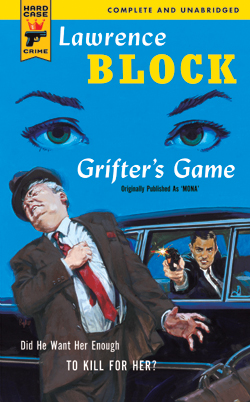
Grifter's Game


Lawrence Block
Grifter’s Game

Open Road Media e-book, 2010
(originally published as Mona in 1961)

Conman Joe Marlin at the beginning of the novel runs from a hotel in Philadelphia, leaving behind a 600-dollar bill. Marlin lives from scam to scam. He is single and looking for rich ladies whom he can "milk", and milk them to the limit he does, and then disappears. In Philadelphia, his scam has gone wrong: Marlin nearly has been fooled by a con lady, the same as he is.

With the remaining money Marlin comes to Atlantic City, where right on the train station he is stealing other people's bags from storage. Solid-looking, Marlin checks in the hotel by the beach, where he hopes to find a lonely and bored beauty that can be his free meal ticket. In his room Marlin checks stolen luggage and besides clothes finds a bag full of heroin. On the beach Marlin meets stunning Mona, vacationing here with her husband, an elderly businessman. And what a coincidence, that the stolen bag belongs to Mona’s husband Brassard. Quiet husband of Mona is a drug dealer, most likely related to the organization. Marlin has a plan to remove Brassard and pick up Mona and her husband’s money.

Grifter's Game is first Block’s novel, which was published under his own name. Block began writing this book as another softcore novel, but then turned towards crime. There are only a few spicy scenes in the book, and indeed, compared to Grifter's Game, any modern novel will seem hardcore porn. Style of the novel is similar to the style of the hundreds of other paperbacks of the time:

«I licked it another time. There was no mistaking the taste, not now, not after many years. When you work in a racket, even briefly, you learn what you can about the racket. You learn the product, first of all. No matter how small your connection with the racket or how little time you spend with it, this much you learn. I had played the game for two months, if that, in a very small capacity, but I knew what I had on my dresser.

I had approximately sixty cubic inches of raw heroin.»


Novel’s plot also does not offer any frills, but Block pays attention to detail and offers a few surprises along the reading. The largest of them is the unpredictable final, hard and somewhat shocking.

Block completes one chapter with a paragraph:

«It was a cheap evening. I didn't risk a penny. I'm not a gambler.»

With Lawrence Block there is no risk: you pick any of his books, and they are all good.

Thursday, January 24, 2013

The Hot Country


Robert Olen Butler
The Hot Country

Mysterious Press, 2012

A young American journalist Christopher Cobb in spring of 1914 is coming to Mexico, where the civil war is in full swing. At the inn Cobb notices a pretty laundress, which seems to Cobb not just a laundress. When an unknown sniper makes two attacks on the lives of American men here in Mexico, Cobb suggests that the sniper is a woman and that woman is the laundress. Much more than in a mysterious sniper the journalist is interested in the German ships at the dock and the question of why some Germans were brought to the city of Vera Cruz, under the cover of night. With the help of a young pickpocket Diego Cobb must find out for his newspaper, who the Germans are and what they want from Mexico.

The Hot Country is a sandwich from a good stylist Butler, where each ingredient separately tastes better than the whole. Cobb is on a train through the country in the grip of civil war, bumping into a gang of robbers and thugs, and this is Western. Cobb seeks a mysterious sniper who hasn’t killed the journalist in one night, and this is searing melodrama. Cobb acquires information and adds the bits of the story to his big report, and this is reporter's novel. Cobb, whose mother is actress, disguised as a German ambassador, and this is a picaresque novel. But collectively this novel fails as a spy novel. Cobb, however, says himself that he is a journalist, not a spy. Perhaps this is so. He is too chatty for a spy, that is just right for a newspaper reporter. Blame for this loquacious can be laid upon Butler: He wrote a novel in the first person, and what else journalists and actors can do, if not to tell, even to yourself.

«My breath caught hard in my chest and I waited. She waited too. Weighing my Americanness, I supposed. Weighing my life. Charting a path for herself.

Then the hammer uncocked and clicked softly back into place. The muzzle drew off my skin. The candle flame vanished in a puff of her breath and I lay very still as she slipped through the dark and out of the room and out of the life she'd left for me
».

Butler wrote a moderately exciting adventure story similar to the ones that were written at the beginning of the last century.

Tuesday, January 22, 2013

A Cold Day in Paradise


Steve Hamilton
A Cold Day in Paradise

Minotaur Books, 2012 (reissue)

After a psychopath killed Alex McKnight’s partner and nearly killed McKnight himself, Detroit cop takes an early retirement. Doctors removed two bullets from the body of McKnight, and the third one stayed there, very close to his heart. After eight years in the service McKnight receives disability payment and goes to live in a small town in Michigan called Paradise, where Alex’s father left some forest cabins. McKnight spends six years in Paradise, when a local lawyer asks Alex to work for him as a private investigator. Uttley, the lawyer, fires a previous PI because he was incompetent and almost makes Alex to get private investigator’s license. McKnight does not need the money, and he takes the job, because he thinks that he knows how to approach people. Soon someone kills the bookie, through which Edwin Fulton, a local rich man and gambler, placed his bets, and in the middle of the night Fulton finds the body of a bookmaker, calls Alex, asking him for help. After the first dead bookmaker follows the second, and McKnight starts getting ominous notes and calls from Rose, the same psychopath who killed McKnight’s partner.

The longer, the story is the more confusing, moving away from the mystery and practically flowing into horror territory. The fact is that Rose was caught six months after the murder and sentenced to life imprisonment in a high-security prison. And he could not escape from prison. But one who threatens McKnight knows what only Rose could know. Naturally, not only the hero is frightened, who thought that the past will remain the past, but the reader too, who already suspects that some magic will involve.

McKnight is a private investigator only conditionally: he's just a former cop, with his fears, and he doesn’t have special insight. Most of the book, he acts like a hunted animal, a little bit more, and the one who plays with him will drive Alex crazy.

McKnight with his knight name and the real knight have in common only metal: the knight's armor, as the hero of the book has a bullet next to his heart. The rest of Alex is far from the hero of the Middle Ages: he slept with his best friend’s wife, been a cop, but hadn’t been promoted to detective, he’s not particularly sharp on the mind and language, and his code of honor is quite specific. Far more likely that McKnight is short for “nightmare”: the whole protagonist’s life became nightmare.

A Cold Day in Paradise is a chilling novel, the grotesque in some way, but no frills there. In here, for example, the bartenders do not remember all the customers for the last three years:

«THE BARTENDER WAS no help. I asked him if he had been there that past Monday. It took him a full minute to figure that one out, so I didn't think he'd be able to remember if there were any suspicious characters there that night. So I just paid the man and headed down to Uttley's office ».

This book is, in general, not a bullet to the heart, but very close.

Monday, January 21, 2013

Kiss Tomorrow Goodbye


Horace McCoy
Kiss Tomorrow Goodbye

Open Road Media e-book, 2012
(originally published in 1948)

Ralph Cotter, a criminal with a university degree, with the help of another convict’s sister, bribes a guard and escapes from prison, in a shootout killing his escape partner. Holiday, sister of the deceased, and Jinx, another criminal, help Cotter to hide in a town where no one knows Cotter and Cotter does not know anyone. Cotter and his associates need the money to hide on, and Cotter, relying on his sophisticated mind and unprecedented audacity, immediately decides to rob a grocery store, which is directly in front of the garage, which belongs to a shady but funky character that helped the criminals escape. The robbery is successful, except for the fact that the robbers kill market’s owner. With six thousand dollars Cotter plans to run, but the garage owner coward Mason turnes him in to police and leads the detectives directly to the apartment where Cotter and Holiday live. One of the detectives is Inspector, and, feeling that these cops are corrupt, Cotter bribes them from his share of the loot. But instead of fleeing, dodgy criminal devises a cunning plan, and the plan works so that the Inspector is now hooked by the dangerous criminal.

Pulpster and Hollywood actor and screenwriter Horace McCoy is mostly known as the author of the novel They Shoot Horses, Don't They?, but Kiss Tomorrow Goodbye is another must-read from this great writer. This book has every right to be called noir. Kiss Tomorrow Goodbye is a distorted story of the ascent and fall of heinous character, smug, selfish, cruel, placing himself above everyone.

We have seen many nefarious types for more than half century of noir, but Ralph Cotter stands out by the fact that he was an educated man, versed in philosophy and logic, and when necessary, able to be so well-mannered and highly moral gentleman that even the most cautious people fall under his spell.

This is how Cotter describes Holiday, when he first meets her:

«She smiled at me, unbuckling her trousers but not unbuttoning the fly, slipping them off, arching her shoulders against the back seat to raise her buttocks out of the way. Her legs were slim and white. I could see the skin in minutest detail, the pigments and pores and numberless valley-cracks that crisscrossed above her knees, forming patterns that were as lovely and intricate as snow crystals. And there was something else I saw too out of the corner of my left eye, and I tried not to look, not because I didn't want to, not because of modesty, but only because when you had waited as long as I had to see one of these you want it to reveal itself at full length, sostenuto. I tried not to look, but I did look and there it was, the Atlantis, the Route to Cathay, the Seven Cities of Cibola ... »

Disgust to everithing seeps through the pores in individual sentences and whole paragraphs of the novel («You fools, you mere passers of food, I was thinking; I shall not be saddled with you for long, I shall not be saddled with you for longer than is absolutely necessary »). The novel was ahead of its time, therein lies its appeal, it is not out of date even by now. Most of the books of the time are not that would be too simple plotwise, but they may seem funny and toy by now. This simplicity is not here: update several details, and the novel could easily occur in our days, and we still would have marveled by audacity of this dark novel. McCoy even stylistically is twenty years ahead of his time: in the late 60's not all writers have ventured to use such words as «faggot» and «nigger» in their prose. McCoy doesn’t avoid scenes of beating women and sex scenes. If you are to show your character, then show it from the front and in profile and in full height.

Cotter’s problem is that he, with his mind and life skills, sees American society far and wide and does not want to have nothing in common with this society. But the only alternative to this society, for Cotter, is to become a criminal. And what Cotter would not do, what would he not plan, no matter how different he is from the others, he is still on the one level with other punks and thugs, stupid and short-sighted.

Kiss Tomorrow Goodbye has not received as much attention as it deserves. This book can and should be read and re-read.

Tuesday, January 15, 2013

Blackbirds


Chuck Wendig
Blackbirds

Angry Robot Books, 2012

Miriam Black lives on the road. She hitchhikes, earning a living by stealing from people. To honor or dishonor of Miriam, but it needs to be said that she steals from the dead people. The fact is, Miriam is able to predict the death of another person. It is enough to touch someone's skin, and in her head there is the image: she sees, when and how a person dies. So, finding people who are about to die, she is either rubbed their trust or follow them, so that later, when the person is dead, she pick up the money that was there with him or her. You can’t get rich this way, but it’s enough for a living. Especially if a living means no home, friends, relatives, and no prospects for the future.

At the beginning of the novel Miriam takes the money from the wallet of a man, who had the heart attack just at the moment when he was about to have sex with Miriam in a hotel room. With a black eye and in dirty, torn clothes, Miriam gets in the truck and accidentally touches the driver. The vision shows that the driver named Louis will be brutally murdered in thirty days, and before his death he will call Miriam by name. Miriam, scared, leaves Louis, but their paths will cross yet. Death in the face of three psychopath murderers already comes on the heels.

Chuck Wendig, after the novella Shotgun Gravy, again makes the main character of his novel a woman. And hell, if I had not seen the author's name on the cover, it could be assumed that a book was written by a woman. Miriam Black is even more sophisticated creation from Wendig. She swears, is rude to dangerous types, keeps a diary, where records all her foresight, and her whole life is full of strangers and no loved ones. Here is an excerpt from a conversation between Miriam and two bikers:

«" What's up? " he asks, like not much else is going on.

Ashley's legs start to go limp.

"That guy you're choking to death?"

"Uh-huh."

"He's my brother. He's ... got problems. One, he's got bad manners. Two, his name is Ashley, and with a name like that, he might as well have a couple vaginas in his pocket, am I right? Three, he's at least half-retarded. Though I'm willing to put money on two-thirds retarded, if you're up for a friendly wager. Mom used to feed him lawn fertilizer when he was a kid, I think as some kind of retroactive abortion attempt. "»


Under a layer of black humor (Miriam no longer takes her life seriously after so many deaths in her head, and humor is the only protection to not go crazy) hides a very dark and full of despair story of a girl who is given a gitf (or, rather, curse) to see someone else's death but not given to prevent these deaths. The story itself is quite local, even small, but it is only that on the surface. Plotwise it is a road novel, with a pinch of noir, the cruel murderers, suitcase full of drugs and roguish hero with supernatural powers. There is something in Blackbirds that is significantly Stephen King-ish. This book could’ve been written by King of The Dead Zone and Misery, when he was writing 200 pages novels. This is also the story which is typically American, with roadside cafes, motels, gas stations and shady characters that can be found on both sides of the highway - occurring somewhere in the heart of the country.

But under a thin layer of the plot there is a thick layer of thoughts on the themes of life and death. Wendig doesn’t waste words. To get to the point, he uses only one sentence instead of ten unlike 95 percent of the fantasy authors. Blackbirds is no fantasy, though. Just insanely good, acrid, burning prose. And the dialogues are top-notch:

"His dick killed him," she says.

"His dick."

"His erection, more specifically."

"You banged CEO Grandpa?"

"Jesus, no. I did flash him a tit, though. He was so pumped fill of dick pills - and not prescribed stuff, but shit from, like, some village in China - that it killed him. My chest isn't exactly impressive, but I guess it's enough to kill an old man. "


Wendig is a phenomenal talent, breakthrough of the last year. Absolute must-read.

Monday, January 14, 2013

The Drummer


Anthony Neil Smith
The Drummer

Self-published ebook, 2011
(originally published in 2006)

Back in the Eighties, I played drums for a heavy metal band called Savage Night. Todd was the lead singer. We had one platinum album, a bundle of decent videos on MTV, and several years of successful touring. The money rolled in, the chicks wanted us bad, and near the end, radio spun our power ballad all day and night.
We found out we were broke on a tour of Japan. The record company dropped us—grunge was conquering our space—and we owed millions to tour promoters. After a decent show in Tokyo, the four of us sat in a sushi restaurant and tossed around possibilities. Todd thought we should add a keyboard player and do another album more pop than metal to pay off our debts and make us maybe superstars, the way Aerosmith morphed from bluesy bar band to kid-friendly Top 40.


After a decade and a half after his group collapsed the drummer Merle Johnson (it is not his real name) is drinking beer in one New Orleans’s bar. To avoid persecution from the IRS, Merle (then Cal Christopher, though this is not his real name, as well) had staged his own death, burning his house. Transferred all savings to bogus accounts, Merle straightened himself a new identity and settled in New Orleans, make a living as a sound engineer and living in a former funeral home. Merle started a new life from scratch, and the last thing he needs now is that his past reached him, forcing back into hiding. But Todd Delacroix, the band’s frontman, has tracked Merle and started to blackmail him, threatening to reveal the drummer’s whereabouts, if Merle does not agree to participate in a group’s reunion. Merle has almost killed Todd, but the next day Todd is found dead in a hotel room, or rather, Merle himself finds his ex-bandmate still alive after the overdose, but deliberately calling for ambulance too late. And instead of running from the police, the press, and the IRS, Merle remains in the city, wanting to find out how he was found and who faked Todd’s suicide.

The novel at the time was dubbed as heavy metal noir, and in general it is almost accurate designation. How many crimes (especially murders) take place in a musical environment, except for gang-related shootings among rappers and sacrifices in black metal? I doubt that many, the more interesting it was to learn about the behind the heavy metal scenes. Anthony Neil Smith, it should be noted, leans more on noir, rather than on heavy metal. Book protagonist Merle lacks stupid nostalgia: the long hair, snotty ballads in a metal frame, groupies, drugs before and after performances. Merle really leaves the past in the fire of his house, and not just pretending. He now listens to electronic music, does not indulge in drugs, loves (platonically) pious woman, and would not exchange his present to the past, no matter how successful it may seem. Smith does not allow his character annoying whinings about how everything used to be good, but now everything is bad.

Despite the fact that the novel is full of memories of the hero’s past (so we know the background of Merle) the protagonist doesn’t has time for whinings. All the book he is on the run, if not hiding, he is attacking, and his every action, it seems, only worsens the situation. And the protagonist has no much choice: death, prison or a disclosure, which, for him, is worse than death.

This grim story is peppered with charming descriptions of New Orleans:

«The first thing I did in town was to find Bourbon Street and hit as many bars along the way as I could manage in a few hours. My first Hurricane-a sweet drink full of rum-hit me harder than those drunks in England. Tried the tourist drinks at the frat bars, the vampire bars, the jazz clubs, the strip clubs. Washed them down with watery beer. The music was killing me with goodness, the bar bands more talented playing cover sets than most of the high profile LA people I'd worked with back in the day. Fusion guitarists with gritty blues in their veins, bleeding on the strings. The singers straining through a cloud of cigarette smoke and touching my frozen kernel of a soul. I cried. Couldn't help it.

When I asked for the finest restaurant in the city, a sax player pointed me towards the streetcar, told me not to get off until I reached Commander's Palace, smack dab in the middle of the Garden District. So I did. Stumbled past an ancient cemetery until I found the front door of an elegant turquoise house, the name of the restaurant hanging above me. The captain asked if I had a reservation. I pulled a wad of hundred-dollar bills from my pocket and said, "What I don't spend on food will get passed around as tips, comprende?"

Seven courses. My first creole dishes-oh Jesus the sauces, the crawfish, the shrimp, the rich spicy aroma. Three bottles of wine. Bananas Foster for dessert. I had never been happier at the dinner table. I wanted to puke ».


The Drummer is loud, fast and unforgettable.

Thursday, January 3, 2013

First Novel


Nicholas Royle
First Novel

Jonathan Cape, 2013

The novel opens with a scene in which the main character of the book, Paul Kinder, parses his Kindle to pieces, and then just throws it away. Paul is obsessed with debut novel, especially those that are out of print or whose authors no longer even mention their first books. Paul is an author of a novel published by a small press, and now it’s almost impossible to find copies of his book. He lives alone in Manchester and teaches creative writing at the University, leading the the First Novel course. Paul is unsociable and most people he remembers only for their identifying signs: Overcoat Man, Dog Man, Umbrella Lady, etc. Paul spends his spare time in the garden, touches his collection of paperback books, as well as looks in second-hand stores for rare books.

In the beginning of the book one of Paul’s students named Grace refers to the teacher with a problem: she can not find all the books from the list of recommended reading, and Paul gives her his number, so that later they could meet and he lent her a copy. On the same day, when Paul takes a walk in the park, he finds the body of Overcoat Man. Paul scours body, wearing gloves, but in the pockets finds only five pounds bill. Paul goes on in the evening barbecue to his friends, AJ and Carol.
There, he meets his pal Lewis. One of the guests mentions that Paul is a writer, but he says that he only writes about restaurants and books and does not mention novels. Both Paul and Lewis recently moved to Manchester, although once grew up here. AJ and Carol live near the airport, and the conversation inevitably comes to the fact that in this area there are many pilots. Paul writes his second novel about the pilots and collects material for it.

The story told in the first person is punctuated with excerpts from a novel, but whose novel is this - it will become clear only at the end of the book.

First Novel by Nicholas Royle is not Royle’s first novel, the title shouldn’t mislead you. Royle is a master of strange prose, prose of dream and macabre (I've read in the past year two of his stories, and I still remember I did not understand half of them). This novel is a delightful dizziness while being exercise in style. After reading the book once, you could not understand everything that was happening in the book. First Novel requires focus and concentration, it’s not the book you will read in a one sitting. I read the book twice, but I'm sure that some of the plot twists and turns are still left hidden from me.

The book combined several techniques of writing. The beginning of the novel is almost plotless fiction written in first person, largely autobiographical (Royle himself is obsessed with debut novels). Later in the book the writer inserts fragments of the novel, which later transformed into an independent story - a family chronicle. The author then begins to shift the narrative lens, and strangeness, mismatches, overlaies appears. Deeper into the novel Royle already writes dreamlike prose, where it is difficult to understand who is alive and who is not, who is real and who is not, who is the hero of the novel, and who is the hero of the novel inside the novel. The end is experimental, written in the future tense, where the protagonist is at a crossroads. He either is delusional, or dreams, or just trying to forget. Each technique is used for a reason, and works on a whole story. A fragment of the novel becomes the past, present is questionable, fictional characters are indistinguishable from nonfictional. This is one of those books where you have to question not only what the narrator said, but everything else as well.

However by the finale pieces of the puzzle are beginning to take shape, and the ending is truly a strange and shocking, sophisticated and unpleasant. Nobody will get what he wanted. No one will be happy, because how can there be happiness in such a distorted world.

Subplot (also a novel in the novel) about the pilot Raymond Cross is less spectacular, it is more typical. However, this can be attributed to the fact that this is a novel written by a student, and how expect the perfection from a person who is just learning.

The book, of course, is not just an exercise in style. Royle raises subjects of choice and parental responsibility for the fate of children, generously sprinkles them with black humor and twists the plot as anyone rarely can.

This book is a mature and unusual, and certainly not for everyone.