Wednesday, August 17, 2011

The Night Sessions


Ken Macleod
The Night Sessions

Orbit, 2009

2030s. Because of the endless wars for the faith at the beginning of the XXI century religion is not entirely banned, but believers become silent and weak minority. People no longer say about god that faith will not overcome by the mind and the soul of man. But someone suddenly starts killing people associated with religion. In Scotland, a local priest is blown off and then bishop is shot, and it becomes clear that these murders are linked. Detective Inspector Ferguson and his team must find who is responsible for a series of murders committed. The lives of thousands of people are in danger.

If the near future, which is described in Macleod’s novel, seems not too convincing, the plot - the police investigation - redeems this defect. Ferguson is quite a standard inspector, he is not engaged in self-destruction, not committing unfair moves, he is an exemplary family man, without drinking problem by the way. Investigation of the murders brings Ferguson and his team to a sect of robots, and this is the gusto in this book. Robots in the book are more humane than people. The detective and his men are described by the author with such reluctance, as if all the people are boring. That's why Ferguson in entire novel behaves exactly like a robot: he is almost devoid of feelings, not even showing a peculiar desire to complete the investigation. Robots, on the contrary, they feel and show their feelings a lot more than people. Macleod describing robots uses most delicious details, robots here face moral choices. And indeed the protagonist of the novel can be considered a leki, a small Tripod robot working with Ferguson in the pair.

«The Night Sessions» can not be called a perfect novel. Mystery line is fascinating, but too slow. The future is in the book in general is unbelievable, but it is inventively in detail. Certainly robots will like this book.

Monday, August 15, 2011

Dr. Seuss & Co. Go To War


Andre Schiffrin
Dr. Seuss & Co. Go To War: The World War II Editorials Cartoons of America’s Leading Comic Artists

The New Press, 2011

The sequel to the collection of Dr. Seuss «Dr. Seuss Goes To War». What is interesting is that this collection of The World War II caricatures and cartoons, so this is the fact that it contains not only cartoons by Dr. Seuss, which became known mainly through his children books, but by also other artists of that time, who published the cartoons in newspapers and magazines.
Cartoon is a type of art that should immediately cause a smile (and even better laugh), but at the same time cause embarrassment. This is a sign of good cartoons. Ironically, the works of the doctor Seuss are not impressive. Whether they are too parochial, understandable only to the Americans, and even then not to all, or graphics are clumsy, but the fact is that the drawings of Dr. Seuss do not raise either smile or embarrassment. Despite the extensive commentary by Andre Schiffrin to each section of the book, explaining the situation in the U.S. in the late 30's and early 40's and the government's attitude to U.S. military operations in Europe and the Pacific ocean, these comments are still no substitute for knowledge of the inner and foreign U.S. policy in wartime.

Nevertheless, the book is a success, thanks to the work of other artists of the forties. Cartoons drawn by Saul Steinberg, Melville Bernstein, Al Hirschfeld, John Groth, Eric Godal are far wittier and more inventive visually, than the pictures by Dr. Seuss. These cartoons highlight the inner life of States and the war with Nazi Germany. They are simply easier to understand for Europeans, and even without commentary. Caricature is the same joke, and if you begin to explain the effect is lost. Especially there is worth mentioning the work of Saul Steinberg. He is a true master. In the book he is represented by single cartoons and short comics. He draws in a number of pictures Hitler so fun that you laugh to tears. He has a very simple drawing style, but he feels a joke on a subconscious level. Every one of Steinberg's cartoons are fun.

The book covers the period from 1941 to 1945-th, and there makes fun of everything, from Stalin to Japanese kamikazes. «Dr. Seuss & Co. Go To War» is an excellent tutorial on the history, and most importantly - very funny one.

Thursday, August 11, 2011

Evaporating Genres


Gary K. Wolfe
Evaporating Genres

Wesleyan University Press, 2011

"Evaporating genres", this is the title of this book, a collection of essays on fantastic literature. In there in the introduction to Part I Wolfe writes that ««genre» is used largely as a term of convenience», thus there is meant that the genre as such does not exist, these are labels that are glued, but the literature has no clear boundaries. However, the book's title has the word "genre", and therefore, as if we did not want to abandon the genre, and simply divide the literature on good and bad (for example), we can’t do that. To show and prove that the genres evaporate and diffuse, we first need to recognize that the genres exist, otherwise there would be nothing to prove. And therefore this book should not have to exist.

Speaking of genres, you'll notice another feature of the book. In his essays, Gary Wolfe often lists those authors who are now working between genres, Michael Swanwick, Kelly Link, China Mieville, Jeff Ford, etc etc. But as it is easily to see that these authors tentatively are referred to as “genre authors”, they are published by genre imprints and publishing houses, their works are criticized in the genre magazines and blogs, all of these authors are on this side, that is clear. Wolfe, would he wanted or not, pulled his favorite authors on his side - the side of science fiction (fantastic literature). But in the book there are almost no references to other authors, those who are commonly regarded as "mainstream".

To understand the book, it is necessary to understand the author. Wolf is a critic who is between a reviewer and an academic. In his essays, he often uses a historical approach, noting the evolution of the author, genre, subgenre. Wolf is the critic-cartographer and critic-historian. He is one of that breed of critics that can determine the location of the author in literary history, to find parallels between one author and others, to trace the roots of a given work. He sometimes digs in breadth, not depth, but the width of his scope is staggering. Wolfe knows how to lay out literature on the shelves, but can see the depth in novel as well.

His essays are exactly like the maps, extensive, where sometimes there are too many objects to focus on one particular.

Wolfe has his favorite writers (it's all the same Ford, Rickert, Link). Like any critic, he tends to exaggerate some of figures. Thus, in his essay «Evaporating Genres» in part «The Construction and Deconstruction of Horror», the author writes about the development of the horror genre, placing for Stephen King half-paragraph, and for Peter Straub several pages (in the book there is also a whole essay on Straub’s books), while to me Straub seems a phony figure.

Genres are evaporating, and Wolfe with this book helps to their evaporation.

Tuesday, August 2, 2011

Snowdrops


A.D. Miller
Snowdrops

Atlantic UK, 2011

Nicholas Platt (Russian friends call him Kolya) is 38-year-old lawyer from London who works in the middle of the noughties in Moscow. Foreign bank, which employs Nicholas, gives loans to the oil business. In the metro Nick accidentally helps two Moscow girls to frighten away a handbag thief. Twenty-something girls, presented as sisters Masha and Katya, seeing that Nick is foreigner, find an interest in him, and Nick thinks that he’s falling in love with one of them, Masha, the older one. They exchange phone, and three weeks later, when Nick had almost forgotten about the strange meet, Katya calls Nick and designate a meeting at a restaurant. Girls tell that they came to the capital from Murmansk in search of happiness. After learning that Nick is not only foreigner but also a lawyer, although not specializing in real estate, the girls show more interest in Nick.

At the same time in mid-September, when Nick met Masha and Katya, the bank, which employs Nick, begins to work with a new client, known as the Cossack. He connected with Narodneft and wants to open his oil tower. The bank begins to prepare the documents.

During a meeting at the restaurant the girls tell Nick that they have family in Moscow - "Auntie" Tatiana Vladimirovna. A few days later the girls with Nick named visit Tatiana Vladimirovna, an elderly woman who survived the siege of Leningrad. The old woman wants to exchange her appartment at the center to the apartment in the new (but still unfinished) house in Butovo with an additional charge. In Butovo they meet with Stepan Mikhailovich, the owner of a house under construction. The developer shows an old woman her future apartment, promising that the house is about to be ready. Nick does not know yet where this story will lead him to.

On the one hand, "Snowdrops" is a predictable novel almost from the beginning, and it will open nothing new to a Russian reader. The author lived in Russia, and he knows Russia. There are many Russian transcribeded words, explanations about the Russian culture and Russian life style, which will be incomprehensible to a foreigner. The author does not take up the global height, does not construct a conspiracy theory, he builds the story on the example of the little man and on the example of a simple and banal story shows what modern Russia is. And even being a Russian, you still read this novel with great interest. You nod while reading, yes, this is so, yes, we live that way. And the story is indeed trivial: two girls trick an adult man for money, using him in addition to trick other people. And such stories happen in Moscow perhaps a few dozen per day.

But, as the hero of the novel Nick states, this story is not about Russia but about the person. Miller was able to give its hero's unique voice, melodic and calm. In this story, only he does not seem to understand what all this about. Fled from too prevailing life in England, Nick here, in Moscow, finds his happiness - short and deceived him. The novel is written from first person, but with the transition to the second - as if Nick addresses to his future wife, repents of all sins. It’s hard to believe that such a person could afford to drive his nose, and possibly even cause the death of an old woman, Miller made Nick too honest. But conscience still will not give rest to the end of Kolya's life. My snowdrop was me, said Nicholas by the end of the book already knowing what would happen is something inevitably bad, but it kills the conscience within. These half-year with Masha, Tatyana Vladimirovna, old neighbor is the best time of his life. And this is the worst, most shameful period in his life as well. Nicholas saw what Russians worth, but he thinks that he is no better and even worse. No matter what country you are in, you decide for yourself and answer for yourself. You self is in inside, not in outside.

This novel is worth your love even for its honesty.

Wednesday, July 27, 2011

The Search for Philip K. Dick


Anne R. Dick
The Search for Philip K. Dick

Tachyon Publications, 2010

Memoirs of the third wife of Philip K. Dick, who lived with him for six years, consist of three parts. The first part describes life with one of the most influential writers of the second half of XX century. This is the most vulnerable point of the book, but, perhaps, the most interesting as well. The relationship between then married on his second wife Dick and recently moved to that town where he lived, Anne Dick, a young widow with two children, started easy. Ann and Philip have been interested in each other, and Anne also had a passion for writers (her late husband was a poet.) For Ann’s sake Dick without any problems divorces his wife, and his new wife becomes Anne. During these six years of life Dick’d written Confessions of a Crap Artist, Martian Time Slip, The Man in the High Castle, The Game Players of Titan and other books. Dick often included scenes from his life in his own books. Anne was also the prototype for many of the heroines of the novels of Dick. During these years there has been one of the most critical moment in Dick’s literary career:

Phil's agent submitted the Confessions manuscript to Knopf. Alfred Knopf personally wrote to Phil saying he was interested in publishing the novel if Phil would rewrite the last third to make the female character more sympathetic. He compared Phil's writing to that of Salinger, Roth, and Mailer, the three top novelists of that time. We were both thrilled - but Phil said, "I can't rewrite this novel. It's not that I don't want to, it's that I'm not able to. "This is a big clue to Phil's writing. At the time I was disappointed that Phil wouldn't or couldn't take advantage of this fantastic opportunity, but it was his novel, his career, his decision. Of course Knopf didn't buy the novel.

Perhaps, if Dick then would sell the novel to Knopf, we would not see The Man in the High Castle, The Three Stigmata of Palmer Eldritch, Valis, but we would see another Dick.

Anne initially admired prolificity of the husband and was proud that he was quite well-known writer, but later everything started to change. Dick's novels became more and more anxious, gloomy, and the writer himself has changed, gradually losing control of himself. Anne tried to save the marriage, but saving the family could cost Dick a part of himself. And because of this you should not trust everything that is written in this book. It's the memories of hurt women, left behind and abandoned. Anne takes a firm stance here: I was right in everything, the family split up due to the fault of Phil. And emotions often obscure the truth.

We should not believe Dick as well, who was himself a master of invention. He made his life like his books and his books like his life. More objective in the book are the next parts of the book where Anne Dick, based on interviews and documents, restores the childhood of Dick and the life after her divorce with him. The author covered a large number of sources, including interviews with other wives of Phil, to show the reader the most plausible picture of events. After the divorce from Anne Dick's life, however, takes the shape so surreal that the remaining two-thirds of the book reads more like fiction than like non-fiction.

At the end of his life, Dick has become a mockery: he suffers from various types of mental illness, becomes paranoid, inconsistent. A great writer, lost soul, he becomes the hero of his own novels. However, he lived as he wanted. And we finally learned what was the life of the great creator.

Tuesday, July 26, 2011

The Needle


Jennifer Grotz
The Needle

Houghton Mifflin Harcourt, 2011


In her second collection of poems Jennifer Grotz looks at people and urban landscape of the modern city. In an interview Grotz noted that she’s tried to make this book more objective. Indeed, the poet is almost merges with the world. In the first part of the book most of the poems are about a city, and in them there is almost no "I". City in Grotz’s poetry is not mythologized, it remains what it has in a very material sense: the walls, roads, the smells, the colors, of course, people.

The city would begin as slowly as the old man in a brown fedora
making his way down the street, a walking stick in one hand
and the arm of the elderly woman beside him in the other.


The author has traveled extensively, and this is reflected in Grotz’s poems. Icons, Town Square, a nun, break-dansers, street theater - all this the author brings with her from the travel, putting into verse.

I can't make out their words, but I'm thinking about an actor
who bequeathed his own skull to the Royal Shakespeare Company
to serve as Yorik's in the graveyard scene,

wanting perhaps to serve later Hamlets in this modest way,
having spent many nights holding up a plaster copy
and looking deep into the empty eye sockets, open jaw.


The second part consists of poems about the deseased brother. Grotz writes about it without any strain, with love sometimes not even sister’s but mother’s: «I mothered you, I protected you, you were my baby, my toy». Together with memories of the brother the memories of childhood come. Serenity (not coldness) of poems of Grotz also is in the selected rhythm. Almost all the poems here are written in long lines, with correct, complete sentences. Grotz’s world is not broken, it is too beautiful, though at times is painful, to break down, roll into individual words.

Grotz’s poetry is natural poetry, the poetry of life and prosperity. But the poems in this book were written even with that degree of intelligence, when you look at clouds and see a cat's face, but understand that this is primarily just a cloud.

Monday, July 25, 2011

God Bless America


Mark SaFranko
God Bless America

Murder Slim Press, 2010

A small American town Trenton. The postwar years. Childhood of a future writer Max Zajack. Scandals between parents, losers-relatives, stupid neighbors, racism, school lessons, household duties. Everything that surrounds little Max, he hates. Max tells the story not from the perspective of a young boy, yet not really knowing the world, but from the perspective of an adult who knows too much. In the story there is no innocence, hope and joyful rose-colored glasses, which seem to be inherent in all children. But not in Max. He, it seems, from the first day of his life knew there would be no good for his life. Yes, and how we can hope for something, if you are surrounded with a loser father, until his death called to work on the most impenetrable work, and his psychic mother, obsessed with cleanliness, drunken relatives, idiots classmates. America itself is rolling slowly into the abyss together with the people inhabiting it. If in the U.S. there is a paradise place, then Mark SaFranko does not know about this. His America is the land of immigrants and blacks.

Little Max has no delusions about himself as well. He is so passive that even after being beaten and robbed, he did not care. Max realizes that he is not far gone from his clueless father and a nervous mother. He goes with the flow and he does not care much where he will be: «I did nothing, nothing ever happened, and nothing was ever going to happen. But life went on. Even if you were miserable, life always went on».

SaFranko is a master to build excellent individual scenes. The whole book is divided into small chapters, and each chapter is almost a complete story, stand-alone story. Despite the monotony the life of Max is a full of events. All of them are usually tragic and comic at the same time.

«God Bless America» is probably the funniest book I've read this year. There are so many idiotic situations, so much stupidity, so much light-heartedness. Without this sinister laughter, the book would be totally bleak.

This Mark SaFranko is a great talent and his «God Bless America» is a small masterpiece.

Saturday, July 23, 2011

Gun


Ray Banks
Gun

Self-published e-book, 2011

Richie, after 18 months in jail, is back on streets. Not wanting to work like all law-abiding citizens, Ritchie in search of work appeals to Goose, the one-legged crime boss, for whom Richie received the time. Goose does not even remember who Richie is, but throws up job for him: to pick up a gun at the address and brought it to Goose. Richie agrees. The difficulties begin as soon as Richie gets a gun.

Ray Banks in the image of Richie presents us a loser of that breed, which attracts trouble like a huge magnet. The novella is written in the third person, but the author uses the method that the boundary between the first and third person is almost erased. Because of his bad luck Richie is so embittered at the world and himself, it seems that his curse is directed to a reader: «A lot of thoughts running through Richie's head, the same old story about a lost leg on Goose Green when everyone knew what really happened - stupid bastard mainlined an artery. But you never said that to Goose. He might've been a fucking cripple and nose-deep in his own product, but Goose had a rep that stretched back since before the riots. And that rep was what brought Richie over today».

On the example of Richie we can clearly see a contemporary life of the lower classes in England. They are too proud to work, not educated, often dumb, but Richie takes what he needs to take with his aggressiveness.

«Gun», that is also important to note, is a work not only speeding, but still very funny. And despite the fact that we are simpathizing with Richie in the course of reading, we also think, 'All of this is his own fault".

This "Gun" is a deadly thing.

The Fever Kill


Tom Piccirilli
The Fever Kill

Crossroad Press e-book, 2010

Crease, an undercover cop, so got used to a role that even his boss, drug lord Tucco, considers him his right hand and perhaps the best friend, returns to his hometown. Crease knocked up Tucco’s girlfriend, almost left his family with several adopted children, and now runs from its own present to a dark past. Crease’s father, a local sheriff, ten years earlier participated in the liberation of kidnapped a little girl but the girl was killed and a ransom was never found. Sheriff then drinks himself to death, and Crease, not endured humiliation from the townspeople, runs away to New York and becomes a cop, like his father. Returning to his hometown, Crease investigates kidnapping of that little girl, meets old friends and waits for arrival of Tucco thirsting for revenge.

Piccirilli is especially good at characters such as Crease. They are broken down, riven between past and present, they do not really know what they want from life, but not because they did not see life, but because they saw too much. Crease also can not really explain his visit to his hometown: «It wasn't to make amends to the old man. He could never do that and wouldn't bother trying. But he'd come back here for some reason and he figured this might be a part of it, and anyway, he had a day or two until Tucco showed up». Crease, without knowing why, begins to question relatives, neighbors of the killed girl, and let the mystery part there is not so sophisticated, «The Fever Kill» is an excellent mestery among other things.

«The Fever Kill» is also modern Western. Knowing the ability of Tucco’s using of knife, Crease also readies cold arms, realizing that the fight with the boss can not be avoided. Returning to his hometown is the last chance to atone for his sins (and the sins of the father) and, if you are lucky to stay alive, to decide where to go.

This short Piccirilli’s novel is a real pleasure.

Thursday, July 21, 2011

Cavemen in Space


Joey Weiser
Cavemen in Space

Self-published, distr. by Adhouse Books, 2010

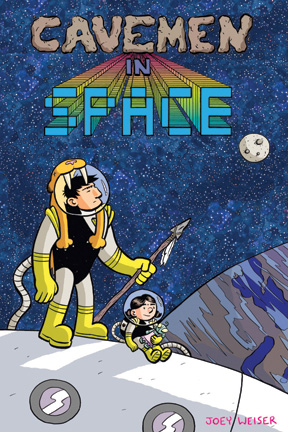
A scientist from the future takes away some prehistoric cave men and places them in his spaceship «The Wheel». With the help of special techniques the scientist works on brains of people from the past, raising their level of intelligence. Chief of the cavemen - a tall man in an animal's skin with the name Washington - is the principal assistant of the scientist. Each of the cavemen do what they do once in the past, but this time more consciously. To the spacecraft with an unexpected tour comes an alien race with outwardly friendly intensions. But the aliens are more insidious than they appear, and the team of cavemen will beat off the alien hordes.


«Cavemen in Space» is a funny story in the spirit of science fiction of 40-50th with a mixture of "Flintstones." Subject of jokes here are the future technology and the past of the cavemen. Do not expect from a novel infinite action. The battle with the aliens begins only at the end of the book, and the battle scenes are drawn in cartoon style. Weiser carefully looks at the problem of adaptation of cave men in the world of the future. Washington and his friends feel the new features, feel the need in them, they like to help a scientist, like to develop, but their origin is not extinguish. For all the sophistication of the brain inside each cave man still Cro-Magnon sits, whose survival instincts trump everything else. And so the most important task for the cavemen is not to fight with the aggressive aliens but to choose his true purpose: to go back and be himself or to stay and feel his own inferiority to the end of days?
Weiser in his seemingly young adult book asks not children's questions.

Finch


Jeff Vandermeer
Finch

Corvus, 2010

In the city of Ambergris, half rotten and lying in ruins, in an apartment two dead bodies are found. One of the bodies belongs to the man, the other to a gray cap, a representative of fungus race, enslaved people. Grey caps captured Ambergris six years before the described events. Fungi have used the war between the royal houses, and now hold the men under his control, having caught on its side apostates – the partials: they are people whose bodies are irrevocably changed under the influence of fungal spores used as drugs. However, the gray caps are not all-powerful, and to find the killer of a man and a gray cap, a gray cap named Heretic orders the detective John Finch to investigate the murder. Murder is extremely strange, in the apartment gray caps did not find any evidence, any possible clues, not even the slightest idea who the murdered were. On the body of the fungus was only a memory bulb. After eating it, you can get access to the memories of a dead man. Finch’s boss Heretic tells the detective to solve the crime as soon as possible, otherwise Finch will be sent to a labor camp. In the city, however, units of the rebels are still operating, plotting to overthrow the plan of gray caps, until it it too late. And when Finch realizes that the murders are somehow connected with the rebels, his life is hanging by a thread.

«Finch» is called a "fungus noir", and this is only half of the true. Fungus here does play an important role, but book is called noir by mistake. Yes, there is a dark atmosphere, there is a detective, betrayals, but these features are not unique to noir only. «Finch» is a police procedural in the world of George Orwell's "1984" with a fair amount of Philip Dick. Finch in the novel is not doomed hero. He is clever and rather relies on its head, not the heart. Finch is tired man, tired of himself, of his helplessness, of total despair. He is a fighter, but the enslavement breaks even the most persistent. In the life of Finch, there are women who could be considered femme fatal as yet another feature of noir. But women are not selfish, greedy, fallen, but also tired of trying to survive under the weight of fungus race. They are not heartless ladies, each of them loves Finch. A lump of events that is about to lead to disaster, suddenly turns into a completely different direction.

Does that mean that «Finch», erroneously been called noir, is a bad novel? Certainly not. This is exciting novel. Primarily due to the fact that Vandermeer managed to create a distinct character in Finch. Finch, all these years living under oppression and working for someone else's race, pushes his past as deeply as possible into himself. His past is his salvation and his death. He was once a soldier, now an accomplice to the gray caps. Finch despises himself to work for the invaders to stay alive. And when the investigation takes the detective on the rebels before Finch faces the most difficult choice in his life.

Fungal mold in the book is a metaphor for decay and rot. Above the town is filthy smell, all enmeshed in a cobweb. And it seems that this will never end. Inside people hope rots. Many sit on the drug, changing forever. (Thus, another detective, Stark, under the influence of mushrooms becomes just inhuman and asks Finch to kill him.)

Vandermeer deceives the reader several times, first offering a police investigation, then a spy novel, and after all partisan chronicles. The author masterfully weaves intrigue, there are a lot of plot twists. Fantasy ambiance refreshes a detective story.

Stylistically Vandermeer successfully demonstrated that level of fear and despair that fill the city. Residents of Ambergris are afraid to say too much and think too much, and Vandermeer also removes all the excess from a sentence: «Back in the hotel. Near midnight. Didn't know for sure. Approached the landing below the seventh floor. Heard Feral hissing at something. Saw a flickering, golden light that projected a circle of fire. Elongated and slanted down the hallway. Distorted further by the fungus on the walls. A rank smell, like too-strong perfume».

Vandermeer has written a masterful, wonderful novel, and we can only applaud.

Wednesday, July 20, 2011

The Language of Dying


Sarah Pinborough
The Language of Dying

PS Publishing, 2009

«There is a language to dying. It creeps like a shadow alongside the passing years and none of us can avoid oit taste in our mouths. Whether we are sick or healthy it finds us eventually. It is a secret hushed thing that lives in the whisper of the nurses' starched skirts as they rustle up and down our stairs. They've taught me to face the language a syllable at a time, slowly creating an unwilling meaning from it ». So begins this story about dying. In the family the father dies, and five his children gather in the home to be with his father the last few days before his death. The story is told by one of the daughters, who took care of his father, while everyone else went away and minded their own businesses. The story tells from the first person view, but with permanent patches of the second person, this is a kind of monologue, addressed to the dying. Coming father's death is not only the death of one individual, but also the death of the family, its disintegration. A few days before his death it’s the last chance for children to stay together, reunite, solve problems, to forgive one another, and then again to return to their lives, not particularly good ones (especially for the three brothers).

A reader of the novella is also supposed to become a member of the family as an equal surviving parent's death. Inside everything stops, you are a little shaking, throat dry. In such cases, the death of someone else always seems worse than your own.

Before his death, a person leaves all too much, and no one is between here and there. So reading this book, the reader is left alone with a book - with pain, fear and hope.

Tuesday, July 19, 2011

Popgun Vol. 4


Popgun Vol. 4
Ed. by D.J. Kirkbride, Anthony Wu, Adam P. Knave

Image Comics, 2010

How to define the compilers of this anthology, «Popgun» is a mixtape. Completely different styles, different stories, different characters. If we continue to compare the book with music, something there sounds out of tune, something is too loud, somewhere there is nice vocals (art), but the music (the plot) is so-so. 500-plus pages of colors and you can’t like all of that.

To start, there is too much escapism in the book. People from our world are faced with another world, and the parallel world, however beautiful or dangerous it was, is always better than our world. Sci-fi here is in all its forms, from fantasy to neocyberpunk mystery. And if art is most often very good, the stories are always too flighty, with no internal logic. Almost always there is interesting complication of the plot, but not a solution. However, a number of works in «Popgun» proved to be equally successful in terms of art and in terms of plot.


A realistic story of Stephanie Ramirez «Thinking Out Cloud» reads like a YA fantasy. In the «Agent Orange» by Darren Rawlings robot private detective exposes dishonest businessman, knocks-out a few robots and saves the world from an ancient curse. «Family Reunion» by David Brenion and Joe Flood tells about what happened to the heroes of cartoons and books after they lost their former glory. Authors create a funny satire on Superhero stamps. «The Eye» by Jeremy Tinder starts as a typical story about a private eye with a big eye instead of a head, but later the story turns into something bigger (and with large portions of the black humor). «Rusted: Faded Signal» by Nick Tapalansky and Alex Eckman-Lawn attracts the attention first of all with a wonderful art, you get the impression as if you read the yellowed parchment. The story unfolds in a desert, where, after some catastrophe, a girl tries to find a radio tower to get the help. Completely insane is «Sasquatch» by Nick Edwards. Children go into the woods for a picnic, and one of the boys, bespectacled Nigel, becomes so teased that he runs away to the river, looking for solitude, but instead meets sasquatch. They become friends, and here you can begin to laugh. Hilarious story.


One of the few realistic graphic stories here is «Hamburgers for One» by Frank Stockton, it is also one of the best in the book. Plump clumsy young man takes out the trash, feeds rat with a candy and goes to fast food cafe. In there his attention is attracted by a pretty brunette cashier. Stockton is unhurried, attentive to details; sometimes the artist achieves photographic autenticity in panels.

We should also mention a number of single-page strips by Erik Larsen «Reggie the Veggie». First and foremost this is a very clever and funny comics, as comic strip about a legless cripple can be funny.

Graphically «Popgun» is an almost ideal anthology, bright, bold, diverse, but it lacks good storytelling.

Lemon Styles


David King
Lemon Styles

Sparkplug Comics, 2010

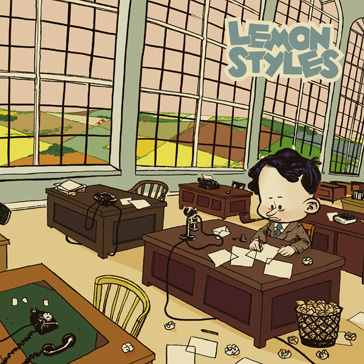
We often perceive comics as moving pictures - with the obvious plot complication and denouement - as opposed to art books, where the drawing deliberately stopped in time. «Lemon Styles» is a mix between a comic and an art book, with the clarification that this art book drawn by a comics fan and a man with a good sense of humor. This slim book is a collection of single-page strips with a repeating set of characters. They are three of them: the blonde with pierced ears, balding bespectacled man with a bow tie instead of a tie and long-nosed curly man with larhe eyebrows. On each page, they play some scene from everyday American life. This is King's neighbors, as they are represented to us by the author.


Each page is divided into four panels, and that is plays obtained in four acts. In each of the plays at first glance, there is a plot, but I did not in vain called «Lemon Styles» art book as well. It’s good to keep on the coffee table and read a page a day, otherwise all the pages will be merged into one. David King on its pages captures something elusive, that moment between intention and the rejection of the action. And if you read the book in one read, important component of the book will disappear. The author has excellent sense of humor, but he applies this sense here in the opposite direction. When you read from page three panels of the four, it is clear that the fourth will be a gag: gag is that there is no gag. Behind this book we can see a great aptitude of David King, the next time I want to see how he can use his strange sense of humor in a large project.

Monday, July 18, 2011

plug for Locus magazine


Locus magazine
01’2011
02’2011
03’2011

I wrote about "Locus" last year, since in the magazine some important changes have been made. The most important of them is that the magazine is now distributed in digital form. Now it's fast and cheap (foreign subscribers receive digital version for free). If earlier you would have to wait for weeks, now the magazine can be read on the first day of sales. The second major change is the interviews. Previously, "Locus" mainly publishes interviews with writers. But fandom is not just writers and, accordingly, readers. It is also artists, critics, editors, podcasters etc etc. All these figures were often unnoticed. Now you can read in a magazine interview, for example, with the editor Sharyn November (02-2011), and in the January issue the main theme is e-books with dozens of interviews in the magazine.

What I always liked in interview in "Locus" is the fact that they were not short-term. Today interview with the author often turns into a way to just make a PR for a book, reduced to combinations of the samequestions. How did you write this book, what are working on now, who you are influenced by - these plus some other questions are compiled, and interview is done. The interviewer will not go deep, and the author does not want to strain (especially if the author after the book is out this month has to give several dozens of interviews). So, what lies deep in the interview - a conversation - disappears, replaced by a quick chat, not binding to anything. In "Locus" a figure of interviewer is generally removed, there are no questions, only a monologue of the interviewee, but in this monologue you can see an interviewer carrying on a conversation. One interview is never like another. Interview in "Locus" is something like an interview in science fiction The Paris Review.

In addition to the interview in the magazine, of course, there are lots of news, obituaries, the results of the year in the February issue, as well as reviews.

"Locus" as it was as remains the most influential magazine in the world of SF and fantasy.